
What is servo?
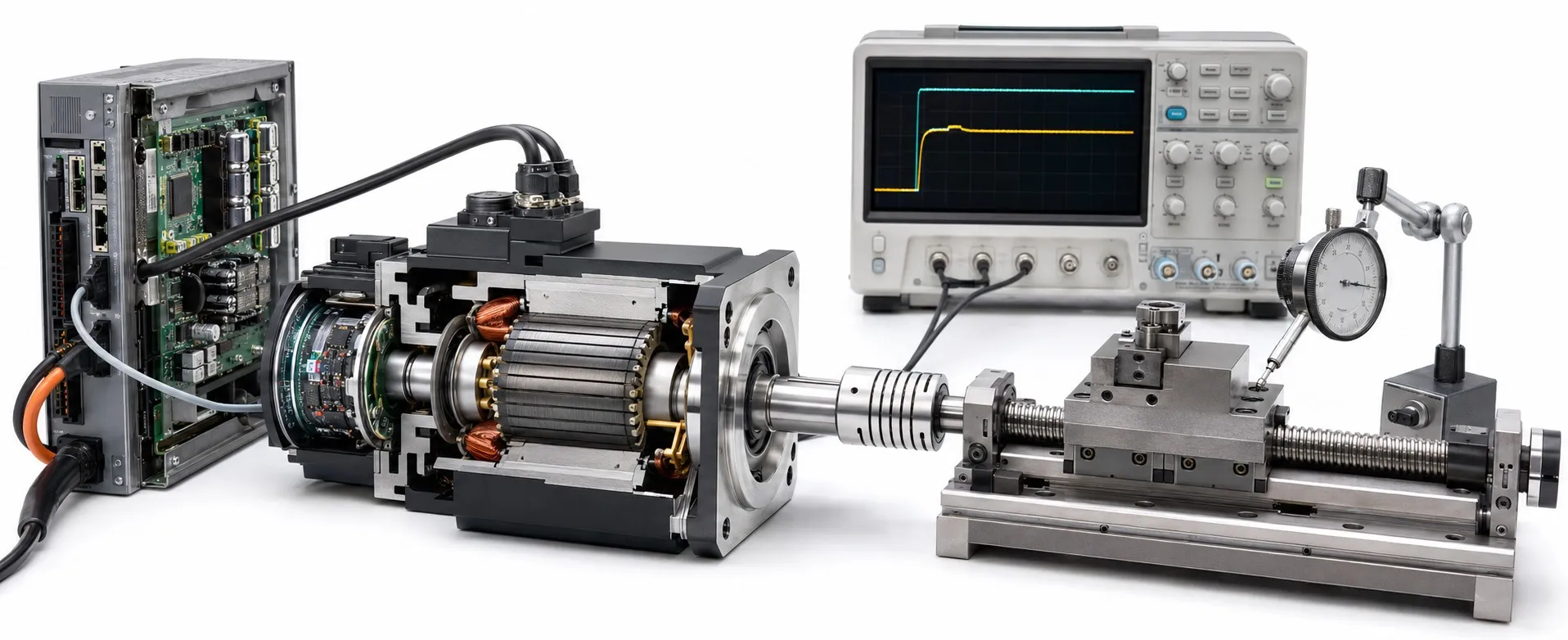
Motion control built around feedback
A servo is a feedback-based motion control system that regulates a mechanism’s position, speed or torque according to a command. People often use “servo” to mean the motor itself, but an industrial system depends on the motor, drive, feedback and mechanical load working together. Its defining feature is that it measures the motion and uses the result to adjust control.
Which components work together?
Motor: This converts electrical energy into motion. A servo motor is used on axes requiring fast response and controlled movement. Common industrial AC servomotors have a permanent-magnet rotor and a wound stator; electromagnetic interaction between the stator and rotor produces torque. However, servo control is not limited to one motor construction.
Servo drive: This processes commands and regulates motor currents. Feedback device: An encoder or resolver reports the actual motion. Controller: A PLC, CNC control or motion controller can define the axis target and motion profile. Some of these functions may be built into the drive; their location depends on the system architecture.
From command to correction: how the loop works
The control compares the commanded value with the measured value. Their difference is the control error. According to the selected mode and settings, the drive changes motor torque to reduce that error. This process repeats continuously, responding to new measurements as the load changes. It does not guarantee zero error under every condition: motor capacity, mechanical compliance, friction and control tuning limit performance.
Position control determines where the axis moves, speed control determines how fast it moves, and torque control regulates the turning moment it produces. Speed, torque and position control serve different purposes. In a common cascaded arrangement, the position loop generates a speed demand, the speed loop generates a current demand, and the inner current loop regulates motor current. In servo torque control, torque is generally regulated through motor current; directly measuring force at the load requires a suitable additional sensor.
A simple example: moving a table by 250 mm
Suppose a directly coupled screw moves the table 10 mm per revolution. A 250 mm move from the starting position ideally requires 25 motor revolutions. The controller commands this move with an appropriate acceleration and deceleration profile. If position measured from the same reference is 248 mm, the remaining error is 2 mm, equivalent to 0.2 revolution. The control considers both this error and the current motion speed. A correctly defined home position establishes the coordinate reference, while axis control manages individual or coordinated movements.
Editor’s note: An encoder mounted on the motor primarily measures the motor shaft. Coupling backlash, belt stretch or screw errors can leave the table in the wrong place even when the motor reaches its target. Therefore, encoder resolution and actual machine positioning accuracy are different specifications. Applications requiring direct load measurement may need a linear scale or additional load-side feedback.
Are gears required, and do they reduce torque?
A servo system does not always contain gears. The motor can drive the load directly or through a belt, screw or gearbox. A planetary gearbox, for example, can reduce speed while increasing output torque. Describing the main purpose of a reduction gearbox as “reducing torque” is therefore incorrect.
Consider a motor operating at 3000 rpm and 2 Nm, connected through a 5:1 reduction gearbox. Assuming 90% efficiency at that operating point, output is approximately 600 rpm and 9 Nm: 2 × 5 × 0.90 = 9 Nm. This calculation does not permit exceeding the gearbox’s speed or torque ratings. Load and transmission calculations must consider backlash, stiffness and load inertia as well as the reduction ratio.
Servos, stepper motors and small hobby servos
In a conventional open-loop application, a stepper motor advances according to command pulses. Without continuous measurement of actual motion, overload-induced missed steps may go undetected. A servo uses feedback within its control process. However, closed-loop stepper systems also exist. A servo-versus-stepper comparison should consider speed, torque, cycle time, load and total cost rather than accuracy alone.
Small hobby servos may combine a motor, gears and control electronics in one housing. This construction does not describe every industrial servo system. Also, servos are not universally limited to 180 degrees: rotary servo axes can make multiple revolutions, while linear servo axes produce straight-line motion.
What matters during sizing and commissioning?
When choosing a motor and drive, consider more than the power rating. Continuous torque, permitted peak-torque duration, operating speed, load inertia and motion profile must be assessed together. Frequent acceleration and deceleration make cycle heating and braking energy important. Motor and drive electrical characteristics, encoder interface and the manufacturer’s specified pairing must be compatible.
Depending on the controller, commands may use pulse-and-direction signals or an EtherCAT servo interface. The choice between speed control and position control follows the machine’s task. Automatic tuning and, where necessary, servo gain adjustment then adapt the response. Increasing position loop gain indiscriminately can cause mechanical vibration and overshoot rather than solve a mechanical problem. Mechanical integrity and control tuning need to be addressed together.
Typical uses include measured feeding in packaging machines, axis movement in CNC equipment, joint control in robots and controlled torque in winding systems. The purpose is to repeat the required motion within the specified accuracy and time.
Related pages: Servo motor types, servo motor and drive prices.
Sources
Kollmorgen: servo system components and mechanical transmission options
OMRON: servomotors, drives, encoders and control loops
maxon: gear ratio, losses and output torque
Oriental Motor: comparing servo and stepper motor systems
Yaskawa: torque, motion profiles, inertia and regeneration in servo sizing
OMRON: gain adjustment and mechanical vibration