
Faq For Servo
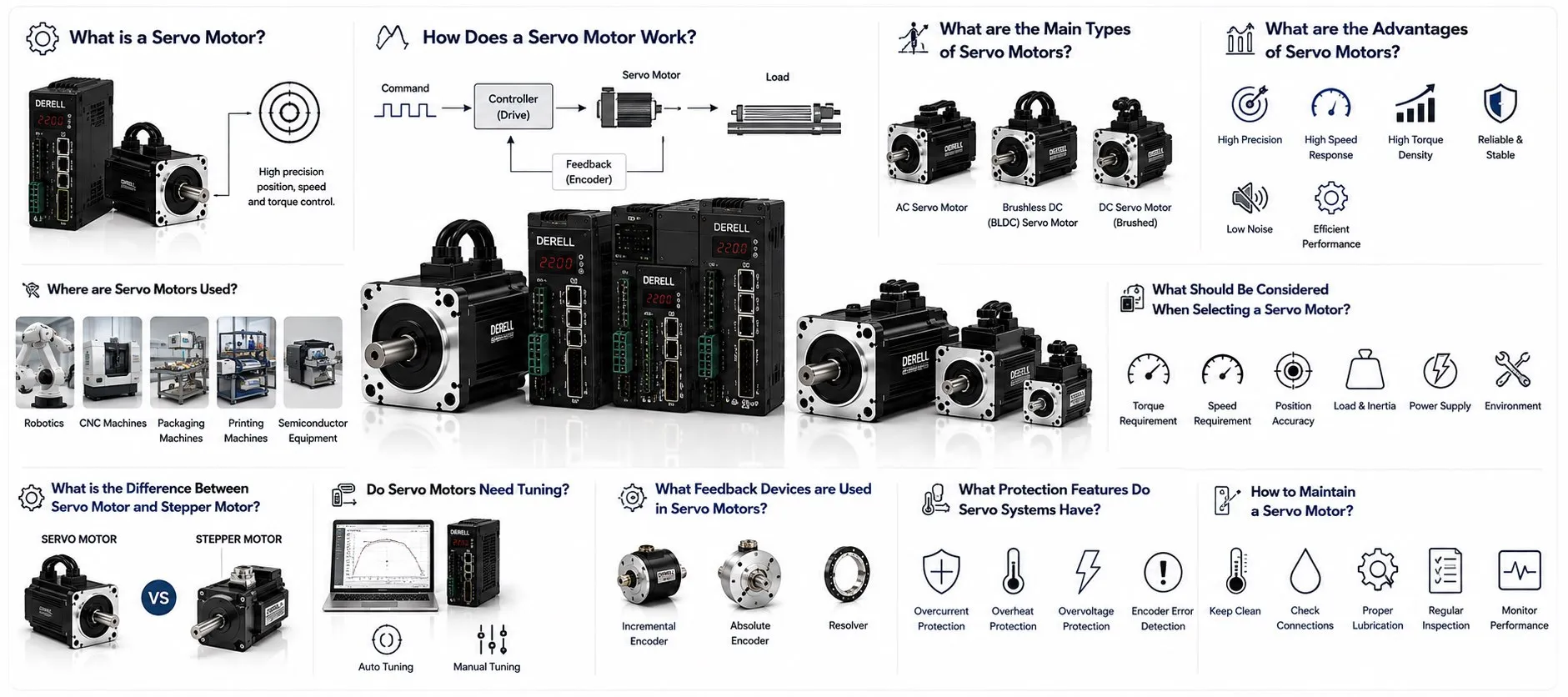
Servo FAQ: Motors, Drives, Sizing and Commissioning
Hello colleagues,
A servo system uses closed-loop control to compare commanded motion with actual motion and reduce the difference. The servo motor, servo drive and feedback system work together, while a PLC or motion controller defines when to move, where to go and which motion profile to follow. This guide provides practical answers about position control, speed control, torque control, sizing and commissioning. The question directory below links to detailed articles on each subject.
What do the motor, drive and feedback device actually do?
The motor produces mechanical motion. The drive supplies and controls electrical power. An encoder or resolver provides motion measurements. The basic components of a servo system also include power and feedback cables, a command interface and the mechanical transmission. A correctly rated motor can still fail to operate if its cable, feedback interface or drive is incompatible.
In a common position-controlled servo, the position loop generates a velocity demand, and the velocity loop generates a current/torque demand. The current loop regulates motor current. This connects speed and torque control with position control. Where these loops run—inside the drive or in an upstream controller—depends on the system architecture.
Is the motor's wattage enough to size a servo?
No. Servo motor sizing must consider continuous torque, peak torque, operating speed, acceleration, load inertia and duty cycle together. Peak torque is not a continuous rating; allowable duration and current limits depend on the motor and drive combination. The gearbox ratio also changes the reflected load inertia, required motor speed and mechanical backlash.
A practical example: At a rated operating point, T ≈ 9550 × P / n, where P is in kW, n is in rpm and T is in N·m. A rating of 1 kW at 3000 rpm corresponds to approximately 3.18 N·m. This alone does not establish whether the system can start, accelerate rapidly or hold its load. Matching the motor and drive also requires checking the torque-speed curve, supply voltage, current capacity and feedback compatibility.
Does encoder resolution equal machine accuracy?
Resolution describes the smallest change a measurement can distinguish. Accuracy describes closeness to the true target, while repeatability describes how closely repeated moves agree. Servo system precision depends on screw lead error, coupling compliance, backlash and temperature as well as the encoder. Measuring the motor shaft accurately does not guarantee the same accuracy at the load.
A useful field check: If the drive reports the same motor position but the table stops in different places depending on the approach direction, investigate mechanical backlash. Compare repeated moves from one direction with moves that reverse direction. Applications requiring it may use additional feedback at the load; the drive or controller must support this arrangement.
Servo or stepper—and how should the PLC connect?
A stepper motor can suit particular motion and cost requirements, and closed-loop stepper motors are also available. The statement “all stepper systems are open loop” is therefore incorrect. A servo versus stepper comparison should examine usable torque at the required speed, load changes, settling time, vibration and total system cost.
Depending on the model, commands may use pulse/direction, an analog reference or an industrial network. With EtherCAT servos, the motion capabilities and configuration of the controller matter alongside the drive. CNC and robotics applications may require multi-axis synchronization, while SCADA typically handles monitoring and supervisory functions. An HMI screen alone does not provide axis synchronization.
Common mistakes in tuning, maintenance and braking
Before configuring a servo drive, verify the motor definition, direction, scaling, homing and travel limits. Auto-tuning can simplify setup under suitable conditions, but it cannot eliminate mechanical looseness or incorrect sizing. When an axis vibrates, examine mechanical connections, signal noise and filtering and dynamic performance instead of simply raising the gains.
Servo maintenance includes checking connections, moving cables, bearing symptoms and thermal management. Apply lubrication only to mechanical components for which the manufacturer specifies it. Routine firmware updates are not automatically a maintenance requirement either; when a change is needed, check compatibility and back up the parameters.
A holding brake, controlled deceleration and regenerative braking perform different tasks. Unless the manufacturer specifies otherwise, the motor's internal holding brake is intended to hold an axis that has already stopped. Dissipating deceleration energy in a resistor does not mean that energy is returned to the mains. Assess energy efficiency against the actual drive architecture and motion cycle.
25 servo questions: Choose your starting point
Start with the first group to learn the basics, the second to select equipment, or the third to investigate commissioning and maintenance issues. The final group covers advanced motion control.
Fundamentals and operating principles
What is a servo motor and how does it work? Understand the relationship between commands, motion and feedback.
What is a servo drive, and how does it control the motor? Explore the roles of the power stage and control loops.
What are the basic components of a servo system? Consider the motor, drive, controller, cables and mechanical transmission together.
How does a servo motor achieve position control? Distinguish target position, actual position and following error.
How are speed and torque controlled in servo motors? Learn when and why each control mode is used.
How do encoders and resolvers provide feedback? Understand measurement types, interface compatibility and the feedback path.
Where are servo systems used in industry? Compare motion requirements in packaging, machining and automation.
Motor selection, accuracy and performance
What are the differences between servo and stepper motors? Compare application requirements as well as purchase price.
How do you choose between AC, DC and brushless servo motors? Consider motor construction, drive support and operating conditions together.
Which parameters matter when selecting a servo motor? Start with torque, speed, inertia, duty cycle and motor-drive compatibility.
What determines servo precision and accuracy? Separate feedback quality from errors introduced by the mechanics.
How is high dynamic performance achieved? Explore acceleration, settling time and mechanical stiffness.
Commissioning, maintenance and energy
How are servo drives programmed and configured? Focus on motor setup, command sources, scaling and tuning.
What matters in servo motor maintenance and repair? Assess connections, cables and mechanical symptoms systematically.
How is servo motor temperature managed? Review duty cycle, cooling and mounting conditions together.
Why do noise suppression and signal filtering matter? Consider interference, wiring and filter delay together.
How can servo system energy efficiency be improved? Review unnecessary motion, losses and the motion profile.
How is regenerative braking integrated into servo drives? Distinguish the DC bus, braking resistor and energy recovery paths.
Advanced motion control and multi-axis systems
How are servo motors modeled and controlled? Connect mechanical and electrical dynamics with control design.
How is field-oriented control applied to brushless motors? Explore rotor position and current components in motor control.
Where can adaptive control help a servo system? Explore the possibilities and limits of adaptation to changing loads.
What role do real-time operating systems play? Examine timing and task-execution requirements in motion systems.
How are multiple servo axes synchronized? Explore shared motion profiles, coordination and timing.
How are servo motors integrated into robot kinematics and dynamics? Connect axis motion with robot geometry and load models.
How is interpolation used for precise motion? Learn how motion between points and coordinated axis paths are generated.
This guide provides general technical information. For an actual installation, follow the motor and drive manuals for compatibility, operating limits and safety requirements.
Refine Search
- Dynamic modeling of servo motors
- How are field-oriented control (FOC) strategies implemented in brushless DC servo motors (BLDC)?
- How are servo drives programmed and configured?
- How can the energy efficiency and sustainability of servo systems be enhanced?
- How do feedback mechanisms (encoders, resolvers) work in servo systems?
- How do servo motors play a role in position control?
- How is a selection made between different types of servo motors (AC, DC, brushless)?
- How is high dynamic performance achieved in servo motors?
- How is speed and torque control achieved in servo motors?
- How is the kinematic and dynamic integration of servo motors achieved in robotic applications?
- Regenerative braking integration in servo drives
- Servo drive and motor relation
- Synchronization of multi-axis servo systems.
- What are the advanced interpolation algorithms for servo motors?
- What are the applicability and advantages of adaptive control algorithms in servo systems?
- What are the basic components of a servo system?
- What are the common industrial applications of servo systems?
- What are the fundamental differences between servo motors and stepper motors?
- What design approaches and materials are preferred for thermal management and heat dissipation in servo motors?
- What factors influence the precision and accuracy of servo systems?
- What is a servo motor and how does it work?