
Kw and Newton
Kilowatts and newtons: connecting power, force and torque
There is no fixed conversion from kilowatts to newtons. A kilowatt measures power; a newton measures force. Motor specifications also use newton-metres (N·m) for torque. To connect power with a pushing or pulling force, you need linear speed. To connect power with shaft torque, you need rotational speed.
Three quantities, three different meanings
| Unit | Quantity | Relationship |
|---|---|---|
| kW | Power | 1 kW = 1000 W = 1000 J/s |
| N | Force | 1 N = 1 kg·m/s² |
| N·m | Torque | Force × perpendicular moment arm |
The correct symbol is kW, with a lowercase k and uppercase W. A watt describes the rate of energy transfer. A newton-metre describes a force's turning effect about an axis. N and N·m are not interchangeable. Although torque and energy share the same base-unit dimensions, they are different physical quantities.
Converting mechanical power into a linear force
When force acts in the direction of motion, P = F × v. Use watts for P, newtons for F and metres per second for v. With power expressed in kilowatts and a nonzero speed:
F (N) = 1000 × P (kW) / v (m/s)
If the moving load receives 1 kW of mechanical power at 1 m/s, the corresponding force is 1000 N. Delivering the same power at 0.5 m/s corresponds to 2000 N. The table shows several operating points:
| Mechanical power | Linear speed | Force at this operating point |
|---|---|---|
| 1 kW | 0.1 m/s | 10 000 N |
| 1 kW | 0.5 m/s | 2000 N |
| 1 kW | 1 m/s | 1000 N |
| 1 kW | 2 m/s | 500 N |
These calculations do not establish a motor's available force at every speed. The electric motor and transmission still have current, torque and mechanical limits. If force is at an angle to motion, the general relationship is P = F × v × cosθ; only the force component along the motion transfers power.
For a rotating shaft, use torque and rpm
Rotational mechanical power follows P = T × ω. Expressing torque and rotational speed in N·m and rpm gives:
T (N·m) ≈ 9550 × P (kW) / n (rpm)
P (kW) ≈ T (N·m) × n (rpm) / 9550
Power and speed must refer to the same shaft. The approximate constant 9550 comes from converting kilowatts and revolutions per minute; it is not an efficiency factor. Using different torque units requires the appropriate unit conversion.
A motor rated at 2.2 kW and 1450 rpm has approximately 14.49 N·m rated torque. Another motor rated at 2.2 kW and 2900 rpm has approximately 7.24 N·m. This is why motor selection requires more than a power rating.
Halving one motor's speed does not automatically double its torque. That conclusion assumes the same mechanical power remains available. Check the actual torque-speed curve, drive capability and thermal limits. A servo motor operating in torque control must also stay within its continuous and short-duration ratings.
From shaft torque to pulling force
At the rim of a drum or pulley, tangential force is related to torque by T = F × r, so F = T / r. Use the effective radius in metres, not the diameter. This is one way shaft torque acts on a mechanical load.
With 50 N·m at the drum shaft, a 0.10 m radius gives 500 N; a 0.05 m radius gives 1000 N. At the same shaft speed, however, the smaller drum moves its rim at half the linear speed. The extra force is accompanied by lower speed, not extra power.
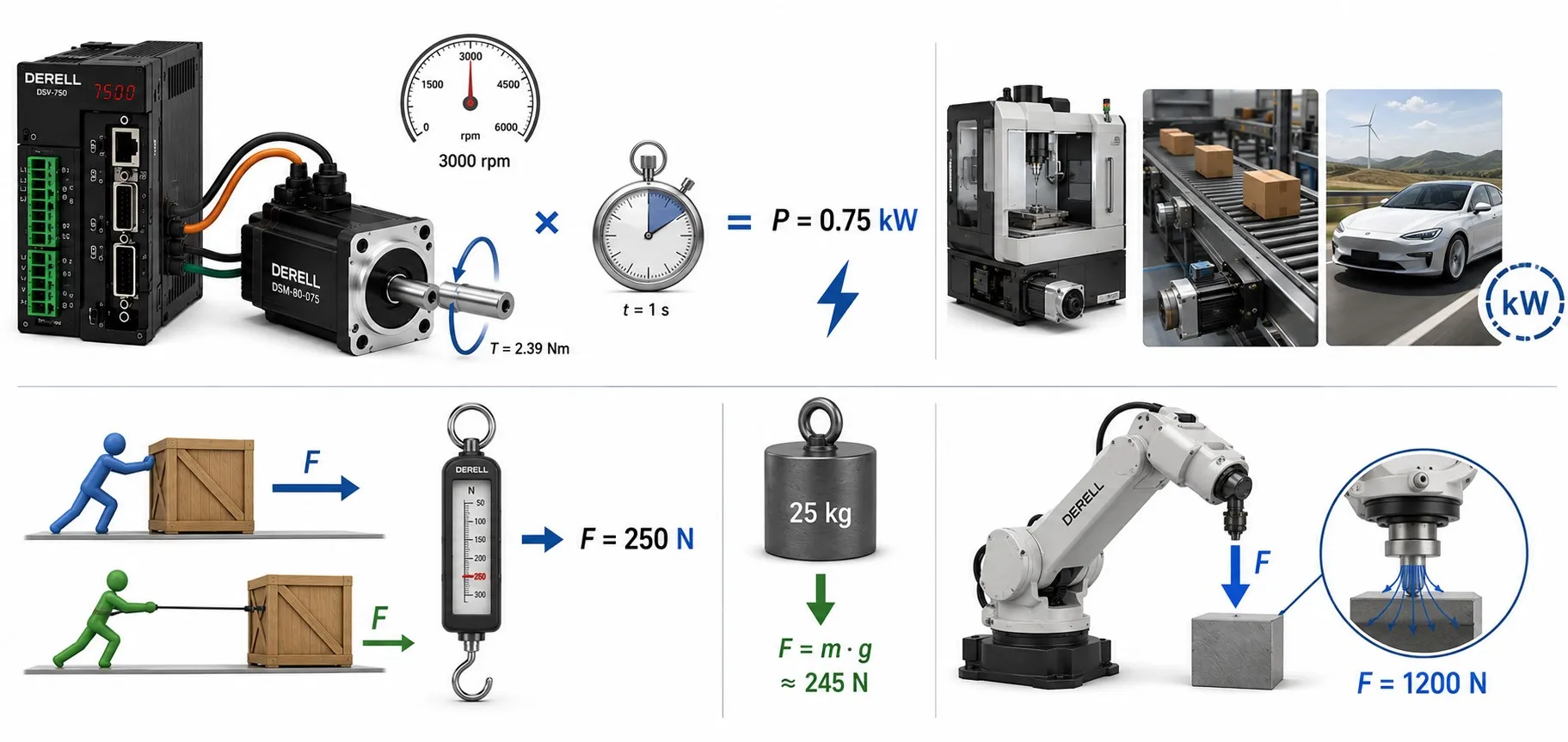
A lifting example: kilograms are not newtons
Kilograms describe mass; newtons describe force. The relationship between mass and weight is F = m × g. Using g ≈ 9.81 m/s² near Earth's surface, a 100 kg mass weighs about 981 N. A force of 1000 N therefore does not mean a mass of 1000 kg.
Raising a 100 kg load at a steady 0.2 m/s requires an ideal load power of 100 × 9.81 × 0.2 = 196.2 W, or 0.196 kW. If total efficiency from electrical input to the load is assumed to be 75%, input power is approximately 0.1962 / 0.75 = 0.262 kW. This describes the stated steady operating point. Acceleration, other lifted components and the duty cycle require additional consideration.
Keep electrical input and mechanical output separate
Motor losses mean Pshaft = Pelectrical × ηmotor. A conventional industrial motor's nameplate kW rating usually describes rated mechanical output, but check the manufacturer's definition. Three-phase electrical power calculations use voltage, current and power factor; VA and watts represent different quantities. Efficiency losses reduce the power available for useful motion.
A gearbox trades speed for torque. Defining the reduction ratio as i = ninput / noutput, output torque is approximately Toutput = Tinput × i × ηgearbox. A 10:1 reduction with 90% efficiency produces about nine times the input torque, while output power is 90% of input power. For a gearmotor, do not combine output rpm with upstream power while ignoring losses. Gearbox selection also requires checking permissible torque and mechanical loading.
Why can a stationary motor produce torque but no shaft power?
At zero speed, torque may still be present. However, P = T × ω gives zero rotational mechanical power when ω = 0. Electrical consumption can remain substantial. Dividing rated kW by zero rpm cannot calculate stall torque. Starting torque and stationary holding capability must be obtained from the motor-and-drive specifications.