
Types Servo Motors
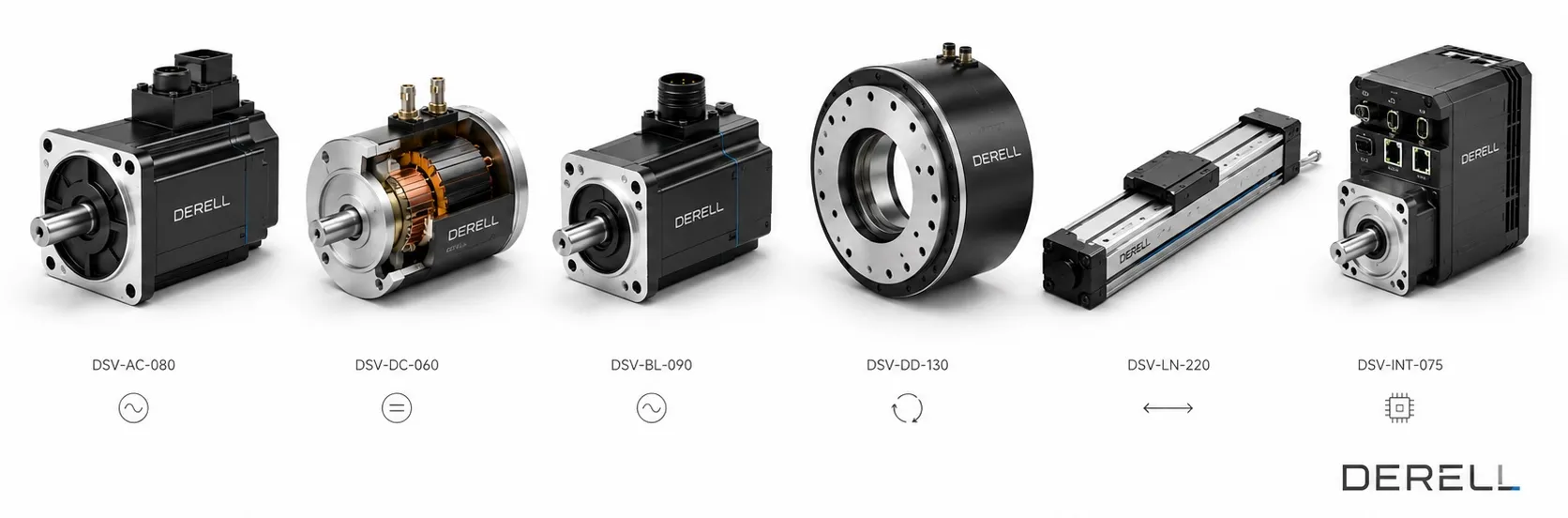
Servo motor types: compare the right characteristics
A servo motor works with a compatible drive and feedback system to control motion. The labels AC/DC, brushed/brushless and rotary/linear describe different characteristics. One motor can be brushless, rotary and frameless at the same time. Position, speed and torque control describe operating modes rather than separate motor constructions.
| Classification | Options | What it describes |
|---|---|---|
| Electrical construction | Brushed DC / brushless | How commutation is performed. |
| Motion | Rotary / linear | Whether the motor produces torque or straight-line force. |
| Integration | Housed / frameless | How the motor fits into the machine. |
| Transmission | Direct drive / geared | How motor motion reaches the load. |
Brushed DC and brushless designs
Brushed DC servos use brushes and a commutator to switch current in the rotating armature. Paired with suitable feedback and a drive, they can control position or speed. Brush wear belongs in the maintenance plan. The DC label does not establish that a motor is inherently the simplest or fastest option.
Brushless servos use electronic commutation. They eliminate brush servicing, while bearings, cooling and mechanical loading still affect service life. Permanent-magnet synchronous motors are common in industrial AC servo systems. A BLDC motor is also brushless, but brushless construction alone does not make a motor a complete servo system.
AC and DC are not a universal ranking of power or efficiency. Keep the drive’s supply and the motor’s construction separate: a drive powered from a DC source can operate a brushless motor.
Rotary motion versus direct linear motion
A rotary servo delivers torque through a rotating shaft. It can turn an indexing table, move a robot joint or drive a screw. A linear servo motor produces straight-line force, specified in newtons. Linear motors suit applications such as precise transport and positioning axes.
A rotary servo driving a ball screw remains a rotary motor. The mechanism converts its rotation into linear travel. A true linear-motor axis produces that motion directly and requires an appropriate guide, load support and linear feedback arrangement.
Direct drive, torque motors and geared axes
In a direct-drive axis, the motor moves the load without a gearbox. Removing gearing can eliminate gear backlash and reduce transmission components, but the motor must meet the load’s torque and inertia requirements directly. Torque motors are often used where substantial torque is required at low speed.
A planetary gearbox trades motor speed for increased output torque, with efficiency, backlash and stiffness included in the design. A torque motor is not the same thing as torque-control mode. A suitable conventional servo can also operate in its drive’s torque mode.
Housed motors and frameless integration
A housed servo provides a motor assembly with its own housing, shaft and bearings. A frameless servo supplies rotor and stator components for integration into the machine. Bearing support, alignment, heat management and feedback integration become part of the machine design. Frameless does not automatically mean gearless.
Brakes and feedback are additional choices
Choosing between a motor with a brake and a motor without one depends on the load-holding requirement. A holding brake should not be confused with a brake intended for repeated dynamic stopping. For encoder and absolute feedback options, consider drive compatibility and the machine’s reference requirements as well as resolution.
Hobby servos use a different product format
A position-controlled hobby servo usually packages a motor, gearing, sensor and control electronics together. Its angular range is model-specific; 180° travel is not universal. In a conventional continuous-rotation hobby servo, the command mainly requests direction and approximate speed, rather than a particular stopping angle. Special models with additional feedback need to be assessed separately.
Start with the axis requirements
For motor and drive selection, establish motion type, continuous and peak torque or force, speed, load inertia and duty cycle. The load and transmission calculation covers the mechanism; the broader selection criteria include supply, environment and feedback. “Variable-speed servo” is not a separate construction type: adjustable speed is a control capability.
Related reading
Understanding servo autotuning · Servo versus stepper motors · Servo systems overview
Technical references
Kollmorgen — Servo Motor Basics · Kollmorgen — Brushed DC Motors · Kollmorgen — Frameless Motors · Yaskawa — Rotary, Direct Drive and Linear · Pololu — Continuous Rotation and Multi-turn Servos · Kollmorgen — Servo Motor Selection