
What is a frameless motor?
Hi everyone,
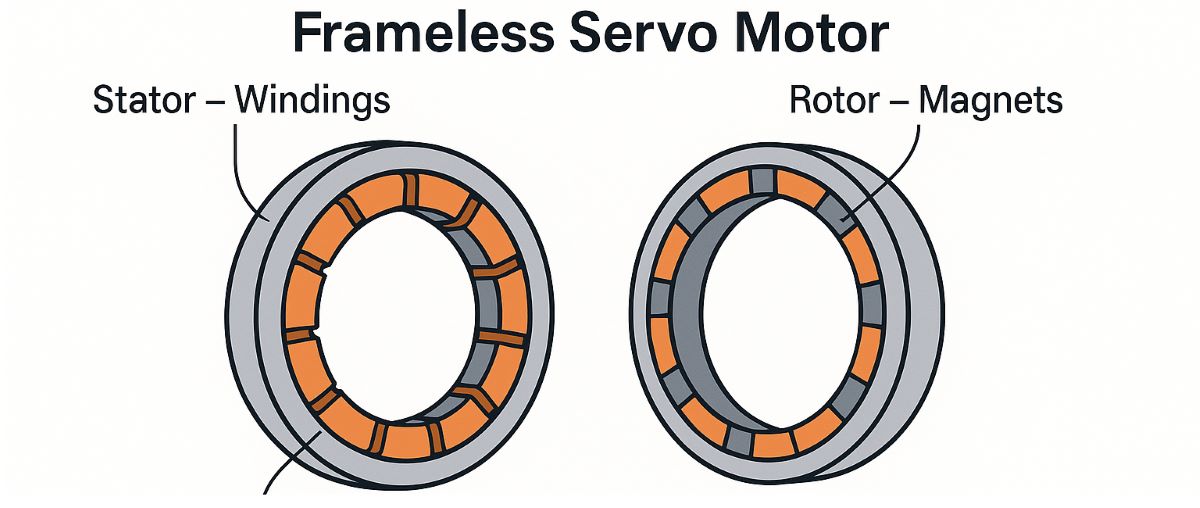
Frameless servo motors are a special type of electric motor used in applications requiring industrial automation, robotics, and rapid motion control. Frameless motors consist of only rotor and stator components, without an outer casing or housing. This design allows the motors to be lighter, more compact, and more flexible. As a result, frameless servo motors are ideal for systems requiring high precision and speed.
Frameless servo motors are used in motion control systems and robotics. These motors are available in various configurations, including axial flux and permanent magnet designs. They are often used in conjunction with integrated drives, commonly referred to as direct drives. This integration results in lower friction and backlash times, leading to lower energy loss and less mechanical wear.
Frameless servo motors offer advantages for applications that demand high dynamic performance and precision. Some of these advantages include:
+ Lightweight and compact design: Frameless motors occupy less space and add less weight, resulting in faster acceleration and better response times.
+ Flexibility: Frameless motors have modular and customizable designs for integration with existing systems and equipment.
+ High performance: These types of motors provide high speed and precision with low inertia and high torque density.
+ Energy efficiency: Frameless motors deliver more efficient performance with low energy consumption and less heat generation.
+ Reduced maintenance requirements: Frameless motors experience less mechanical wear, which translates to a longer service life and lower maintenance costs.
Frameless servo motors can be used in various industries, including industrial automation, aerospace and defense, medical equipment, and more. The flexibility and high performance of these motors make them ideal for applications that require complex motion profiles and precise positioning.
From my own experience, the biggest advantage of frameless servo motors is how they can be integrated directly into the frame of your machine. No need for extra bearings, shafts, or end covers—they become a true part of the application. Especially in compact and lightweight designs, they are irreplaceable.
With traditional servo motors, you always need mounting kits, adapters, or flanges. With frameless, all these headaches disappear; the machine builder can put the motor directly inside a gearbox or even a robot arm joint.
When it comes to precision, they are unmatched, especially in robotic joints or medical equipment. Vibration drops, there’s no dead volume, and you get direct torque transmission. For precision positioning, frameless motors leave most closed-body competitors far behind.
Of course, nothing is perfect. Frameless motors put extra responsibility on the application engineer. Bearing selection, shaft design, thermal management—these are all up to the integrator. Anyone expecting a “plug and play” experience will be disappointed.
Another thing: if you ignore the thermal management, you’re asking for trouble. Compactness is great, but forget cooling and you’ll have thermal overloads and failures in no time—especially in continuous, high-current setups.
In industry, you see them most often in high-precision multi-axis machines. In defense, they drive unmanned vehicles. In my view, anyone chasing “minimum space, maximum performance” will eventually fall for the frameless servo concept.
If you don’t pay close attention to shaft/frame tolerances and magnetic centering during assembly, your first power-up can be a disaster. Do it right: read the data sheet, calculate your load, and don’t hesitate to talk technical with the motor manufacturer.
One more bonus: If you want to work with integrated resolvers or encoders, you’re in full control mechanically. It may seem a hassle to those used to “plug and play” systems, but the performance difference is absolutely worth it in the end.
Bottom line: If compactness, lightweight, and precision matter, machine builders can’t give up on frameless servo motors. But only those who learn by hands-on prototyping—not just reading books—discover the real difference. My advice: If you can, test everything in a prototype; check the thermal and mechanical balance in the real environment.
And don’t forget: Every beauty has its flaw. The “freedom” of frameless servo motors can turn into trouble without solid engineering. Don’t hesitate to consult with the manufacturer before integrating on your own—half-done work always doubles your costs.
Your shopping cart is empty!