
What is Mechanical vibration?
What is mechanical vibration?
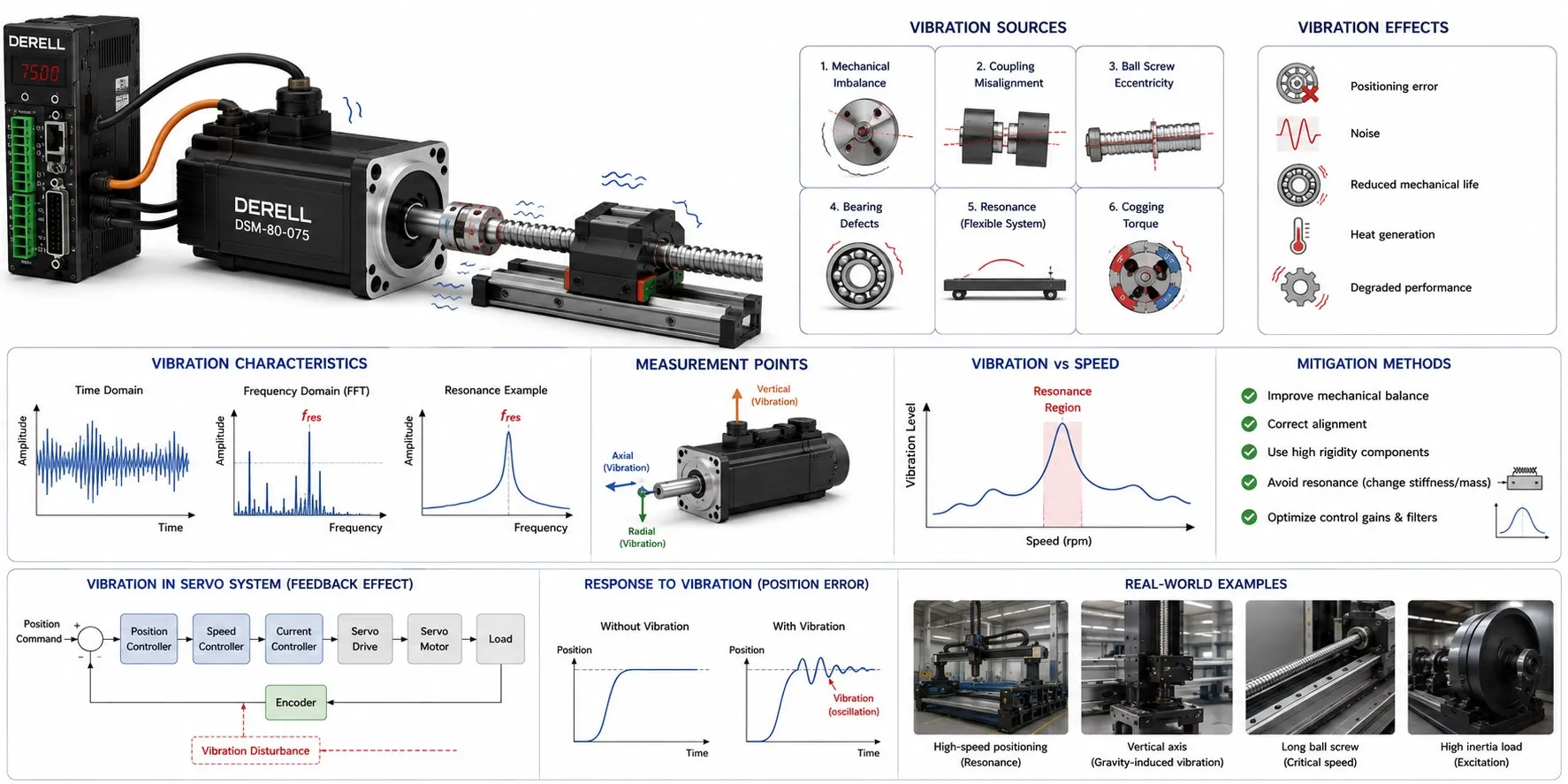
Mechanical vibration is oscillating motion around an equilibrium position. Think of a motor housing shaking, a fan support moving back and forth, or a positioning axis trembling after it reaches its target. An electric motor or a servo motor can excite this motion, but the structure and load influence the response. Vibration may be periodic, impulsive or irregular. A vibrating feeder uses it deliberately; a precision machine usually needs to keep unwanted motion under control.
Amplitude tells you how far; frequency tells you how often
Amplitude describes the size of an oscillation. Frequency counts cycles per second, expressed in hertz (Hz). Both traces above complete two cycles in the same time. The right-hand trace has a larger displacement amplitude, but its frequency is unchanged. A machine can shake more strongly without vibrating more frequently.
For shaft rotation, f = n / 60, where n is rpm. At 1500 rpm, the shaft turns at 25 Hz, completing one revolution every 40 ms. A 50 Hz electrical supply does not mean every vibration component occurs at 50 Hz. With a gearbox, input and output shafts also have different rotational frequencies.
What do µm, mm/s and g mean?
| Quantity | Unit / convention | What it tells you |
|---|---|---|
| Displacement | µm; peak or peak-to-peak | How far does the part move? Useful for shaft motion and clearance assessment. |
| Vibration velocity | mm/s; often RMS | How fast is the oscillating motion? Commonly used for overall vibration monitoring. |
| Acceleration | m/s² or g | How quickly does velocity change? Valuable for high-frequency content and impacts. |
Vibration velocity is not shaft speed. A vibration meter reporting mm/s RMS is describing oscillating motion. RMS is the root-mean-square value; peak and peak-to-peak are different conventions. Compare results using the same quantity, amplitude convention and frequency band. In acceleration measurements, g means gravitational acceleration, not grams: 1 g is approximately 9.81 m/s².
For a single sinusoidal component, using matching amplitude conventions, v = 2πfX and a = (2πf)²X. With X in metres, the results are m/s and m/s². At a fixed displacement amplitude, increasing frequency increases velocity and acceleration. You cannot convert a general vibration reading from mm/s to µm using one constant without knowing its frequency content.
Where unwanted vibration comes from
Imbalance is an uneven rotating mass distribution. Misalignment occurs when coupled shaft axes do not line up under operating conditions. Looseness allows unwanted movement at supports or joints. Bearing damage can introduce impacts. Several faults can coexist, so replacing one component may leave the underlying cause in place.
Operating loads matter too. Changing torque excites the drivetrain; sudden torque increases and the mechanical effects of torque deserve attention in flexible systems. If vibration rises within a particular speed range on a variable frequency drive, investigate the machine structure as well as the drive settings.
Resonance: When a modest input produces a large response
Mass and stiffness give a structure its natural frequencies. Repeated excitation near one of them can produce a much larger response, particularly when damping is low. This is resonance. Pushing a swing at the right rhythm is an everyday analogy: timing can matter as much as force. Damping dissipates energy and affects the response amplitude.
A pronounced vibration increase over a narrow speed range is worth investigating. Remedies may involve reducing excitation, changing structural stiffness, adding suitable damping or adjusting the permitted operating range. Low-frequency vibration and resonance are different concepts: resonance concerns how a structure responds to an excitation frequency.
Why a servo axis may shake at the target
A servo drive uses closed-loop control to compare commanded and measured motion. An encoder or another feedback device supplies motion information. The speed loop and its loop gain must suit the mechanics. Excessive gain can excite oscillation, while backlash and compliance can undermine positioning accuracy. More gain does not automatically mean better performance.
Check the load, joints and transmission before changing servo tuning. Then follow the drive manufacturer's procedure. PID-based vibration control can help in a suitable system, but it cannot repair a loose mechanical joint.
Turn measurements into evidence
Make repeatable measurements. Use the same location, direction, sensor mounting and frequency band at comparable speed and load. A thin cover panel and a bearing housing do not provide equivalent readings. Record operating conditions with each result. A trend against a healthy baseline helps distinguish a developing change from normal operating variation.
An FFT spectrum separates the signal into frequency components. A strong 1× running-speed peak may suggest imbalance, but it does not prove it. Direction, phase, harmonics and measurements across the machine help distinguish competing explanations. An overall reading is useful for screening; identifying the cause requires appropriate analysis.
There is no universal mm/s limit for every machine. Use the relevant part of the ISO 20816 series, the measurement method and operating conditions, together with manufacturer guidance and machine history. Define acceptance and alarm values for the actual equipment. After a repair, repeat the measurement under comparable conditions to confirm the improvement.