
Faq for Components
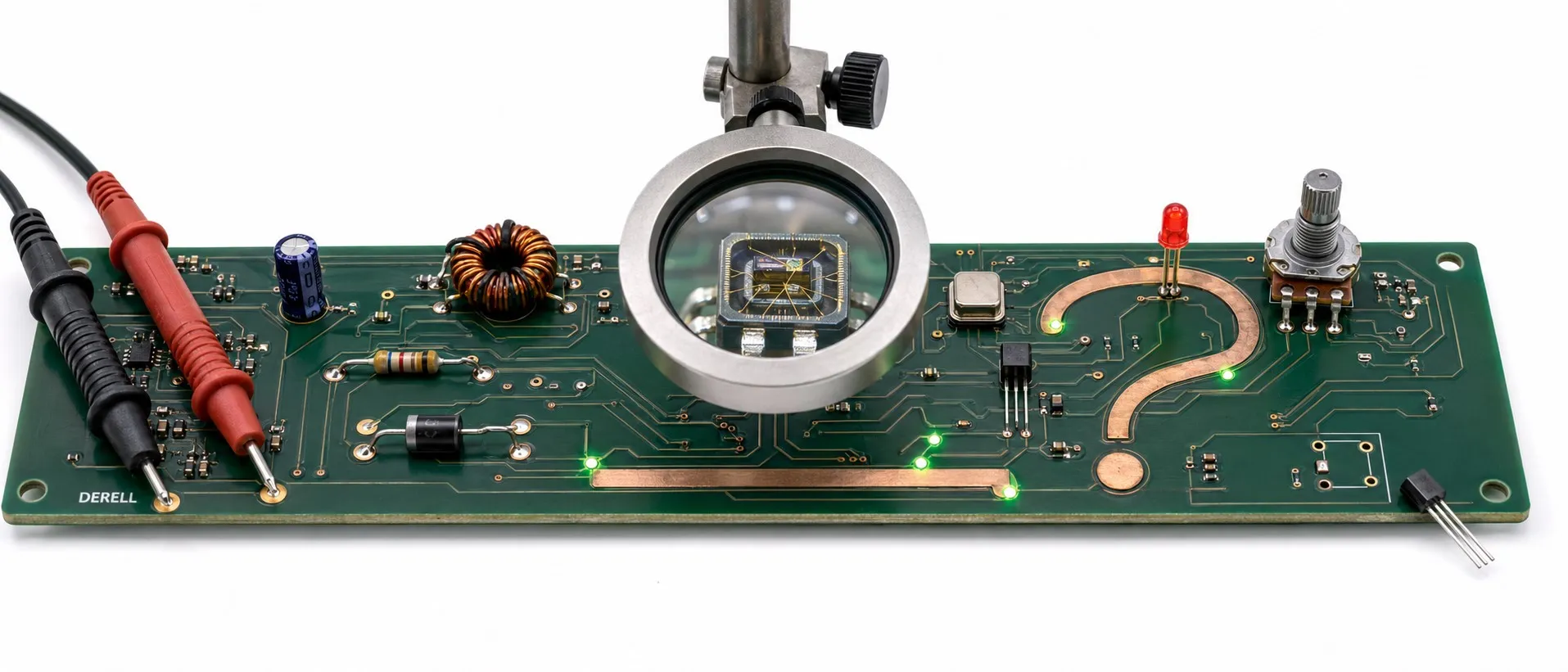
Electronic components FAQ: what parts do and how to choose them
Hello, colleagues,
A component is an individual part of a larger system. In electronics, the term covers many kinds of circuit devices, from a resistor that limits current to a processor that executes a program. Understanding a circuit board involves more than recognizing names: it means knowing what each part does and how the parts work together.
Components, modules and devices describe different levels of a system. A single diode is a component; several parts assembled to perform a particular function can form a module. A finished device, such as a power supply, contains components and may contain modules. The boundaries depend on context. The following sections introduce electronic parts by the jobs they perform.
Parts that control current, voltage and stored energy
What does a resistor do? It limits current, forms part of voltage dividers and dissipates electrical energy as heat. A potentiometer can act as an adjustable voltage divider or, with a suitable connection, a variable resistor. Its resistance, power rating and connection arrangement all matter.
What does a capacitor do? It stores energy in an electric field and is used for filtering, supply decoupling and signal coupling. An inductor stores energy in a magnetic field and develops a voltage in response to changes in current. These parts often work together, but they are not interchangeable.
Rectification, switching and power control
What does a diode do? It conducts readily in its forward direction while largely blocking reverse current. Applications include rectification, protection and signal processing. A transistor can amplify a signal or act as a switch in an appropriate circuit. A MOSFET is a type of transistor widely used in power electronics and fast switching.
Where are triacs and thyristors used? Applications include power control and controlled rectification. Triacs are particularly associated with AC load control; a conventional thyristor has different conduction behavior. An electromechanical relay switches contacts through a mechanism driven by its coil. The load's AC or DC supply, current and switching frequency influence the choice of switching device.
Producing light, sensing light and isolating signals
What does an LED do? It emits light when forward current flows and needs a suitable resistor or driver to control that current. A photodiode converts light into an electrical signal. An optocoupler transfers a signal using light and can provide electrical isolation between circuits. Light emission, light detection and signal isolation are distinct functions.
Integrated circuits and programmable control
What is an integrated circuit? It combines many electronic elements within a semiconductor structure. It may be an amplifier, regulator, memory or processor. A microcontroller typically integrates a processor core, memory and peripherals on one chip. A microprocessor system often uses external memory and supporting circuitry. Not every IC is a processor, and a controller board contains much more than its processor.
Timing and wireless communication
What are crystals and oscillators used for? They support stable timing and frequency generation. A crystal resonator is different from an oscillator: the oscillator also includes circuitry that sustains oscillation. A ceramic resonator is another timing component; frequency tolerance and stability must suit the application.
What is an RF module? It is an assembly that transmits, receives or performs both functions at radio frequencies. It may contain a processor, amplifiers, filters and other components. Two modules operating at the same frequency are not necessarily compatible; their protocol, modulation, interface and supply requirements also matter.
Power conversion and protection components
What does a transformer do? It transfers energy through alternating or changing magnetic flux and can provide voltage conversion and electrical isolation, depending on its design. Types such as autotransformers do not provide isolation. A varistor is used to limit voltage transients. Its role should be considered alongside other protection parts, including TVS diodes and fuses. Voltage transient protection and overcurrent protection are different functions.
Other common component questions
What is the difference between active and passive components? Resistors, capacitors and inductors are typical passive components; they do not provide power gain on their own. Transistors and many ICs are classed as active components, using supply energy to amplify signals or carry out controlled operations. Classification can depend on the definition being used. For practical learning, focus first on the component's function in the circuit.
What is the difference between SMD and through-hole parts? Surface-mount devices (SMDs) are soldered to pads on the board surface; through-hole (THT) parts have leads that pass through board holes. These terms describe mounting methods. Surface mounting alone does not establish superior quality or performance. Electrical characteristics, thermal conditions and mechanical requirements must also be considered.
Are similar-looking parts interchangeable? No. Compare the part number, datasheet, pinout, voltage and current ratings, tolerance, speed and temperature limits. Relevant details include a capacitor's capacitance, voltage rating and polarity, or a diode's type and operating characteristics. Matching the package or just one rating is not enough.
Can a multimeter fully test every component? No. Multimeter measurements can reveal shorts, open circuits and certain basic values; they cannot independently verify processor firmware or an RF module's communication functions. Diode testing and capacitance measurements can also be affected by parallel circuit paths. Before resistance, diode or capacitance tests, disconnect power, remove stored energy and verify that no voltage remains.
Technical references: Murata — basic circuit elements · Microchip — MCU / MPU · Murata — crystals and resonators.