
What is a microprocessor?
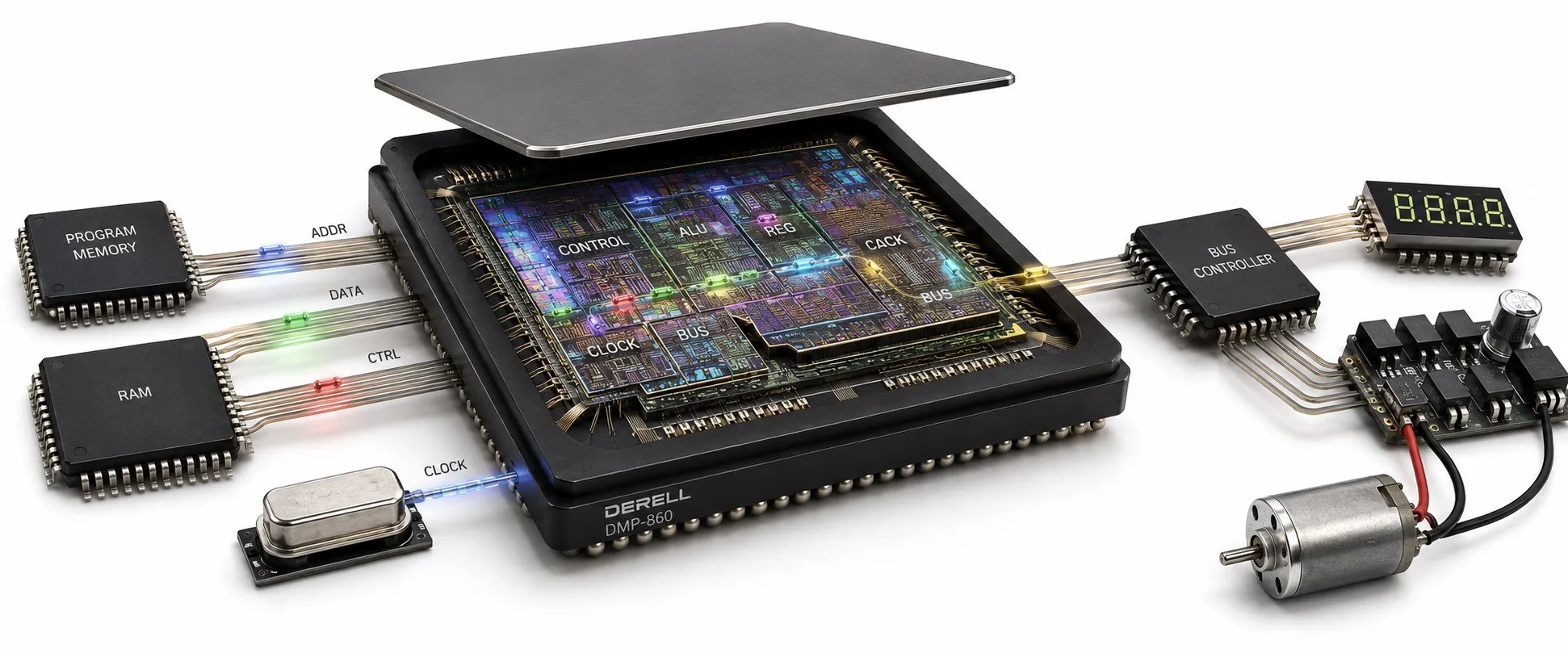
What is a microprocessor, and how does it work?
Dear colleagues,
A microprocessor is an integrated circuit that executes program instructions and provides the functions of a central processing unit, or CPU. It performs calculations, evaluates logical conditions and manages data processing. Calling it the “brain of a computer” is useful, but the processor operates alongside program memory and the supporting circuitry required by the system.
Its digital circuits contain large numbers of transistors. In CMOS implementations, MOSFET circuits provide the basis for logic operations. Their physical switching behaviour is organised into larger structures that execute instructions.
Are CPU, microprocessor and SoC the same thing?
CPU refers to the processing unit, while microprocessor refers to a processor chip implementing that function. A CPU core can also form part of a larger chip. A SoC — System on Chip may combine processor cores with a memory controller, communication interfaces, graphics or other accelerators. A SoC does not necessarily contain the system's RAM or every supporting component.
A microcontroller generally combines a CPU, memory and peripherals on one chip for control tasks. Microprocessor-based systems commonly use external memory and more extensive software environments. The distinction is not absolute: modern microcontrollers can use external memory, and microprocessors can integrate numerous peripherals.
The main functional blocks
Arithmetic logic unit — ALU: Performs operations such as addition, subtraction, comparisons and bitwise logic. Some processors also have separate execution units for floating-point, vector or other operations. The control unit coordinates the operations and data movements required by instructions.
Registers: Small, fast storage locations inside the processor. They can hold data, addresses and processor state. The program counter tracks address information associated with instruction flow. Cache reduces the latency of accessing instructions and data, but does not replace all main RAM.
Memory and bus interfaces connect the processor to system memory and peripherals. Waiting for data takes time, too. Consequently, a fast CPU can spend time stalled by slow memory or insufficient data transfer capacity.
Fetching, decoding and executing instructions
The processor retrieves a machine instruction from memory or cache and decodes it to determine the operation and required operands. The appropriate unit then performs the operation. Depending on the instruction, the processor may write a result to a register or memory, perform a comparison or branch to another address. Not every instruction produces an arithmetic result.
Animation: how an addition instruction is processed
The green box highlights the stage being explained. The example assumes that 12 and 8 are already available in registers. The animation does not show real execution timing; modern processors can overlap the stages of multiple instructions.
Why clock speed alone does not determine performance
Clock frequency describes the number of clock cycles per second. 1 GHz means one billion clock cycles per second, rather than one billion completed instructions or additions. Instruction type, core design, memory stalls and instructions completed per cycle all affect performance. Equal GHz figures do not imply equal performance across different architectures.
A board's crystal oscillator or another clock source may provide a reference for the processor's internal clock generation. PLL circuits can produce different operating frequencies. Some processors adjust frequency during operation in response to power and temperature limits; the advertised maximum frequency may not be sustained under every workload.
What do core count and 32/64-bit mean?
A multicore processor contains several processor cores. Suitable software and workloads can distribute tasks across them. However, four cores do not make every program four times faster. Sequential work, shared resources and data exchange limit the benefit. Hardware thread count is also different from physical core count.
32-bit and 64-bit descriptions relate to an architecture's native register and data processing widths, with implications for addressing and software compatibility. Moving to 64-bit does not automatically double speed or accuracy. The instruction set, software, operating system and actual memory limits must also be considered.
Why does a processor board need supporting circuitry?
The processor requires suitable DC power. Some designs need several supply rails and a defined power-up sequence. Power circuitry may use inductors, capacitors and resistors selected for their particular functions. Stable supplies, clocking, reset and correct memory connections are fundamental operating requirements.
Information from a sensor reaches the processor through an appropriate input interface. Even an indicator LED must be connected within its current limits. The processor is not a power switching device for motors or coils. Driver circuitry and any electrical separation using an optocoupler or another isolation method must be selected for the complete system.
Where are microprocessors used in industrial automation?
Microprocessors can serve in industrial computers, operator panels, vision systems and some PLC architectures. They process packets in industrial communication gateways and run recording, visualisation and analysis software on SCADA servers. These applications have different memory, interface and timing requirements.
Real-time control means delivering a required result within its deadline, rather than simply processing quickly. Operating system scheduling, interrupts, worst-case software execution times and input/output delays must be considered together. Good average performance does not guarantee the required worst-case response time.