
What is a thyristor?
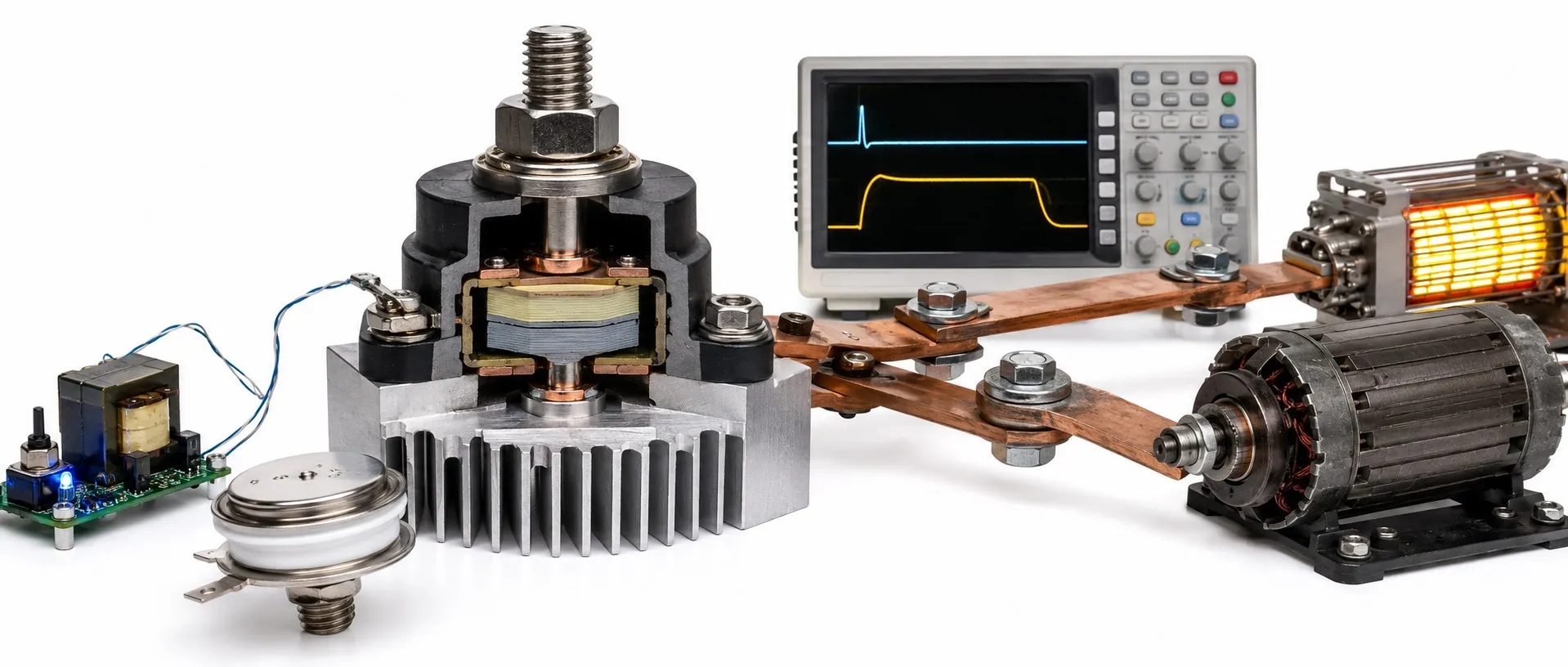
What is a thyristor? SCR triggering and latching
Dear colleagues,
A thyristor belongs to a family of semiconductor power switches. In everyday usage, the term often refers to an SCR (Silicon Controlled Rectifier). Under suitable conditions, an SCR is triggered through its gate and conducts current from anode to cathode. Its defining feature is that it can remain conducting after the gate pulse ends.
The PNPN structure and the A, K and G terminals
A conventional SCR has four semiconductor layers arranged PNPN, forming three PN junctions. A (Anode) and K (Cathode) carry the main current; G (Gate) is the trigger terminal. The three internal junctions and three external terminals are different concepts. Like a diode, an SCR normally conducts in one direction, but its turn-on can be controlled. Check the manufacturer’s datasheet for the pinout and the electrical connection of any metal tab.
How does an SCR turn on and stay on?
With the anode positive relative to the cathode, a gate current of sufficient amplitude and duration initiates turn-on. If the main current reaches the latching current (IL) during triggering, the SCR latches. Once latched, it continues conducting after the gate pulse is removed, provided the main current remains above the holding current (IH). IL concerns establishing conduction; IH concerns maintaining it.
An appropriate resistor limits current in the gate driver. A microcontroller or control IC may determine the firing time; a suitable optocoupler or pulse transformer can isolate the control circuit from the power circuit. The presence of a gate terminal does not itself provide electrical isolation.
Small animation: The gate pulse ends, conduction continues
Gate current — present only in step 2
Main current A → K — present in steps 2 and 3
The orange bar represents gate current; the moving green bar represents main current. This example assumes the main current reaches IL during triggering. In the final step, the load circuit interrupts the main current; the gate does not turn the SCR off. The sequence is slowed down for explanation and does not represent actual switching times.
How does a conventional thyristor turn off?
Removing the gate pulse does not turn off a latched conventional SCR. The main current must fall below IH, and the circuit must allow the necessary turn-off recovery time (tq) before the device can block forward voltage again. In AC circuits, current falling to zero can provide natural commutation. With an inductive load, current and voltage may cross zero at different times; turn-off cannot be explained solely by the voltage zero crossing.
If DC load current does not fall to zero naturally, it must be interrupted in the supply or load circuit, or a suitable forced commutation circuit must be used. Recovery conditions and rates of current and voltage change also matter. This behaviour distinguishes an SCR from a transistor or MOSFET that can be turned off through its control terminal.
Where are SCRs used?
In a controlled rectifier, changing the SCR firing time within the AC waveform adjusts the average DC output voltage. Applications include some DC motor drives, controlled battery chargers and industrial power supplies. Compared with an uncontrolled diode bridge rectifier, the key difference is that the start of conduction can be controlled.
Thyristors also serve in heater power control and some AC switching systems. A single SCR does not conduct in both directions; suitable bidirectional arrangements use two antiparallel SCRs or an appropriate TRIAC. Some solid-state relays (SSRs) use these semiconductor output arrangements. Unlike an electromechanical relay, an SCR has no moving contacts, but it has an on-state voltage drop and produces heat during conduction.
Crowbar protection versus voltage clamping
In a crowbar circuit, an overvoltage detector triggers an SCR to create a low-impedance path across the supply. Safe operation requires coordination of the supply’s current limit or a suitable fuse with the SCR’s surge capability. Discharge current from the output capacitor also matters. An arbitrarily chosen fuse does not guarantee that the SCR will survive.
A varistor or TVS diode clamps voltage surges, whereas a crowbar forces the supply into a protective condition. The comparison of varistors, TVS diodes and fuses explains their different roles and why they are not interchangeable.
Are SCRs, TRIACs and GTOs the same?
An SCR normally conducts in one direction and is turned on through its gate. A TRIAC can conduct in either direction with suitable triggering. A GTO (Gate Turn-Off Thyristor) is a special thyristor that can be turned off by an appropriate reverse gate current. A GTO’s gate-controlled turn-off does not mean a conventional SCR can be turned off the same way. The operating explanation on this page concerns a conventional SCR.
An RCT (Reverse Conducting Thyristor) includes an integrated diode path for reverse current. Reverse conduction and gate-controlled turn-off are separate properties; the RCT designation alone does not imply the gate turn-off capability of a GTO.
Which ratings matter when selecting a thyristor?
Consider the VDRM/VRRM blocking voltages, IT(AV)/IT(RMS) current ratings, IGT gate trigger current, IL/IH, surge current and tq. Also assess dV/dt, di/dt, heatsinking, ambient temperature and package insulation. A current rating is inseparable from its specified temperature and cooling conditions. Recovery time requires particular attention in applications involving faster switching.
What should be checked when diagnosing a fault?
A load that stays on or never turns on may indicate an SCR fault, but the driver, load and connections also need checking. On a de-energised circuit, a multimeter may reveal an obvious short; one diode-test reading cannot verify every SCR operating characteristic. Inspect damaged components, heatsink mounting and cold solder joints together. Disconnect power, verify the circuit is de-energised and discharge capacitors safely before testing. For further reading, see the basic electronics and circuit board repair guide.