
Semiconductor Fast Fuses
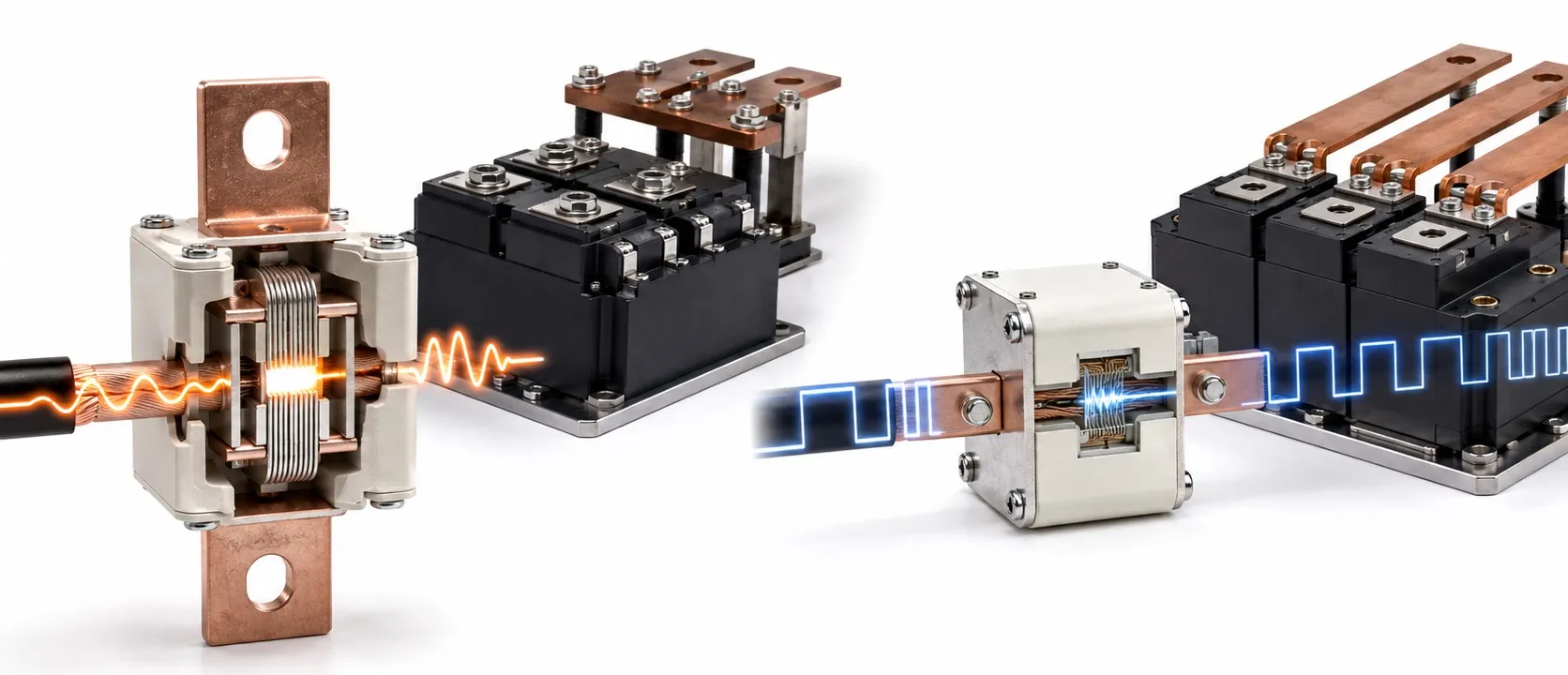
High-speed semiconductor fuses are current-limiting protective devices developed for power diodes, thyristors and semiconductor components in power converters. They are selected for rectifiers, drives, power controllers and UPS systems to reduce the stresses caused by fault current. Cylindrical, blade-contact and bolted-tag designs require electrical suitability and mechanical compatibility to be checked together.
How does a high-speed semiconductor fuse work?
Current flowing through the fuse heats its fusible element. With sufficient fault current, the element melts; the fuse then extinguishes the resulting arc and opens the circuit. A suitable fuse operating in its current-limiting region limits the peak short-circuit current and the associated thermal stress. Its operating time depends on fault current and the product's time–current characteristic; a single microsecond rating cannot describe every model.
Differences between fuse types extend beyond body material and appearance. Two products of the same size can have different utilization categories, operating characteristics and breaking capacities. For semiconductor protection, check the applicable IEC 60269-4 requirements and the manufacturer's data for the specific product.
Six characteristics to assess together
Rated current: Assess the fuse ampere rating against continuous load, repeated current pulses and ambient temperature. Follow the manufacturer's loading conditions. Voltage and AC/DC suitability: Check the voltage rating and operating conditions stated for the applicable circuit type.
Utilization category: Retain the category required by the equipment, such as aR or gR. I²t and operating characteristics: Compare total clearing I²t and the time–current curve with the protected component's withstand capability and the manufacturer's coordination data.
Breaking capacity: The fuse must interrupt the prospective short-circuit current at its installation point under the stated conditions. Its kA rating is not its normal operating current. Dimensions and connections: Check body size, blade or bolted terminals, fixing-hole spacing and compatibility with the fuse holder or busbar.
The difference between aR and gR
Category aR provides partial-range protection for semiconductors and is used for short-circuit protection; overload protection must be provided separately in the circuit. Category gR covers overloads and short circuits for semiconductor protection. Select the appropriate category according to the protective arrangement specified in the equipment documentation.
Why does I²t matter?
I²t is the integral of current squared over time, expressed in A²s. It is used to compare thermal stress during protection; it is not an energy value measured directly in joules. Pre-arcing I²t plus arcing I²t gives total clearing I²t. Two fuses with the same ampere rating can have different values. Compare them using the voltage and fault conditions specified in their technical data.
AC/DC circuits and application compatibility
An AC voltage rating or breaking capacity cannot be transferred directly to DC service. For DC circuits, check operating voltage together with the manufacturer's specified circuit and interruption conditions. In a drive, selection also depends on whether the fuse is installed at the mains input, in a rectifier branch or on the DC bus. For IGBT and MOSFET applications, assess the roles of electronic protection and the fuse together within the equipment manufacturer's specified protective arrangement.
Replacement and ordering information
An operated fuse must be replaced; investigate why the fuse operated before fitting a replacement. Match the complete part number, utilization category and connections. Follow fuse replacement precautions and the equipment manufacturer's instructions. For power circuits containing capacitors, observe the specified discharge time and verify the absence of voltage.
Browse fuse models. If the option you need is not listed, send the relevant seller the existing fuse's complete part number and a legible label photograph, equipment model, AC/DC voltage, operating current and connection dimensions. Confirm current price, availability, delivery and sales terms in the product listing or with the seller.