
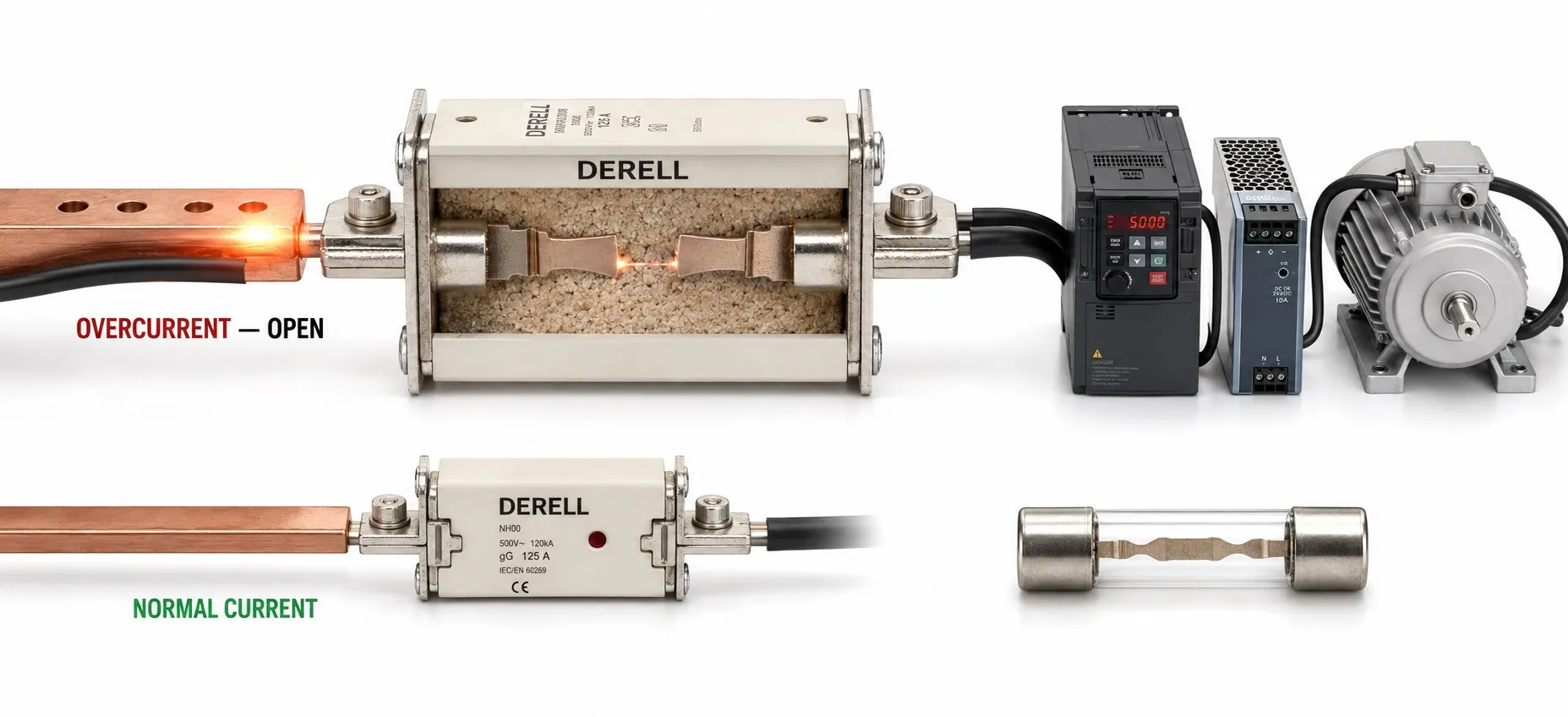
What Is a Fuse?
A fuse protects a circuit against excessive current by opening a deliberately designed fusible element. Current heats the element; under sufficient overcurrent, it melts. The fuse construction then extinguishes the resulting arc and interrupts the circuit. Once operated, a conventional fuse link must be replaced.
A circuit breaker performs an interrupting function using a trip mechanism and separable contacts. It can normally be reset after the fault has been investigated and the equipment is fit for service. A fuse and a circuit breaker may serve similar protection duties, but they are different devices.
Correct protection limits damage to wiring and, where properly coordinated, connected equipment. Overcurrent protection does not cover every electrical hazard. Electric shock, voltage surges and excessive local temperature may require additional protective measures.
Overload and short circuit: two different conditions
An overload occurs when excessive current flows through the intended circuit path. A short circuit creates an unintended low-impedance connection between points at different potentials. Depending on the source and circuit impedance, the resulting fault current can be far greater than the normal load current.
Current-operated fuses respond according to their time-current characteristics. A 10 A fuse is not a precision switch that opens instantly at 10.01 A. Operating time depends on the current magnitude, fuse design, temperature and previous loading.
The Main Fuse Types
Glass and ceramic cartridge fuses
A cartridge fuse encloses its fusible element in a body with conductive end connections. Glass and ceramic are common body materials. The body material alone does not establish the current rating or interrupting capacity. Those values must come from the product data.
A glass body may allow visual inspection, but appearance alone cannot prove electrical continuity. Some ceramic designs contain material that helps extinguish the arc. Two cartridges with identical dimensions can have very different electrical capabilities.
Fast-acting and time-delay fuses
Fast-acting and time-delay fuses have different responses to current over time. A suitable time-delay fuse can tolerate a brief normal inrush event, such as motor starting or capacitor charging, without unnecessary operation.
Time delay does not mean an absence of short-circuit protection. Equally, the fastest available fuse is not automatically the best choice. F and T markings on miniature fuses may identify fast and time-lag characteristics under the applicable standard. Use the actual time-current curve to assess the application.
Surface-mount fuses
SMD fuses are soldered directly to a circuit board. “Surface mount” describes the package and assembly method, not the protection characteristic. Identify the part number and ratings before replacing a board-mounted component.
Industrial fuse formats and utilization categories
NH blade-type and cylindrical industrial fuses are used in power distribution and machinery. A physical format such as NH should not be confused with a utilization category such as gG or aM.
| Category | Typical purpose | Key limitation or distinction |
|---|---|---|
| gG | General-purpose overcurrent protection | Covers overload and short-circuit duties |
| aM | Motor-circuit short-circuit protection | Requires separate overload protection |
| aR | Semiconductor short-circuit protection | Partial-range protection; does not cover low overload currents |
| gR | Semiconductor protection | Full-range characteristic; equipment coordination remains necessary |
For semiconductor protection fuses, current rating is only part of the assessment. Total clearing I²t, circuit voltage and the protected device's withstand characteristics also matter. I²t is the integral of current squared over time, expressed in A²s, and is used to assess thermal stress.
For a variable frequency drive, follow the manufacturer's specified input protection and coordination requirements. PWM operation does not create a general requirement for a device called a “square-wave fuse.”
DC, photovoltaic, battery and automotive applications
DC-rated fuses must interrupt current without the periodic natural current zero crossings found in AC systems. An AC voltage rating cannot simply be reused as an equivalent DC rating. Check the manufacturer's DC voltage and interrupting specifications.
Photovoltaic systems may require appropriate gPV protection. Battery circuits require particular attention to system voltage and available fault current. A low-voltage automotive fuse is not suitable for mains or a high-voltage battery merely because its ampere rating and dimensions appear convenient.
Thermal cutoffs, resettable PPTCs and eFuses
A thermal fuse, also called a thermal cutoff, opens permanently when its temperature-sensitive mechanism reaches its operating conditions. It is different from a bimetal thermostat that may reset after cooling. Temperature rating, electrical ratings and installation method all matter.
A resettable PPTC device heats up and transitions to a high-resistance state under excessive current. It limits current rather than creating the open circuit of a conventional fuse, so residual current can remain. Recovery requires removal of the fault and sufficient cooling, commonly with power removed.
An electronic fuse, or eFuse, monitors the circuit and controls a semiconductor switch. Depending on the model, it can limit current, disconnect a fault, manage inrush or provide additional voltage and reverse-current protection. Check the individual device: these functions are not universal.
Protection Devices That Are Not Conventional Fuses
A varistor, TVS diode or zener diode is used for voltage-related functions. These components do not replace a series overcurrent fuse. A coordinated design may use both voltage clamping and current interruption because they address different fault conditions.
The distinction between MCBs, RCCBs and RCBOs is equally important. An MCB provides overcurrent protection. An RCCB detects residual current and does not provide its own overload protection. An RCBO combines residual-current and overcurrent functions.
An AFDD detects specified arc-fault conditions and is a separate protection category. Remote switching, monitoring or a “smart” label also says little about a product's actual fault-interruption capability. Protection ratings still need to be verified.
How to Select a Fuse
Current rating: Match the fuse ampere rating to the load, conductor capability, operating temperature and manufacturer's derating guidance. There is no single percentage margin that works for every circuit.
Voltage rating: The applicable AC or DC rating must cover the circuit's maximum relevant voltage. A 250 V marking does not mean the fuse opens when the supply reaches 250 V; it describes a rated operating limit for its interrupting duty.
Interrupting rating: Also called breaking capacity, this must cover the prospective short-circuit current at the installation point. A 16 A current rating and a 10 kA breaking capacity describe different properties. The fuse does not have to carry 10 kA continuously, nor does it wait for 10 kA before responding.
Time-current response: The fuse must tolerate legitimate inrush while clearing abnormal current within the protected circuit's withstand limits. Check pulse duration and repetition as well as peak current.
Mounting and coordination: Confirm the fuse holder, dimensions, contact condition and temperature rise. Assess interaction with upstream and downstream protection. Proper fuse selection requires more than finding a matching number on the end cap.
Relevant fuse standards depend on the product and application. IEC 60269 covers low-voltage fuses, IEC 60127 covers miniature fuses, and IEC 60691 addresses thermal links. Equal current ratings across different standards and categories do not establish interchangeability.
What should you do when a fuse blows?
Investigate why the fuse operated. Possible causes include a short circuit, sustained overload, unsuitable characteristic, repeated inrush or excessive ambient temperature. A poor connection in the holder can also produce dangerous local heating without necessarily drawing enough current to operate the fuse.
Do not solve repeated operation by fitting a higher ampere rating or bridging the fuse. That can leave the wiring or equipment inadequately protected. Before replacing a fuse, all relevant energy sources must be safely isolated, with absence of voltage and stored-energy conditions verified by a competent person.