
Which type of fuse?
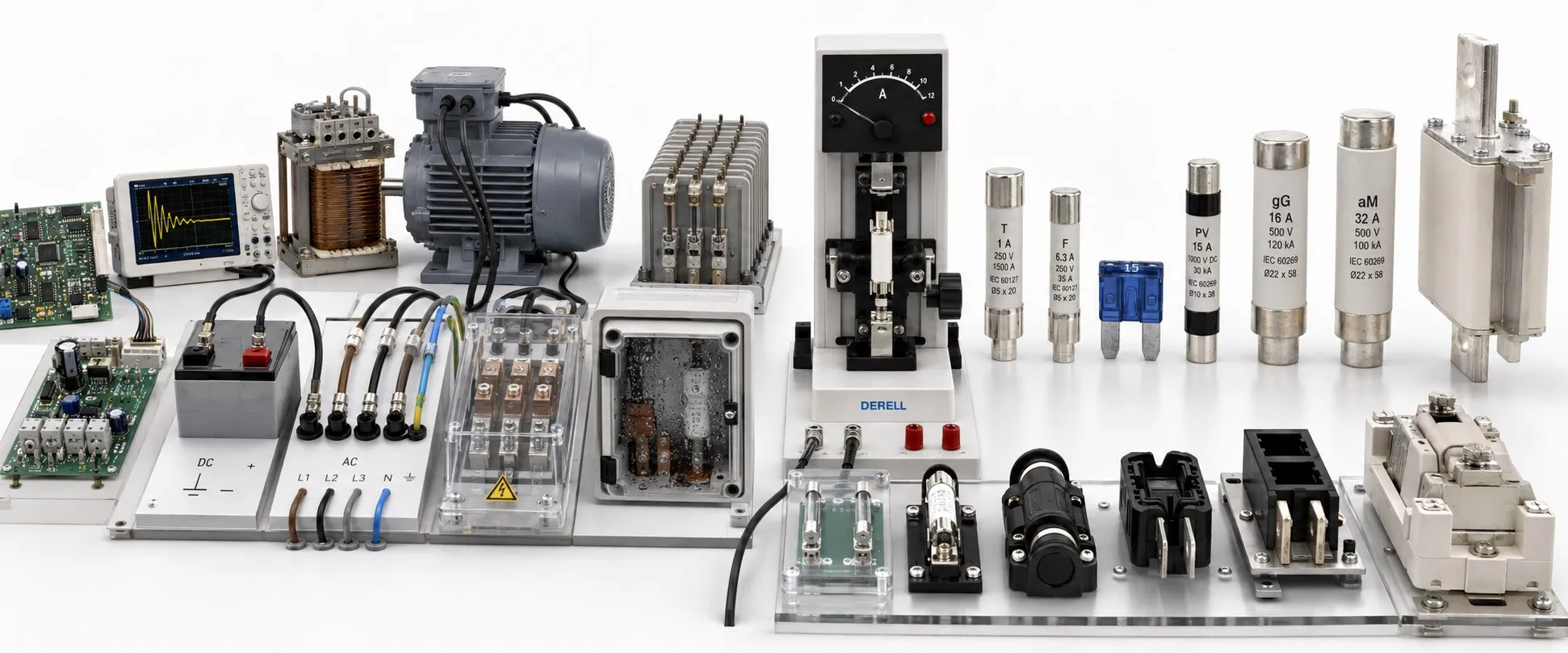
Match the protection to the way the load behaves
Choosing a fuse takes more than matching its current rating or fitting it into a holder. Start by identifying what needs protection, then establish the normal operating current, starting or inrush current and possible fault current. A motor starting, a power supply charging its capacitors and a heater running continuously place different demands on protection. A suitable fuse allows normal operation while clearing faults before they exceed the withstand limits of the wiring and equipment.
Editor's note: Two fuses with the same dimensions and current rating may have different duties. Glass or ceramic describes the body; fast acting or time delay describes its operating behaviour. These are separate properties. An ordinary fast acting equipment fuse is not automatically a substitute for a coordinated semiconductor protection fuse.
Identify the protection duty first
The basic function of an electrical fuse is overcurrent protection, but not every class covers the entire overcurrent range. An overload is an excessive current that persists for a period of time. A short circuit can produce a much higher fault current. The differences between fuse types should be assessed against these duties and their operating characteristics. A fuse alone does not provide every protective function where residual current protection or surge voltage limitation is required.
Operating speed and body material are separate properties
The choice between fast acting and time delay fuses depends on the load's current and time profile. On miniature fuses, F identifies a fast acting characteristic and T a time delay characteristic. A correctly selected time delay fuse can withstand normal inrush. This does not mean it always clears every fault more slowly: its actual response to a high short-circuit current must be checked in the technical curves.
A glass body makes the element easier to see, although visual inspection alone cannot establish that a fuse is sound. Ceramic bodies are common in high breaking capacity designs, but ceramic construction does not establish a particular breaking capacity. Check the breaking capacity, voltage rating and characteristic separately in the datasheet. Matching the 5 × 20 mm dimensions does not establish electrical equivalence.
What do gG, aM, aR, gR and gPV mean?
gG is a full-range category used for general-purpose overload and short-circuit protection. Cable protection requires the fuse characteristic to be coordinated with the cable's permissible current. aM is intended for short-circuit protection in electric motor circuits; it does not provide complete motor overload protection on its own. A suitable thermal overload relay or another overload protective device is also needed.
aR provides partial-range, short-circuit protection for power semiconductors. gR provides full-range semiconductor protection. When protecting a solid state relay, its fuse current rating or an “ultra-fast” description alone is insufficient; manufacturer coordination data is needed. gPV is designed for the characteristics of photovoltaic circuits. A matching DC voltage rating alone does not establish that a gPV fuse is suitable for a battery or another DC application.
Check current, voltage and breaking capacity separately
The rated current is not a threshold above which the fuse opens immediately. Determining the fuse current rating involves the load current, conductor size, installation conditions, operating curve and manufacturer correction factors. A 10 A fuse should not be expected to open instantly at 10.1 A. For high-power equipment, power in kW alone is also insufficient; the supply, number of phases, efficiency and duty matter.
The voltage rating must cover the applied circuit voltage, and AC or DC suitability must be established explicitly. A 250 VAC marking does not establish suitability at the same DC voltage. For DC fuse selection, arc interruption, circuit time constant and the datasheet's application conditions are important.
Breaking capacity concerns the maximum prospective short-circuit current that can be safely interrupted at the specified voltage and conditions. It is not the normal load current. If the prospective fault current at the installation point is 10 kA, a 6 kA device is insufficient as standalone protection. Use with upstream protection must be assessed against a verified manufacturer combination.
Why do inrush, I²t and selectivity matter?
Check both the magnitude and duration of the inrush pulse. A brief pulse and an overload lasting several seconds are different conditions. I²t is the time integral of current squared, expressed in A²s, and is an indicator of thermal stress. It is not directly an energy value in joules. Semiconductor coordination involves comparing the fuse's total clearing I²t with the device's withstand capability under the relevant conditions; checking only the pre-arcing I²t is insufficient.
Selectivity aims to clear a fault using the nearest protective device while keeping other branches in service. A higher upstream current rating alone does not prove this. Check time-current characteristics and manufacturer selectivity tables rather than applying an arbitrary current ratio to the entire fault range.
Include temperature, the holder and installation conditions
The local temperature inside an enclosure may be higher than the room temperature. Adjacent components, limited ventilation and loose connections affect heating in the fuse and holder. The holder must also have suitable voltage, current and permissible power dissipation ratings. Fuse box placement and maintenance therefore involve more than tidy wiring. Select suitable enclosures and connections for humidity and corrosion exposure.
Correcting a fuse selection for ambient temperature is different from using a thermal fuse. A thermal fuse is a separate component that opens under specified temperature conditions; it is not automatically interchangeable with a conventional overcurrent fuse.
How does this apply to real circuits?
Motor circuit: Assess short-circuit protection that tolerates starting, overload protection and contactor coordination together. If the motor struggles to start, investigate mechanical loading and electrical causes instead of simply increasing the fuse current rating.
Power supply: The input fuse of a switching power supply is not selected directly from its output current. Consider the input capacitor charging pulse and the manufacturer's recommendation. For example, a 24 V / 10 A output does not mean the unit continuously draws 10 A from the mains. Protection of the output branches requires a separate assessment.
Heater and SSR circuit: Protecting the heater wiring and protecting the semiconductor inside the SSR are different objectives. Even an appropriately selected high-speed fuse cannot guarantee that a semiconductor survives every failure mode. Heating safety may also require independent temperature limiting.
Check standards, equivalence and replacement requirements
Fuse standards depend on the product family. IEC 60269 provides the relevant framework for low-voltage power fuses, while IEC 60127 concerns miniature fuses; the UL 248 family also distinguishes between application scopes. Products with the same current rating but different standards are not automatically interchangeable. Check the scope of approval and the manufacturer's specified replacement.
When a fuse needs replacing, investigate why it operated first. Repeatedly replacing it with a higher current rating or bypassing it can defeat cable and equipment protection. Safe replacement requires isolation of all energy sources, prevention of re-energisation and verification of the absence of voltage by a competent person. For home electrical safety too, fuses must be considered alongside the other necessary protective measures.
Follow a clear selection sequence
Identify the load and protection duty, then verify the category and operating curve, current and AC/DC voltage, breaking capacity, installation conditions and coordination. Assessing these fuse selection factors together is more useful than a single current recommendation. Keep the complete part number, equivalence information and a reliable supply record when purchasing and stocking replacements.
Related topics
Within the fuse family, explore comparisons of fuse types, fast acting and time delay fuses, semiconductor protection fuses, DC fuses and thermal fuses to understand their different duties.
For the wider circuit, see electric motors, solid state relays, power supplies, residual current protection and surge protective devices.
Fuse information, fuse standards, fuse models main page and the selection sequence.
Technical sources
Littelfuse: Fuseology Selection Guide; current, temperature and pulse assessment
Eaton Bussmann: High Speed Fuses Application Guide; I²t, AC/DC and coordination
Eaton: protection duties of gG and aM cylindrical fuses
SCHURTER: SP 5x20 datasheet; body, characteristic and breaking capacity
Mersen: protection scope of aR and gR semiconductor fuses
Mersen: application characteristics of a gPV photovoltaic fuse