
What are the differences between different types of fuses ?
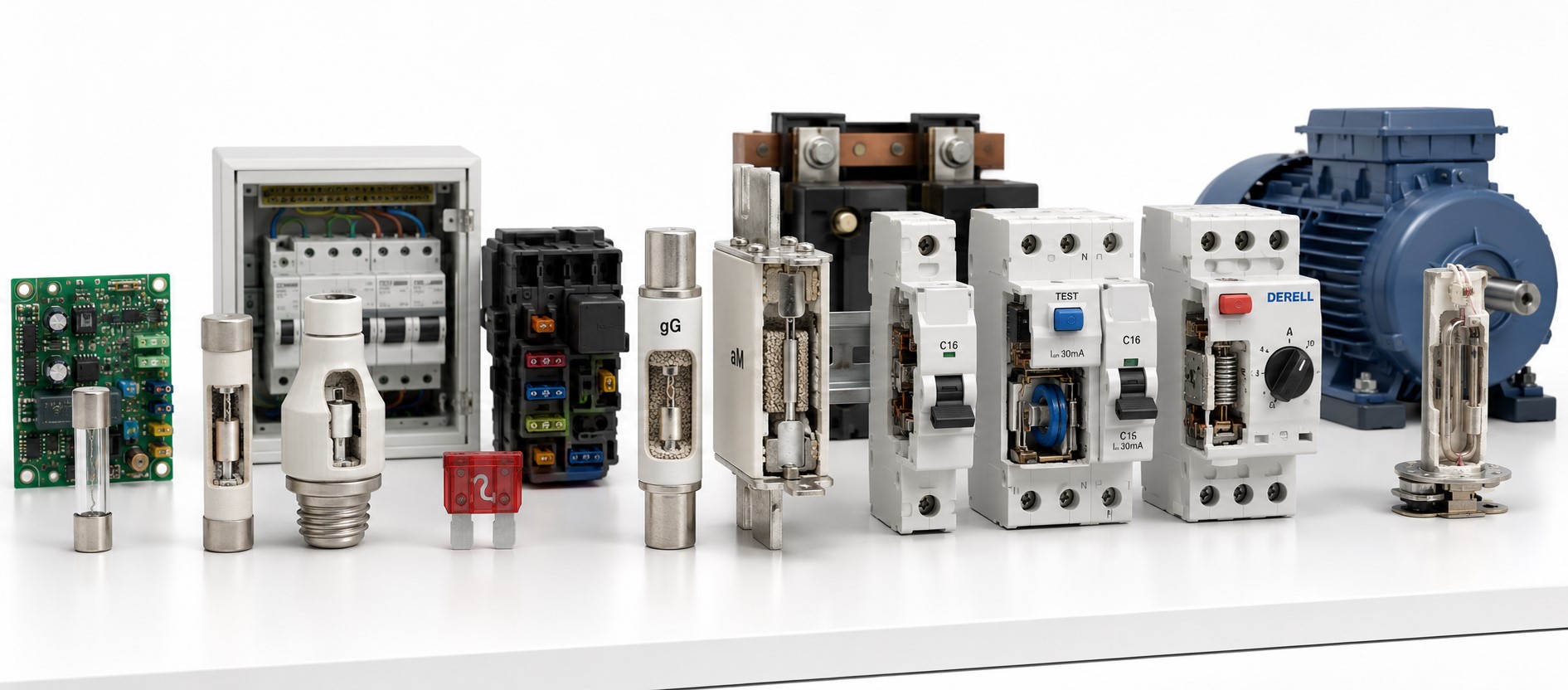
Understanding construction, operating characteristics and protection duties
Hello everyone. Identifying a fuse takes more than checking its shape or ampere rating. Body construction, operating characteristics, interrupting rating and protection duty must be considered together. A fuse can be ceramic-bodied, time-delay and high-breaking-capacity at the same time: these descriptions refer to different properties.
Editor's note: Matching dimensions and amperes do not guarantee matching protection. A glass fuse is not necessarily fast-acting, and a ceramic fuse is not necessarily time-delay. A circuit breaker uses a different interruption mechanism from a conventional fuse; a tripped PPTC can still pass a small current.
Cartridge, glass-tube and ceramic fuses
A cartridge fuse is a replaceable fuse with its fusible element enclosed in a body. Glass-tube fuses and many ceramic-tube fuses belong to this group. Glass allows the element to be inspected, but appearance alone does not prove continuity. Any continuity test requires suitable measurement with the circuit de-energized.
Body material and fast-acting or time-delay operation are separate characteristics. For example, F2A and T2A both indicate 2 A, but F identifies a fast-acting characteristic and T a time-lag characteristic. A correctly selected time-delay fuse can tolerate brief inrush currents. A ceramic body does not establish its breaking capacity: check the specified rating.
Screw-type systems and the term “plug fuse”
In D and D0 screw-type fuse systems, a replaceable fuse-link is used with the appropriate base and screw cap. The English term plug fuse can refer to other screw-in systems, depending on context. It should not be confused with a cartridge fuse inside a mains plug. Base and contact compatibility matter as well as the fuse-link dimensions.
Automotive blade fuses and NH fuse-links
The blade type commonly used in automotive fuses usually has a plastic body and two flat terminals. Colour helps identify the current rating, but the marking and product series must still be checked. Industrial NH blade-type fuse-links belong to a different system. Similar terminal terminology does not make them suitable for the same voltage or interchangeable.
HRC: what high breaking capacity actually means
HRC means high rupturing capacity; it does not mean that a fuse is exclusively intended for high-voltage systems. HRC fuses are also used in low-voltage distribution. The interrupting rating concerns the prospective fault current that can be interrupted safely at the specified voltage and conditions. The current rating describes carrying load current; the interrupting rating describes safely clearing a fault.
gG and aM: general protection versus motor-circuit duty
gG identifies general-purpose, full-range overcurrent protection, while aM identifies partial-range short-circuit protection for motor circuits. An aM fuse therefore does not provide complete motor overload protection on its own; a suitable overload relay or another protective device is required. Motor starting current and starting duration directly affect the selection.
Semiconductor fuses: speed and I²t coordination
High-speed semiconductor fuses have characteristics intended for power devices such as diodes and thyristors. I²t is the time integral of current squared, expressed in A²s, rather than directly in joules. Coordination compares the fuse's total clearing I²t with the protected device's withstand capability under applicable conditions. aR is a partial-range class; gR is full-range. An ordinary F-marked fuse is not automatically a substitute for a semiconductor fuse.
PTC and PPTC devices: limiting current rather than opening the circuit
Resettable PPTC devices heat up during an overcurrent event and increase their resistance. They limit current; they must not be assumed to provide a fully open circuit or safe isolation. Recovery can require removing power and allowing the device to cool after the fault is cleared. Check hold current, trip current, ambient temperature and voltage limits together. Not every PTC component is a resettable overcurrent protector.
Thermal fuses: responding to excessive temperature
Thermal fuses permanently open the circuit under specified temperature conditions. Depending on the design, they use a fusible alloy or a temperature-sensitive element. The ampere marking is not the current at which they are intended to operate. Functioning temperature, electrical ratings and mounting position all matter. A one-shot thermal fuse is different from a thermostat that closes again after cooling.
Miniature circuit breakers: protection that can be reset
Common thermal-magnetic miniature circuit breakers (MCBs) use a thermal mechanism for overloads and a magnetic mechanism for high short-circuit currents. They can be reset under appropriate conditions once the fault has been corrected. B, C and D curves distinguish, in particular, instantaneous tripping ranges. A conventional fuse and an MCB with matching ampere ratings are not directly equivalent in operating curves, current limitation or coordination.
AC and DC suitability must be checked separately
DC fuses must meet the arc-extinction requirements of a direct-current circuit. An AC-only voltage marking does not establish suitability for DC operation at the same numerical voltage. The voltage rating is not a voltage trip threshold; it specifies the voltage at which the fuse can be used safely under its stated conditions.
How to compare devices for a real application
Start with the current rating and load requirements, then check voltage, AC/DC suitability, time-current characteristics, interrupting rating, ambient temperature and holder compatibility. Applicable fuse standards also matter. Exceeding the ampere rating does not make a fuse open immediately. Operating time depends on the magnitude of the overcurrent and the product's characteristics.
For example, an aM fuse selected for motor starting needs additional overload protection; a power supply's initial charging current may require a time-delay characteristic; and a semiconductor circuit may need the manufacturer's specified specialist fuse. For high-power equipment, simply choosing more amperes is not a protection strategy. The selected protection must allow normal operation while protecting wiring and equipment.
Replacement and maintenance
When deciding whether a fuse needs replacement, first investigate why it operated. Installing a higher current rating does not repair the fault. For safe replacement, isolate the supply and verify the absence of voltage; never bridge an operated fuse with wire or foil. During fuseholder and panel maintenance, also check for loose contacts, discolouration and overheating. The fuse-link itself is not always the cause.
Related fuse topics
The primary function of an electrical fuse: what the fusible element is intended to protect.
Factors in fuse selection: combining electrical ratings with application conditions.
Fuses and home safety: the scope and limitations of installation protection.
Industrial fuses: protection duties in panels and distribution systems.
IEC 60269: an introduction to low-voltage fuse classification.
Related equipment and complementary protection
Contactors: coordinating switching equipment with short-circuit protection.
Variable frequency drives: selecting the input protection specified by the drive manufacturer.
Power supplies: distinguishing input inrush from output protection requirements.
Temperature controllers: normal temperature regulation versus independent overtemperature protection.
Ground-fault and residual-current protection: a separate protective function that a standard overcurrent fuse does not provide.
Technical sources
Eaton: current ratings, interrupting ratings and fuse selection
SCHURTER: FST 5x20 time-lag glass fuse specifications
Mersen: gG, aM and other utilization categories
Eaton Bussmann: semiconductor fuses and I²t coordination
Littelfuse: Fuseology and conventional fuse versus PPTC comparison