
What should I consider regarding the placement and maintenance of a fuse box?
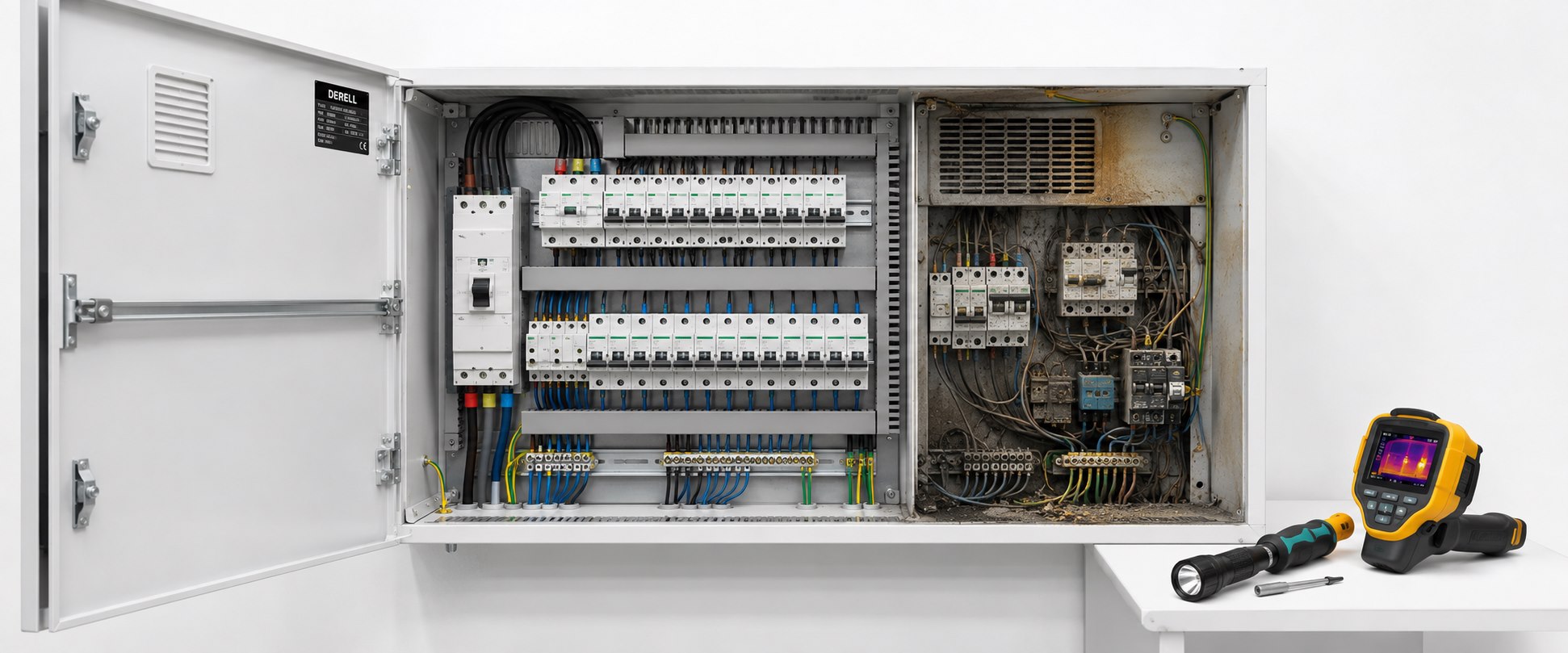
What should I consider when locating and maintaining a fuse box?
A fuse box or distribution board should be accessible, suitable for its environment and fitted with reliable connections. Even correctly selected fuses and other switchgear can be compromised by moisture, excessive temperature, poor connections and obstructed access. Maintenance means verifying that the protection remains effective, rather than simply removing dust.
Location: keep the board accessible and the area clear
Access and working space: The board must be safely reachable, its door must open properly and cupboards, pallets or stored materials must not obstruct it. The main disconnect should be clearly identifiable. Mounting height and working clearances depend on the installation design and applicable requirements; there is no single dimension suitable for every board.
Labelling: Use meaningful circuit names such as “Workshop west-wall sockets” rather than simply “Sockets.” Update labels and diagrams when circuits change. Doors, internal protective covers and unused module blanks must remain fitted, preventing unauthorized access to live parts.
Choose an enclosure for moisture, dust and temperature
Environmental conditions: Assess leaks, steam, washdown water, direct sunlight and nearby heat sources. The IP rating, defined by IEC 60529, describes protection against solid-object and water ingress. For example, IP65/IP66 is not automatically the correct choice everywhere; thermal management and condensation need separate consideration. An internal device's IP20 rating does not establish the rating of the complete enclosure.
Cable entries and seals: Glands, unused-entry plugs and door seals must be intact. Improvised holes can compromise protection. Day-to-night temperature changes can cause condensation in a board in a cold warehouse. Where necessary, specify manufacturer-approved humidity control and enclosure heating. External water ingress must also be corrected.
Internal arrangement and load capacity
Compatible devices and connections: Protective device types, busbars and connection accessories must be compatible. Fuse selection must consider conductor size, fault conditions and load. Increasing the ampere rating does not fix an overcrowded or hot enclosure. Check the existing board's capacity before adding high-power loads.
Wiring and protective conductors: Covers must not crush cables or strain terminations. Do not connect more conductors to a terminal than it is designed to accept. Verify metal-enclosure protective connections according to the design; do not add arbitrary neutral-to-earth links. Individual components meeting product standards do not establish that the complete board is correctly installed.
What can a user observe, and what must an electrician check?
External observation: Check covers and access, and report burning smells, cracks, discoloration, water marks or unusual sounds. Do not reach inside to check temperature by touch. Keep clear of smoke or arcing. Disconnect power only at an appropriate, safely accessible isolation point and obtain emergency assistance where necessary.
Electrical maintenance: Safe intervention requires identification of all supplies, including mains, generators, UPS systems and any PV source. Prevent re-energization and verify absence of voltage at the work point. Check connection torque according to the manufacturer's instructions; indiscriminately tightening every screw is inappropriate. Tightening alone does not repair a burnt terminal.
Cleaning and testing: Use the manufacturer's recommended dry cleaning method on isolated equipment. Do not spray water, arbitrary contact cleaner or compressed air into the board. Competent personnel assess protective-conductor continuity, insulation, protective devices and connections as required. Thermal imaging may require assessment under load; it must be performed by personnel competent in the hazards of energized equipment.
Worked example: why can a connection overheat without a fuse operating?
Assume a connection carries 25 A and has a resistance of 0.02 Ω. Its heat dissipation is P = I²R = 25² × 0.02 = 12.5 W, concentrated at a small connection point. These are illustrative values, not acceptance limits. Local overheating can occur without the current reaching the fuse's operating conditions. Whether a fuse operates therefore does not establish connection integrity.
How often should maintenance be carried out?
There is no universal maintenance interval. Consider manufacturer instructions, load, dust, moisture, vibration, previous faults and the site's maintenance plan. A dusty production area and a clean office need different assessments. Record inspection dates, findings, loading conditions and corrective work. Assess whether damaged devices require replacement.
Operate an RCD's test button at the intervals and under the conditions specified by its manufacturer. The test button does not verify the earthing and insulation of the entire installation. If the test button does not work, do not rely on the protection until an electrician has investigated, including the relevant supply and connection conditions.
Repeated tripping and circuit changes
If a breaker trips immediately after resetting, do not repeatedly re-energize it. Tripping when an appliance starts and RCD tripping are different fault scenarios. Identify the differences between an MCB, an RCD and an RCBO first. Do not increase ratings or bypass protection before establishing the cause.
Technical sources: HSE: electrical safety · HSE: safe isolation · Fluke: thermal inspection · IEC 60529.