
The difference between an MCB, an RCD and an RCBO
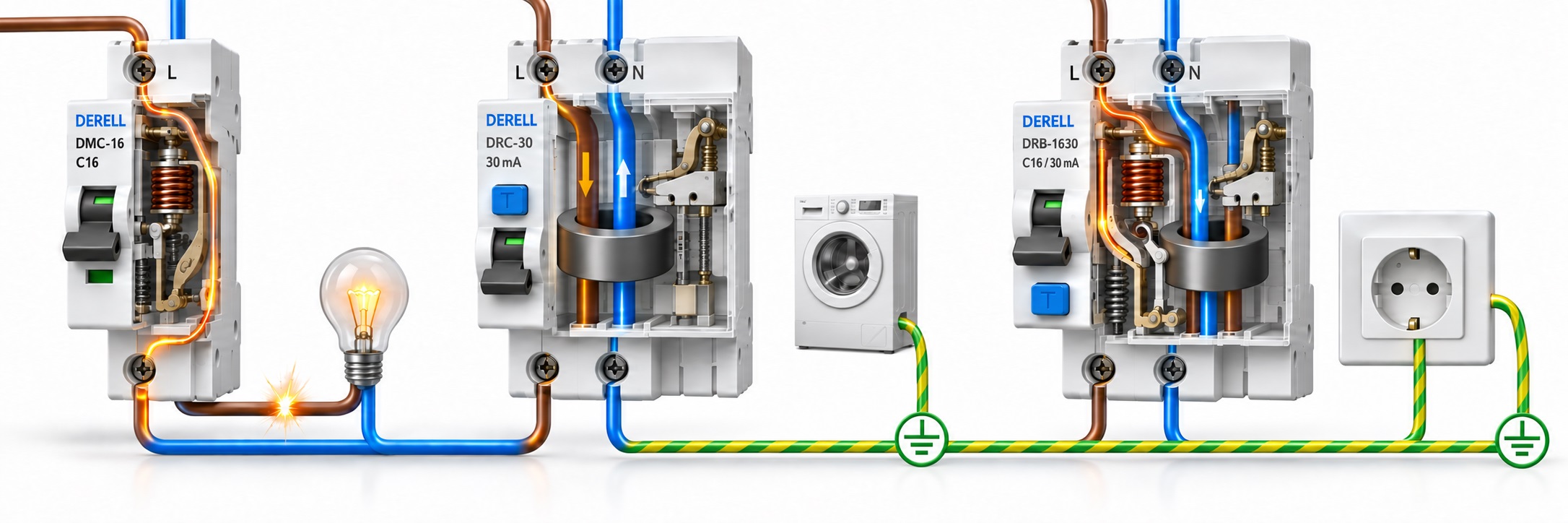
The difference between an MCB, an RCCB and an RCBO
An MCB provides overload and short-circuit protection. An RCCB provides residual current protection. An RCBO combines both functions in one device. Similar-looking devices in a distribution board can therefore respond to different faults. Selecting the right protection requires understanding what the device detects, as well as its current rating.
The terminology matters. MCB means miniature circuit breaker. An RCCB is a residual current circuit breaker without integral overcurrent protection. RCD is the broader term for residual current devices: both RCCBs and RCBOs belong to this family. Consequently, describing an RCD and an RCBO as completely separate protection families is misleading.
Which device protects against which fault?
| Protective function | MCB | RCCB | RCBO |
|---|---|---|---|
| Overload protection | Yes | Not built in | Yes |
| Integral overcurrent tripping for short circuits | Yes | No | Yes |
| Residual current detection at mA levels | No | Yes; sensitivity depends on the model | Yes; sensitivity depends on the model |
An MCB may also trip when a line-to-earth fault produces sufficient current. That does not mean it measures small leakage currents. Similarly, an RCCB opening during an earth fault does not remove its need for suitable overload and short-circuit protection.
MCB: What happens when too much current flows?
An MCB's principal role is to protect the conductors of a correctly designed circuit against the effects of overcurrent. In common thermal-magnetic designs, the thermal element responds to sustained overloads, while the magnetic element responds to high-current events such as a short circuit. Operating time depends on the current magnitude and the device's time-current characteristic.
Imagine a circuit protected by a 16 A MCB carrying 25 A, with all the current leaving through the line conductor returning through neutral. There is an overload, but there may be no residual current. The MCB responds according to its overload characteristic, while an RCCB cannot detect that overload through its residual current function alone. This illustrates why load current and residual current must be treated separately.
Selecting a 10 A, 16 A or 32 A circuit breaker therefore involves more than checking appliance power. The design must also account for cable current-carrying capacity, installation conditions, load behaviour and the required disconnection under fault conditions.
RCCB: Why compare outgoing and returning current?
An RCCB monitors the balance of current through the circuit's live conductors. In a single-phase circuit, this can be explained using line and neutral: when all outgoing current returns through neutral within the same sensing arrangement, the currents balance. If some current returns by another route, an imbalance appears. The device evaluates that imbalance according to its sensitivity and operating characteristic.
The principle also applies to three-phase circuits, where the overall current balance of the relevant phases and any neutral is monitored. A circuit does not have to be overloaded for residual current tripping to occur. An insulation fault in a low-power appliance can also operate the protection.
A 40 A / 30 mA RCCB carries two ratings with different meanings. The 40 A value is its rated current under the specified operating conditions; 30 mA is its rated residual operating current. The ampere and milliampere values are not alternative descriptions of the same function. A 40 A marking does not mean the RCCB automatically trips on overload when the current exceeds 40 amps. The RCCB itself needs suitable overcurrent protection.
What does an RCBO combine?
An RCBO combines overcurrent and residual current protection. Its relevant protective function can disconnect the circuit following an overload, short circuit or a residual current of a type the device is designed to detect. However, combined protection does not mean that every electrical hazard is covered by one device.
An RCBO tripping does not, by itself, establish that earth leakage caused the event: its overcurrent section may have operated instead. Some models provide a separate indication of the trip cause. When identifying which protection operated, check the model, markings and manufacturer's explanation of any indicators.
How should B16, Type A, 30 mA and 6000 be read?
B16: B identifies the overcurrent tripping curve, and 16 identifies a rated current of 16 A. It does not mean the device must trip instantaneously at every current just above 16 amps. B, C and D curves differ particularly in their magnetic tripping characteristics. Selection also considers temporary load characteristics such as motor starting current.
Type A: This describes the residual current waveforms the protection can detect. Type AC, A, F and B RCDs differ in this respect. A B-curve circuit breaker and a Type B residual current device do not describe the same characteristic. An RCBO can, for example, have a B overcurrent curve and Type A residual current protection. For electronic loads such as variable frequency drives, the residual current type must also satisfy the equipment manufacturer's requirements.
30 mA or 0.03 A: This is the rated residual operating current, commonly marked IΔn. Suitable 30 mA protection is used for additional protection against electric shock. 300 mA protection cannot be substituted for that same additional personal protection. Nor does 30 mA represent a “safe current” permitted to flow through a person.
6000 or 6 kA: On an MCB or RCBO, this can identify the short-circuit breaking capacity under the relevant marking convention and standard. It is not a normal load-current rating. Short-circuit values on an RCCB may instead refer to a conditional rating achieved with a specified backup protective device. Identical numbers on different device types must therefore be interpreted using their technical documentation.
One shared RCCB or a separate RCBO for each circuit?
A shared RCCB with individual MCBs: One RCCB can provide residual current protection for several downstream circuits, while each circuit has its own MCB for overcurrent protection. A leakage fault on one kitchen, bathroom or lighting circuit may consequently disconnect the entire group sharing that RCCB.
An RCBO for each circuit: Protection is divided by circuit. A correctly designed arrangement helps keep healthy circuits operating during a fault and makes the affected circuit easier to identify. However, this does not automatically guarantee that an upstream protective device will remain closed. Selectivity between upstream and downstream protection requires a separate assessment of current and time characteristics.
Normal protective conductor currents from multiple electronic loads can accumulate at a shared device. This matters when investigating intermittent RCD tripping. Mixed load-side neutrals between protection groups or incorrect neutral-to-earth connections can also disturb the current balance. Installing new protective devices does not automatically correct existing wiring faults.
What does the test button verify?
The T or Test button on an RCCB or RCBO creates an artificial internal current imbalance to check the residual current tripping function. It must be used under the conditions and at the intervals specified by the manufacturer. If the device does not trip when tested, protection must not be assumed to be operational; the device and its supply conditions require investigation.
A successful button test is not a complete installation test. It does not verify socket earthing, the condition of an earth electrode or the RCBO's overcurrent tripping curve. The required measurements using suitable installation test equipment remain a separate task.
Are earthing and surge protection still needed with an RCBO?
An RCBO does not replace protective earthing. Earthing, protective conductors and protective devices are designed to work together. The fact that an RCD may operate without an earth connection does not establish that an unearthed installation is safe. For example, current passing through a person from line to neutral may remain balanced within the sensing arrangement, so the residual current function may not detect that hazard.
A standard MCB, RCCB or RCBO also does not remove the need to assess surge protection against lightning and switching transients. Sustained overvoltage or undervoltage requires a separate assessment: voltage protection relays and surge protective devices serve different purposes.
How should a trip be interpreted?
If protection operates when a particular appliance starts, that establishes a relationship with the load but does not identify the fault by itself. Overload, starting current, insulation deterioration and wiring faults are different possibilities. Repeatedly forcing a device back on when it trips immediately after resetting, or fitting a higher-rated breaker without establishing the cause, is not a remedy.