
Fuse Standards
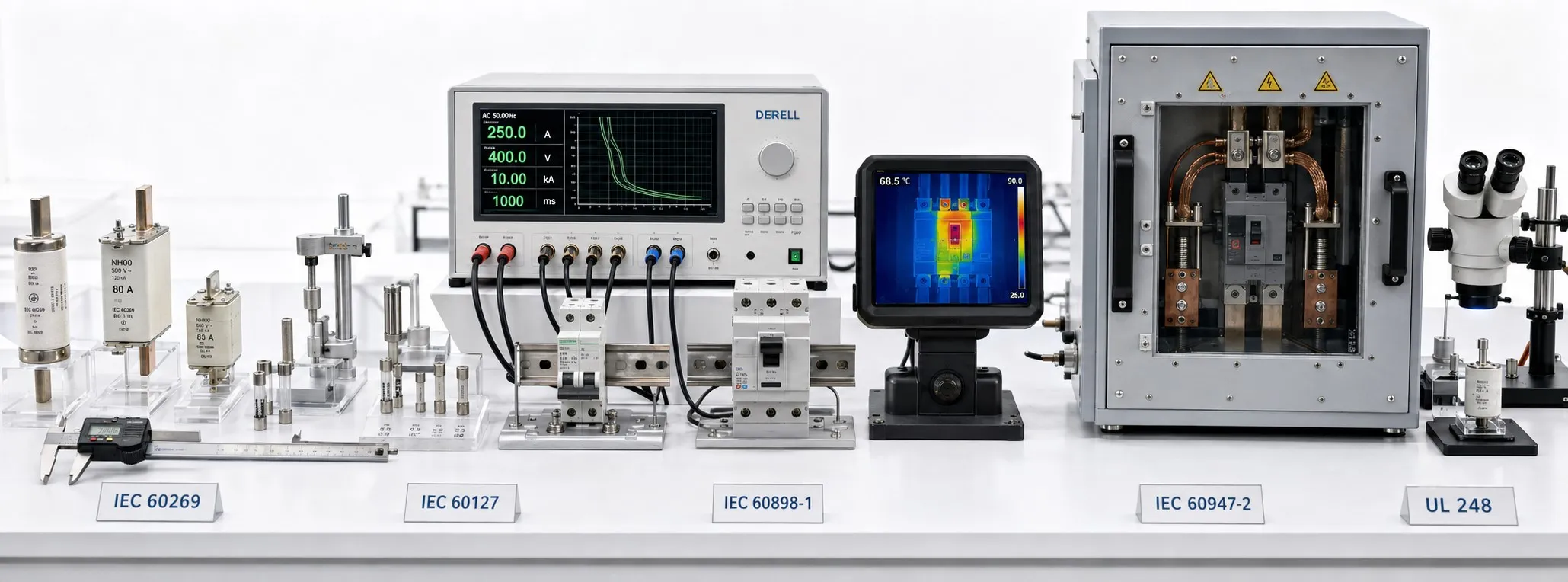
Fuse standards: IEC, UL, BS and correct protection selection
Fuse standards define how an electrical fuse carries current, opens a circuit and safely interrupts fault current. Rated current, rated voltage, breaking capacity, time-current characteristics and dimensions must be considered together. Two fuses with the same ampere rating are not necessarily interchangeable.
Which applications do IEC fuse standards cover?
IEC fuse standards: The IEC 60269 family covers low-voltage power and installation fuses. IEC 60269-1 provides general requirements. IEC 60269-2 addresses fuses for authorized persons, mainly in industrial applications; IEC 60269-3 addresses fuses for unskilled persons, mainly in household and similar applications.
IEC 60269-4 provides supplementary requirements for semiconductor protection fuses. IEC 60269-6 addresses solar photovoltaic systems, while IEC 60269-7 addresses batteries and battery systems. Application voltage and fault conditions are particularly important when selecting DC fuses.
IEC 60127 addresses miniature fuses used to protect appliances and electronic components. Glass or ceramic cartridge fuses and certain SMD fuse types are assessed under the appropriate parts of this family. A miniature appliance fuse should not replace an installation fuse merely because it fits the holder.
UL, BS and regional standards
UL fuse standards: The UL 248 family covers low-voltage fuse construction, markings and performance. UL 248-1 contains general requirements; other parts address specific fuse classes. UL Listed and UL Recognized Component are different approval statuses; a component's conditions of acceptability must be checked. CSA fuse standards are also relevant to Canadian applications.
BS fuse standards: The BS 88 family and BS 1362 address different applications in the United Kingdom. BS 1362 particularly covers fuse-links used in plugs. A plug fuse and an industrial fuse have different duties and selection requirements.
Europe and other regions: When assessing European publications associated with CENELEC or DIN/VDE fuse standards, check the complete designation and edition. AS/NZS standards are relevant to Australia and New Zealand. Different national approval marks do not establish automatic interchangeability.
What do gG, aM and fast-acting markings mean?
gG identifies general-purpose, full-range overcurrent protection, covering overload and short-circuit protection when correctly selected. aM is a partial-range category for short-circuit protection in motor circuits; separate overload protection is required. Starting current must also be considered for high-power loads.
aR and gR identify semiconductor protection categories with different current ranges. For miniature fuses, F denotes fast-acting and T time-lag characteristics. These markings help identify the appropriate fuse type, but F/T characteristics are not direct equivalents of gG/aM/aR utilization categories.
Which fuse ratings must be read together?
Rated current (In): This is a rating established under specified test and operating conditions, not a threshold just above which the fuse instantly melts. Assessing fuse rating against circuit load requires consideration of ambient temperature, inrush current and manufacturer derating factors.
Voltage rating and AC/DC suitability: The voltage rating must suit the circuit. An AC-only rating does not demonstrate suitability at the same numerical DC voltage. Breaking capacity is the fault current that can be safely interrupted under specified conditions; it must meet the prospective short-circuit current at the installation point.
Time-current curve and I²t: The curve relates operating time to current. I²t is the time integral of current squared, used to assess thermal stress; its unit is A²s. Pre-arcing and total clearing I²t are different values. Selectivity and sensitive-component protection require the manufacturer's curves and coordination data.
Dimensions, holder and power dissipation: Check mechanical compatibility and thermal suitability of both fuse-link and holder. Fuse-box maintenance also involves checking for loose connections and overheating. Correct fuse selection involves more than matching the ampere rating in a catalogue.
Which standards apply to circuit breakers?
IEC 60898-1 addresses AC circuit breakers for overcurrent protection in household and similar installations. IEC 60947-2 addresses low-voltage circuit breakers, including industrial applications. These differ from fuse standards. A miniature fuse's T time-lag marking and a circuit breaker's B/C/D tripping characteristics belong to different classification systems.
Testing, conformity and replacement
Depending on the standard and product type, tests assess temperature rise, power dissipation, current carrying, operating characteristics, breaking capacity and insulation. Test conditions and limits are not identical for every fuse. Match the product code, complete standard reference and verifiable approval documentation when purchasing.
Investigate why a fuse operated before increasing its rating. When fuse replacement is necessary, use a suitable product providing the required protection characteristics. Follow safe replacement procedures, disconnect the supply and verify absence of voltage. Standards compliance does not remove the need to investigate the original fault.
Technical sources: IEC 60269-1 · IEC 60127-1 · UL 248-1 · IEC 60898-1 · IEC 60947-2 · Eaton.