
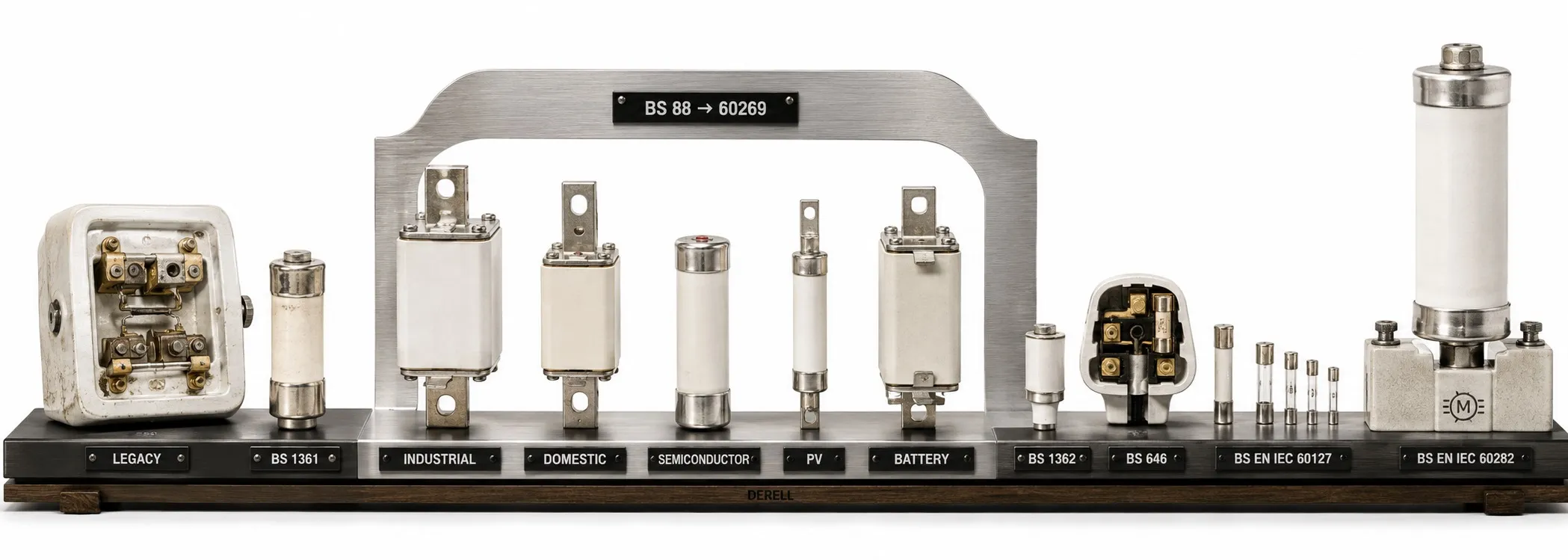
British Fuse Standards: Making Sense of BS Numbers
A BS number on a fuse tells you which technical specification the manufacturer references. It helps identify the product family, dimensional requirements and performance tests. It does not, by itself, establish whether that fuse is suitable for your circuit. With electrical fuses, matching the current rating is only one part of the selection process.
The most useful starting point is the application. A fuse for an industrial feeder, a replacement for an older consumer unit and a fuse fitted inside a British plug have different jobs. This guide places the main British specifications within the wider range of fuse standards and explains what to check before choosing a replacement.
| Reference | Where it applies | What to check |
|---|---|---|
| BS 88 | Several low-voltage fuse systems, including industrial applications. | The specific part, edition, fuse system and utilization category. |
| BS 1361 | Legacy AC cartridge fuses for domestic and similar premises. | Withdrawn standard; the relevant fuse system continued under BS 88-3. |
| BS 1362 | Domestic fuse-links up to 13 A, primarily for BS 1363 plugs. | Up to 250 V AC at 50/60 Hz; fuse bases and holders are outside its scope. |
| BS 646 | Fuse-links up to 5 A for specified plug and socket-outlet adaptor applications. | Two-wire circuits up to 250 V AC at 50 Hz or 250 V DC; not a general electronics fuse specification. |
Reading an Industrial Fuse Specification
You will often find BS 88 referenced on industrial fuse datasheets. The series includes different systems, so an order description that says only “BS 88, 100 A” can leave essential details unresolved. The mounting arrangement, voltage rating and protection characteristics still need to be specified.
Many British low-voltage fuse requirements align with the IEC 60269 family. For orientation, IEC 60269-2 addresses additional requirements for industrial fuse systems, while IEC 60269-3 covers systems mainly intended for household and similar applications. Always check the complete reference stated for the product.
Finding BS 1361 on Existing Equipment
BS 1361 was withdrawn on 1 March 2010. Its British cylindrical fuse system was carried forward under BS 88-3 as system C. The old marking remains useful when identifying installed equipment, but it should not be treated as a current specification for a new design.
A withdrawn standard does not automatically mean that every installed product bearing its number has failed. When deciding whether a fuse needs replacement, consider its condition, the equipment instructions and the protection requirements. Replacement compatibility needs to be established from product data.
Plug Fuses: BS 1362 and BS 646
For the familiar fused BS 1363 plug, the relevant fuse-link specification is BS 1362. The fuse contributes to protecting the appliance’s flexible supply cable. Following the appliance manufacturer’s stated rating is an important part of electrical safety at home.
BS 646 serves a different, more specific plug and adaptor application. It should not be used as an umbrella term for small glass or ceramic fuses on circuit boards. Miniature equipment fuses are also addressed by the IEC 60127 series. BSI currently lists BS 1362:1973+A3:2021 and BS 646:1958+A2:2013 as current publications.
Turning a Standard Reference into a Product Choice
Start with the circuit: Establish the operating current, conductor protection requirements and expected starting or charging current. The fuse current rating is not an instantaneous opening threshold. Consult the time-current curve when comparing fast-acting and time-delay fuses.
Check the fault conditions: The voltage rating must suit the circuit, and the breaking capacity must cover the prospective short-circuit current at the installation point. For DC fuse applications, use the manufacturer’s declared DC ratings rather than assuming an AC rating transfers unchanged.
Identify what needs protection: Cable protection and semiconductor protection can call for different fuse characteristics. On a variable frequency drive, follow the drive manufacturer’s specified fuse types and coordination requirements.
Confirm the hardware: Dimensions, terminal design and holder ratings must all match. A fuse that fits physically may still have unsuitable electrical characteristics. A complete fuse selection check brings these details together.
Does a BS Number Prove Independent Certification?
A standard reference and a certification mark provide different information. A BS number identifies a technical specification. Independent certification requires a separate assessment under a defined scheme. If a product carries an ASTA mark, verify the certificate, covered model and approval scope rather than relying on the logo alone.
British-standard compliance also does not automatically satisfy every overseas approval requirement. A project calling for UL fuse standards needs its own product and application checks. A sound specification connects the applicable standard to a particular product and a defined circuit.