
BS 1362 Plug Fuses: Ratings, Cable Protection and Replacement
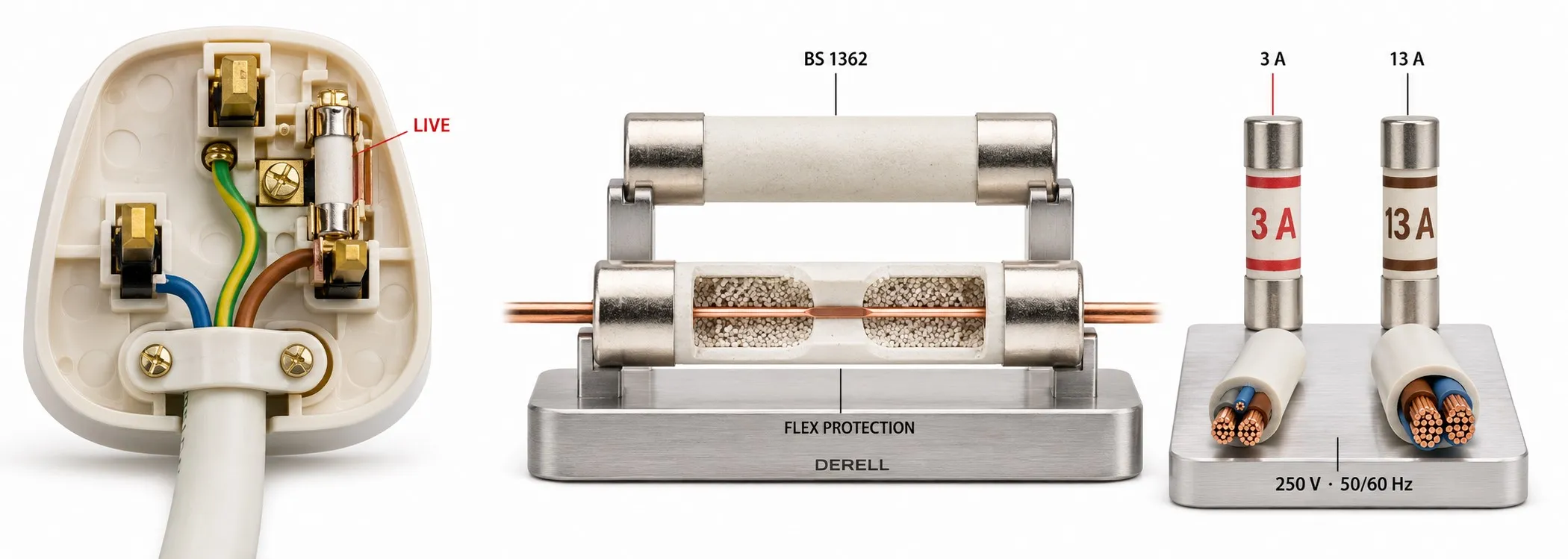
BS 1362 specifies general-purpose cartridge fuse-links for domestic and similar applications, primarily inside BS 1363 plugs. It covers ratings up to 13 A on declared supplies not exceeding 250 V AC at 50 or 60 Hz. Fuse bases and holders are outside its scope.
The familiar cartridge inside a UK three-pin plug is an overcurrent protection fuse. Its job is easily misunderstood: a plug marked “13 A” does not automatically require a 13 A fuse for every appliance connected to it.
BS 1362 and BS 1363 Describe Different Parts
Within the British standards system, BS 1362 identifies the fuse-link specification. BS 1363 addresses the associated plugs, socket-outlets and connection accessories through its relevant parts.
The current BSI reference is BS 1362:1973+A3:2021. Its requirements address dimensions, markings, ratings, power loss, time-current behavior and breaking capacity. Keeping the complete fuse standard reference in technical records avoids confusion between editions.
Why Put a Fuse in the Plug?
The plug fuse provides local overcurrent protection for the appliance's flexible supply cable. It can also interrupt certain appliance faults, but it should not be treated as a guarantee that every component inside the appliance will survive. Effective household electrical protection depends on several measures working together.
A fuse also performs a different function from residual-current protection. The distinction between an MCB, an RCD and an RCBO matters when assessing a fault. A BS 1362 fuse does not replace an RCD or the installation's other protective measures.
Choosing Between 3 A, 5 A and 13 A
3 A and 13 A are the most familiar plug-fuse ratings. Other ratings, including 5 A, remain relevant where specified. Select the fuse current rating from the appliance manufacturer's instructions and the intended cable arrangement.
| Rating | Colour code | What to remember |
|---|---|---|
| 3 A | Red | Common for lower-power appliances where specified. |
| 5 A | Black | Use where required; do not automatically substitute 13 A. |
| 13 A | Brown | Common for higher-power loads with a suitable lead and plug. |
Colour is an identification aid. Read the actual rating and product markings rather than relying on colour alone. The plug's maximum rating describes its capacity; the fuse fitted inside must suit the connected equipment and lead.
What a Wattage Calculation Can Tell You
Converting watts to amperes helps establish the expected load. For a resistive heater operating at 230 V, a 2300 W input corresponds to approximately 10 A, using I ≈ P / V.
That calculation is a starting point, not a complete fuse-selection method. Motors and electronic power supplies can draw starting or charging currents above their normal running current. Power factor may also affect the relationship between watts and amperes. The required fuse operating characteristic must be considered alongside the manufacturer's specified rating.
Size and Breaking Capacity Still Matter
BS 1362 plug fuses commonly use a cartridge approximately 6.3 mm in diameter and 25.4 mm long. A similar-looking cartridge is not necessarily suitable. Proper replacement fuse selection includes compliance, current rating, voltage, operating behavior and holder compatibility.
Breaking capacity concerns fault interruption. Manufacturers may declare a 6 kA breaking capacity for a BS 1362 product; that figure is entirely separate from its normal current rating. Read it with the voltage and conditions stated in the product data.
Neither a BS 646 accessory fuse nor a fuse identified under BS 88 becomes a suitable replacement merely because its amperage matches. Confirm the required fuse type. An AC-rated plug fuse should also not be assigned to a DC protection duty without supporting manufacturer data.
Why Can a Plug Overheat Without Blowing Its Fuse?
A loose or deteriorated contact can generate heat locally while the overall current remains below the level needed to operate the fuse. A hot plug or socket therefore needs attention even when the appliance continues to run.
The same distinction matters with an overheating extension lead. Its outlets share the lead's overall capacity. Several sockets do not multiply the permissible load, and the fitted fuse does not excuse exceeding the accessory's marked limits.
Checking and Replacing a Plug Fuse
Where a fuse has operated repeatedly, investigate the reason it keeps blowing. Unplug the appliance before accessing the fuse. Follow appropriate replacement precautions, use the specified rating and check for a loose carrier or heat damage.
A continuity check on an isolated, removed cartridge can help establish whether the fuse is open. It cannot prove that the cartridge is the correct product. When comparing replacement fuse products, use the markings, manufacturer reference and equipment instructions rather than appearance alone.