
IEC fuse standards
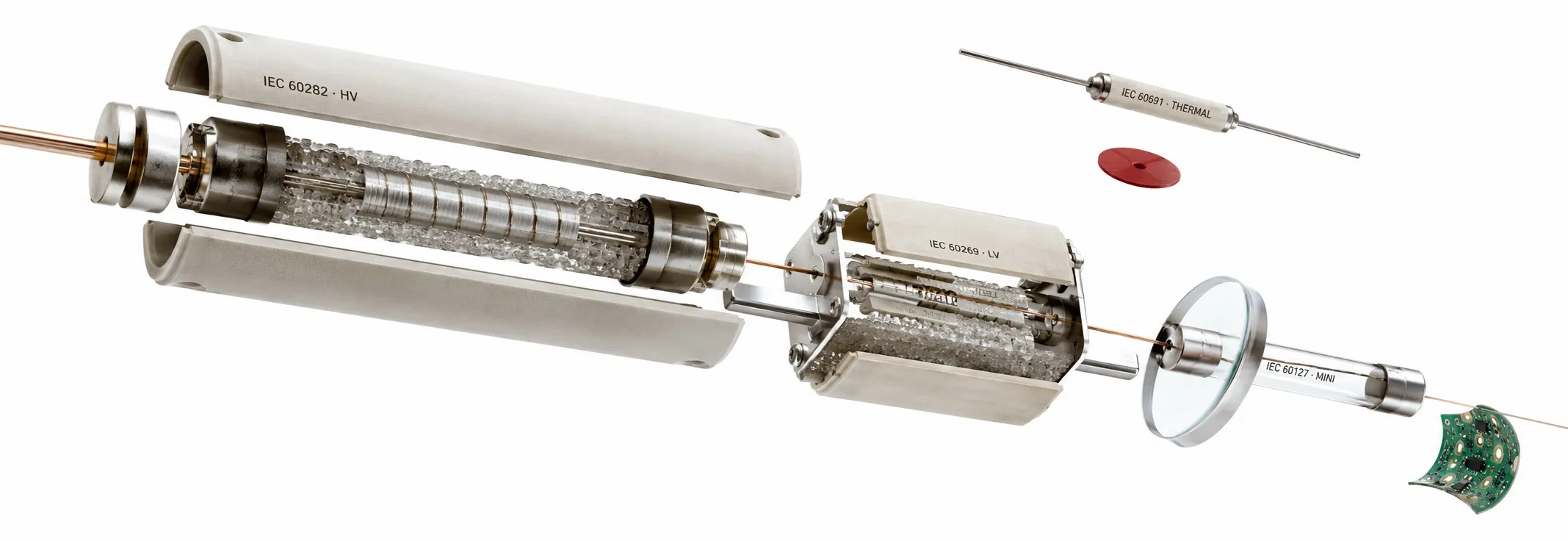
IEC standards for electrical fuses
IEC fuse standards define how an electrical fuse carries current and safely interrupts fault current. IEC 60269 is the principal family for low-voltage power and installation fuses; IEC 60127 addresses miniature fuses protecting appliances and electronic components. The correct family depends on the fuse type and its intended duty.
The parts of IEC 60269
IEC 60269-1 — General requirements: Establishes requirements such as markings, current carrying, temperature rise and breaking performance for low-voltage fuses within its scope. Application-specific parts of IEC 60269 are assessed alongside the general requirements. Part 1 does not cover every fuse technology.
IEC 60269-2 — Fuses for authorized persons: Provides supplementary requirements for systems used mainly in industrial fuse applications. Access to fuse-links and their replacement are addressed under conditions intended for authorized persons.
IEC 60269-3 — Fuses for unskilled persons: Addresses specified standardized fuse systems mainly for household and similar applications. The 2024 edition applies to gG fuses only. The distinction is the protective construction appropriate to users' technical knowledge and experience, rather than a classification of the installation as “low risk.”
IEC 60269-4 — Semiconductor protection: Defines supplementary requirements for semiconductor protection fuses in power electronic equipment. I²t, current limitation and manufacturer coordination data must be assessed. A standard designation alone does not establish suitability for every drive or semiconductor.
IEC 60269-6 — Photovoltaic systems: Addresses supplementary requirements for fuse-links protecting PV strings and arrays. IEC 60269-7 — Battery systems: Addresses protection of batteries and battery systems. These applications require assessment of DC fuse suitability, system voltage and fault current together.
IEC 60127: appliance and miniature fuses
IEC 60127-1 establishes general requirements and tests for miniature fuse-links. Other parts address cartridge, subminiature and modular types; IEC 60127-6 addresses miniature fuseholders. For certain SMD fuses, check the applicable part and product documentation. A small appliance fuse is not automatically a substitute for an installation fuse.
gG, aM, aR and F/T markings
gG identifies general-purpose full-range overcurrent protection. aM identifies a partial-range category used for short-circuit protection in motor circuits; separate overload protection is required. aR identifies partial-range semiconductor protection. The appropriate fuse type depends on the protected component's withstand capability and load behaviour.
On miniature fuses, F means fast-acting and T means time-lag. These characteristics are a different classification from gG/aM/aR categories. For high-power equipment and loads with substantial inrush, starting pulses must be assessed alongside normal operating current.
How should a fuse be selected?
Rated current is established under specified standard conditions; it does not mean the fuse opens instantly just above that value. When assessing fuse rating against circuit load, consider ambient temperature, inrush current, the time-current curve and manufacturer derating factors.
Voltage rating and breaking capacity must suit the circuit. An AC voltage rating does not establish suitability at the same numerical DC voltage. Breaking capacity must meet the prospective short-circuit current at the installation point. Fuse selection requires more than comparing ampere ratings.
Fuseholder compatibility, connections and power dissipation also matter. An otherwise suitable fuse may not provide the intended protection in an incompatible or overheating holder. Fuse-box maintenance should therefore include assessment of mechanical and thermal suitability.
Are circuit breakers covered by the same standards?
No. IEC 60898-1 addresses AC circuit breakers for household and similar installations, while IEC 60947-2 addresses low-voltage circuit breakers. A fuse's utilization category and a circuit breaker's tripping curve belong to different classification systems.
Conformity documentation and replacement
IEC publishes standards; an “IEC certified” claim alone is insufficient documentation. Match the product code, complete standard designation and edition, test report and any independent approval. UL and VDE markings must be assessed under their approval conditions. Check the relationship between European standards and IEC publications in the relevant document.
When fuse replacement is necessary, preserve the equivalent characteristics specified by the manufacturer. Disconnect the supply, verify absence of voltage and follow safe replacement procedures. Increasing the ampere rating without proper assessment to prevent repeated operation can compromise cable and equipment protection.
Official sources: IEC 60269-1 · IEC 60269-3 · IEC 60269-4 · IEC 60127-1.