
UL Standards for Fuses: A Practical Guide to Classes, Ratings and Certification
A specification that calls for a “UL fuse” leaves several important questions unanswered. Which circuit needs protection? Is the duty branch-circuit protection, supplementary protection or a specialized application? What voltage and fault current must the fuse handle?
UL fuse requirements provide a framework for evaluating construction and performance. The correct product still has to be matched to the equipment and its operating conditions. Compliance with a standard does not make a fuse suitable for every circuit.
Start by Separating Standards from Certification
UL Standards & Engagement develops standards. UL Solutions provides testing, inspection and certification services. A manufacturer's statement that a product complies with a UL standard is not, by itself, proof of UL certification.
When reviewing fuse standards, check the exact catalog number against the product's markings, technical documentation and certification record. The standard identifies the requirements; the product documentation identifies the ratings and conditions that apply to the item being purchased.
How the UL 248 Series Is Organized
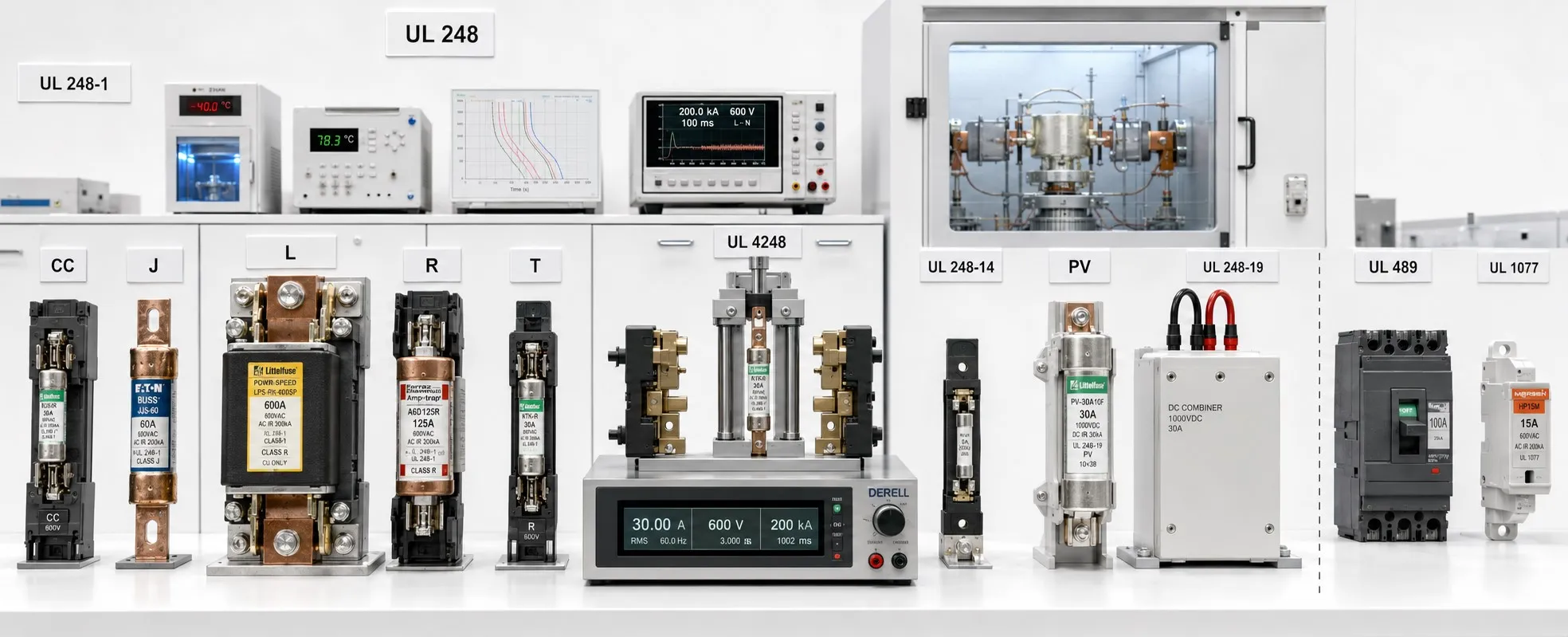
UL 248-1 sets out general requirements for low-voltage fuses. Other parts address specific classes or applications and can supplement or modify the general requirements. Read the applicable documents together.
The familiar UL 248-2 through UL 248-19 group covers many established fuse types. The family also includes documents for electric-vehicle and battery protection, so Part 19 should not be presented as the end of the series.
| Document | Subject | Selection significance |
|---|---|---|
| UL 248-1 | General requirements. | Provides the foundation for the applicable fuse part. |
| Class-specific UL 248 parts | Examples: 248-4 Class CC, 248-8 Class J, 248-10 Class L, 248-12 Class R and 248-15 Class T. | Define requirements for the selected fuse class. |
| UL 248-13 | Semiconductor fuses. | Relevant to specialized power-electronics protection. |
| UL 248-14 | Supplemental fuses. | Cannot substitute for required branch-circuit protection. |
| UL 248-19 | Photovoltaic fuses. | Addresses fuses intended for PV applications. |
| UL 248-20 | Outline of Investigation for electric-vehicle fuses. | Concerns EV power-circuit applications; retain the correct document designation. |
| UL 248-21 | Fuses for batteries and battery systems. | Addresses protection requirements specific to battery applications. |
| UL 4248 series | Fuseholders. | The holder needs its own suitability and compatibility assessment. |
Recognize Legacy References in Older Manuals
UL 198G concerns historical supplementary overcurrent fuse protection. UL 198L concerns historical industrial DC fuse requirements. OSHA includes both in its list of test standards no longer recognized.
These references can help interpret an older machine's documentation. For a replacement, establish the manufacturer's current recommendation and verify the electrical characteristics and certification. Updating a standard number on a drawing does not establish product interchangeability.
Read the Ratings as a Set
Current rating: The ampere rating describes current carrying under specified conditions. It is not an instantaneous opening threshold. Load behavior, temperature and the time-current characteristic all affect selection.
Voltage and current type: AC and DC ratings are not interchangeable. For DC circuits, verify the stated DC voltage, interrupting rating and applicable circuit conditions.
Interrupting rating: This describes the available fault current the fuse can safely interrupt under its specified conditions. It is separate from the continuous current rating and must cover the circuit's available fault current at the applicable voltage.
Opening characteristic: Fast-acting and time-delay fuses can respond differently to startup demand. Read the opening characteristic alongside the class and ampere rating rather than treating any one of them as a complete specification.
Drives and Semiconductors Need Equipment-Specific Coordination
For a variable frequency drive or servo drive, follow the manufacturer's permitted fuse class, maximum ampere rating and short-circuit conditions. Motor power alone is not enough to identify a suitable fuse.
With semiconductor fuses, total clearing I²t and peak let-through current can also govern coordination. Interrupting a fault does not guarantee that every power semiconductor survives it. Establish the intended protection from the equipment and component documentation.
Component Certification Does Not Establish Panel SCCR
A certified fuse does not make the complete control panel certified. Its interrupting rating also does not become the panel's short-circuit current rating, or SCCR, simply because it is installed upstream.
For UL 508A industrial control panels, assess the components and their permitted protective-device combinations. The Supplement SB method provides a framework for determining the assembly rating.
Comparing UL, IEC and VDE Documentation
IEC 60269 utilization categories and UL fuse classes cannot be matched solely by their names or current ratings. Likewise, VDE fuse requirements must be read within their own document structure.
A product may satisfy multiple standards, but the evidence must apply to the exact model. Also distinguish UL Listed from UL Recognized Component: a Recognized component can have conditions of acceptability that must be addressed within the finished equipment.