
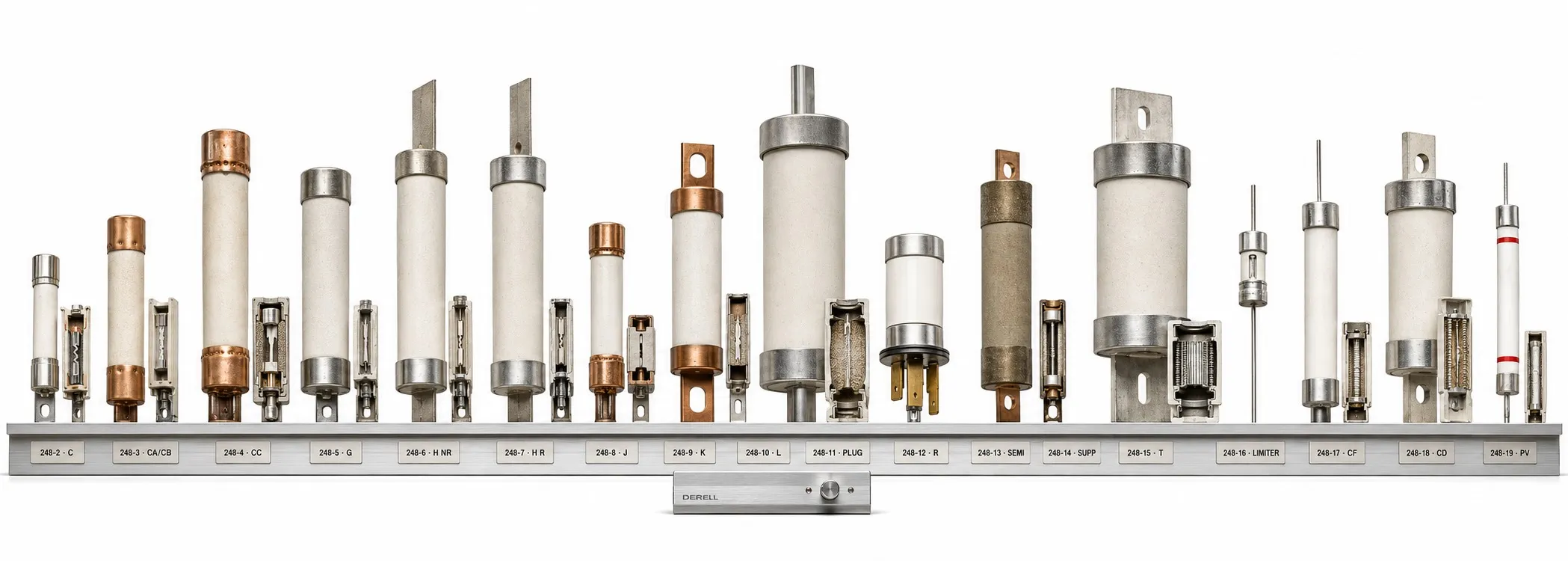
UL 248-2 Through UL 248-19: Finding the Right Fuse Category
The part number in UL 248 identifies a fuse class or a specialized product category. Part 8 covers Class J fuses, Part 13 addresses semiconductor fuses, and Part 19 covers photovoltaic fuses. The sequence is a document structure, not a ranking of protection quality or power capability.
When working with UL fuse standards, begin with UL 248-1 general requirements and then identify the relevant product part. Read the common requirements alongside any additions or modifications in that part.
Complete Map of Parts 2–19
| Document | Fuse class or subject |
|---|---|
| UL 248-2 | Class C |
| UL 248-3 | Classes CA and CB |
| UL 248-4 | Class CC |
| UL 248-5 | Class G |
| UL 248-6 | Class H, non-renewable |
| UL 248-7 | Class H, renewable |
| UL 248-8 | Class J |
| UL 248-9 | Class K |
| UL 248-10 | Class L |
| UL 248-11 | Plug fuses |
| UL 248-12 | Class R |
| UL 248-13 | Semiconductor fuses |
| UL 248-14 | Supplemental fuses |
| UL 248-15 | Class T |
| UL 248-16 | Test limiters |
| UL 248-17 | Class CF — published as an Outline of Investigation |
| UL 248-18 | Class CD |
| UL 248-19 | Photovoltaic fuses |
This table is an index to the documents. It does not assign a common voltage, current range or interrupting rating to every category. Check the applicable edition and the actual product data. The wider UL 248 family also includes documents beyond Part 19, including electric-vehicle and battery applications.
A Fuse Class Is More Than a Letter on the Label
Classes such as C, CC, J, L and T identify different requirements for industrial fuses, including their physical and electrical characteristics. Class C and Class CC are distinct categories. Similar names do not establish interchangeability.
The class designation also needs to be read alongside the product's fast-acting or time-delay characteristic. Do not assume that every model within a class has an identical operating curve. Comparing different fuse types requires the manufacturer's time-current and application data.
“Renewable” Does Not Mean Self-Resetting
Part 6 addresses non-renewable Class H fuses; Part 7 addresses renewable Class H fuses. In a renewable design, the fusible element can be replaced using the manufacturer's specified components and procedure. The fuse does not automatically reset. Improvised wire repairs are not an acceptable interpretation of renewable construction.
Class G Can Have a DC Rating
UL 248-5 permits optional DC ratings. Consequently, the statement that Class G is always AC-only is incorrect. For a DC fuse application, verify the particular product's DC voltage and interrupting ratings. Optional coverage in a standard does not mean every product carries that rating.
Part 14: Supplemental Protection Has a Defined Role
A branch circuit runs from its final overcurrent protective device to the outlets or loads it supplies. The required protection for that circuit must be provided by an appropriate branch-circuit protective device.
UL 248-14 supplemental fuses are not substitutes for required branch-circuit protection. A fuse inside equipment may protect a particular internal section while an upstream protective device serves the supply circuit. Physical size alone does not determine which role a fuse is qualified to perform.
Three Specialized Parts Worth Recognizing
UL 248-13 — semiconductor fuses. These semiconductor protection devices must be selected for the equipment involved. With a variable frequency drive or servo drive, use the manufacturer's specified fuse and coordination data. Semiconductor protection does not automatically satisfy every other circuit-protection duty.
UL 248-16 — test limiters. This part addresses devices calibrated to specified peak let-through current and clearing I²t limits. Its purpose is tied to testing; it should not be treated as a catalogue of ordinary replacement fuses.
UL 248-19 — photovoltaic fuses. This part covers protection of PV strings, arrays and associated wiring within the product's marked ratings. A general DC voltage marking alone does not establish suitability for photovoltaic service.
Fuse Interrupting Rating Does Not Set the Panel SCCR
For an industrial control panel assessed under UL 508A, distinguish the fuse's interrupting rating from the assembly's short-circuit current rating, or SCCR. Installing a fuse with a 200 kA interrupting rating does not automatically give the panel a 200 kA SCCR.
The components and protective arrangement must be assessed together. Where applicable, use the UL 508A Supplement SB method and documented combination ratings. Adding a current-limiting fuse does not, by itself, establish the result.
What to Compare Before Approving a Substitute
Start with the required protection duty and fuse class. Then compare the ampere rating, voltage, AC/DC suitability, interrupting rating, operating curve and holder compatibility. Include I²t, peak let-through and selectivity data where the fuse selection requires them.
The gG or aR designations used within the IEC 60269 framework do not map directly onto UL Class J or Class R. If a product has been evaluated under both systems, confirm the relevant ratings and approvals in its documentation.
Reading UL 198G and UL 198L in Legacy Manuals
UL 198G is a historical reference for supplementary overcurrent protection fuses. UL 198L addressed DC fuses for industrial use. When reviewing older equipment, use these references to understand the original documentation, then establish the applicable UL 248 part and the replacement product's supporting evidence.