
What safety precautions should be taken when changing a fuse?
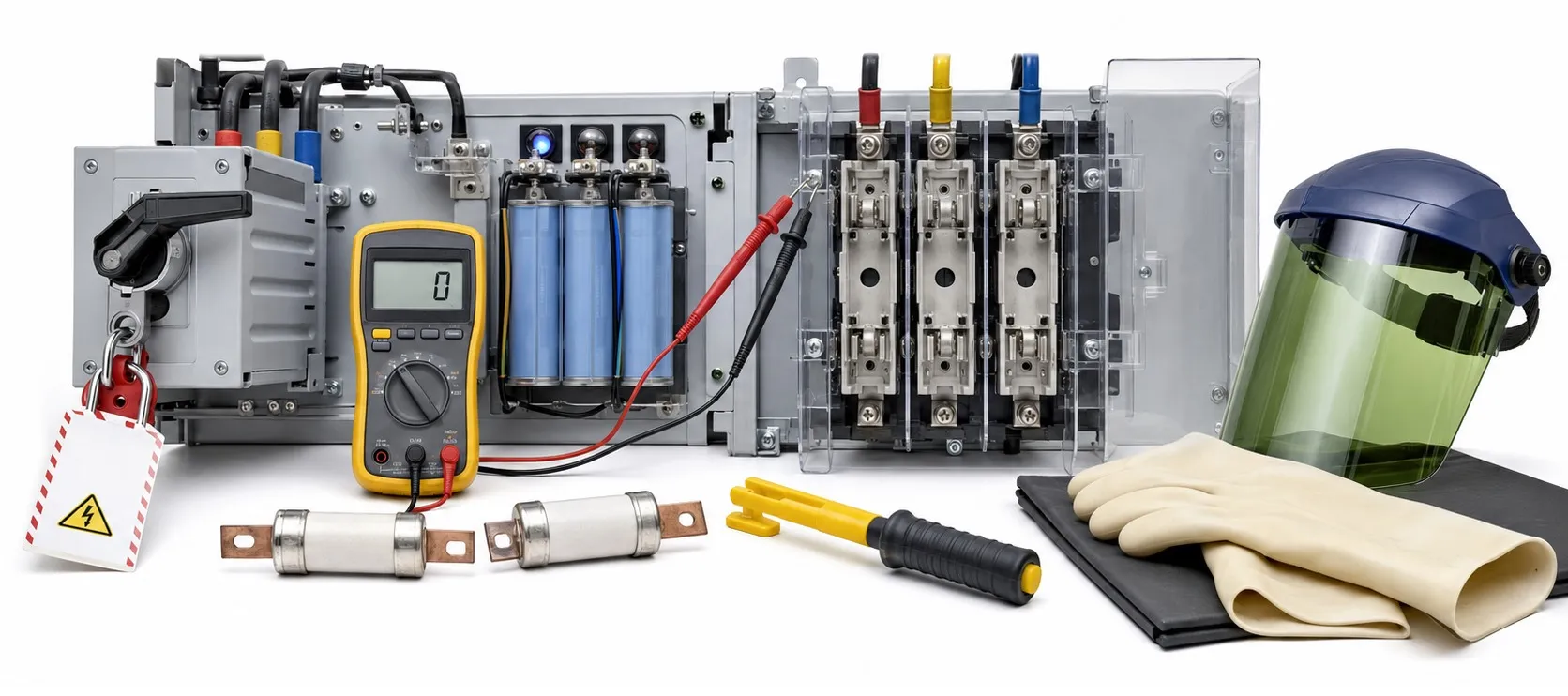
What safety precautions should be taken when replacing a fuse?
Before replacing a fuse, isolate the work area from every supply, prevent re-energisation and verify the absence of voltage with suitable equipment. Work involving removal of panel covers, access to wiring terminals or replacement of a circuit breaker should be performed by a competent electrical professional. Replacing a fuse differs from resetting a circuit breaker; operation does not automatically mean the protective device needs replacement.
Establish why the fuse operated
A blown fuse may result from overload, a short circuit or a connection problem. If operation occurs when a particular appliance starts, assess that appliance and its circuit. Do not repeatedly fit new fuses and restore power without addressing the fault. Burning smells, melted parts, discolouration or arc marks require assessment before the installation is used again.
Disconnect every source of electrical energy
Identify suitable isolation points using circuit drawings and equipment instructions. Consider generators, UPS systems, solar supplies, batteries and separate control supplies alongside the mains. The incoming terminals of a main switch may remain live when the switch is off. An emergency stop button, an HMI stop command or an open contactor alone does not provide safe electrical isolation. Do not use a fuse or fuse carrier to interrupt a load unless its suitability for that purpose is explicitly specified.
Prevent unexpected re-energisation
Apply appropriate locks and warning tags at the isolating devices, keeping control of the keys with the people doing the work. Where several people are involved, use an arrangement that protects everyone. Telling others not to operate a switch does not replace physical lockout. Also control remote commands and automatic restart possibilities.
Verify the absence of voltage at the work location
A competent person should use a suitable two-pole voltage detector to verify the absence of voltage on all relevant conductors at the work location. Prove the detector's operation before and after use, preferably with an appropriate proving unit. A single-pole tester or non-contact detector alone cannot establish that a circuit is dead. The detector and probes must have suitable voltage ratings, measurement categories and sound insulation. Do not start work if the absence of voltage cannot be verified. Access to nearby live parts must also be safely prevented.
Account for stored energy
Capacitors in drives, UPS systems and power supplies can retain dangerous voltage after disconnection. Observe the manufacturer's waiting period and verify a safe condition at the specified test points. A blank display or extinguished LED is insufficient; there is no universal waiting time for every device. Shorting capacitor terminals with a screwdriver is not a safe discharge method. Perform fuse continuity tests only after isolation and verification of a safe condition.
Select the correct replacement
Use the manufacturer's specified part or a verified equivalent. Check fuse type, rated current, voltage, AC/DC suitability, breaking capacity, operating characteristic and dimensions together. Fast-acting and time-delay fuses with the same ampere rating are not automatically interchangeable. Follow product selection requirements and relevant fuse standards. Replacing a 16 A fuse with a 20 A fuse, fitting thicker wire or bypassing the fuse does not resolve a fault. Protection must remain coordinated with cable cross-section and current-carrying capacity.
Inspect the holder, connections and working environment
A new fuse does not repair a loose, cracked or burnt holder, or restore damaged contact spring pressure. Inspect the fuse box and connections and replace damaged components appropriately. Use the specified fuse extraction tool, insulated tools and connection torque. Keep the area dry, well lit and access controlled. Select personal protective equipment for the electric shock and arc hazards involved; ordinary work gloves or an RCD do not replace safe isolation.
Restore power under controlled conditions
After completing the work, check connections, remove tools and refit covers and protective barriers. Inform everyone concerned and remove locks according to the workplace procedure. Restore power only after the required checks are complete. If the replacement fuse operates again, stop further attempts. A protective device that immediately operates again requires fault investigation. Record the replacement component and identified problem in the maintenance log.