
Is a neon voltage tester reliable? Comparison with a non-contact voltage tester
Can you trust a neon tester screwdriver? Non-contact voltage tester vs multimeter
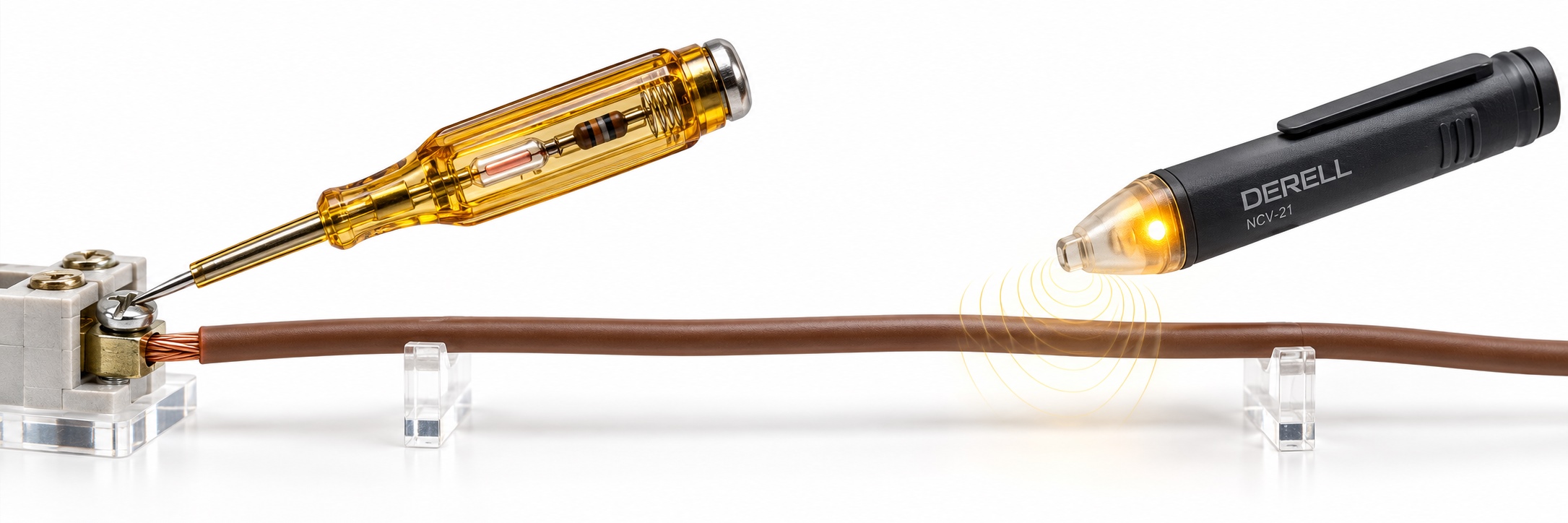
A neon tester screwdriver, a non-contact voltage tester and a multimeter answer three different questions. A traditional neon screwdriver provides a crude indication when it is in contact with a live conductor under suitable conditions. A non-contact voltage tester, often called an NCVT, senses the alternating electric field around a conductor without making a metallic connection. A multimeter can measure the actual voltage between two defined points.
The key point: both the neon screwdriver and the NCVT are useful screening tools, but neither should be treated as proof that a circuit is dead simply because it does not indicate voltage.
Voltage is a potential difference. A tester screwdriver does not tell you whether the circuit is at 180 V, 230 V or 250 V with useful measurement accuracy; it simply gives an indication under the conditions in which its detection method works.
How a traditional neon tester screwdriver works
A traditional phase-test screwdriver normally contains a high-value resistor and a small neon indicator. The tip touches the conductor and the user touches the contact at the rear of the tool, allowing a tiny current path to develop through the tester and the user's capacitive or electrical coupling to the surroundings.
That operating principle immediately tells you why it is not a precision instrument. Footwear, flooring, gloves, humidity and the user's coupling to earth can affect the indication.
It is a phase indicator, not a voltmeter. If you need a numerical voltage, use an appropriate method described in how voltage is measured.
Why can a neon screwdriver fail to light?
There may be voltage present while the indicator remains dim or off because the return path through the user and surroundings is too weak for a useful indication.
That is why “no light = definitely dead” is not a safe conclusion.
When you need an actual AC reading, the measurement is a different task: see how AC voltage is measured with a multimeter.
Can a phase tester light on neutral?
It can. Neutral is not a magic conductor that is guaranteed to sit at exactly zero volts at every point.
Load current, loose connections, a broken neutral, wiring errors and capacitive coupling can all create unexpected voltage on a conductor believed to be neutral.
For that fault path, see why voltage can appear on neutral and neutral versus protective earth.
What a non-contact voltage tester actually detects
An NCVT senses the alternating electric field around an energised conductor. The sensor does not need a metal-to-metal connection with the wire.
That makes it very convenient for quickly scanning insulated cables, outlets and equipment before moving on to a more specific test.
The trade-off is that it does not directly measure the voltage between two defined points. Its response depends on field strength, detection range, cable depth, shielding and the geometry around the conductor.
Does an NCVT detect DC?
A standard non-contact voltage pen is primarily an AC electric-field detector. It should not be expected to diagnose a battery or ordinary steady DC supply in the same way.
For 5 V, 12 V, 24 V and battery systems, use an appropriate DC voltage measurement.
The electrical reason begins with the difference between AC and DC.
Why can an NCVT indicate a wire that is not actually energised?
Because it responds to an electric field rather than making a direct two-point voltage measurement.
A disconnected conductor running beside a live wire can be capacitively coupled to it. The resulting field may be enough to trigger the tester.
This is closely related to ghost or phantom voltage.
And why can it miss a genuinely live conductor?
A weak electric field, shielded cable, deep conductor, unsuitable detection range, flat battery or poor tester position can all prevent an indication.
So silence from an NCVT is not proof of absence of voltage.
Checking the tester against a known live source is a useful functional check, but it does not turn the NCVT into a dedicated proving-dead instrument.
NCVT versus multimeter
An NCVT tells you that an AC electric field may be present. A multimeter, correctly connected, tells you the voltage between two test points.
That difference is crucial when a cable gives an unexpected indication. The NCVT may be doing exactly what it was designed to do while still not answering the question you actually need answered.
For numerical measurements, continue with AC voltage measurement.
Which one is safer?
They are different tools, so the comparison needs context.
The NCVT has the advantage of not requiring direct metallic contact during a quick AC-field check. A multimeter provides far more information, but the probes make direct contact and the instrument, leads and test method must be suitable for the installation.
That is why CAT ratings and the wider EN 61010 safety framework matter when test equipment is used on mains circuits.
Ghost voltage explains many “mystery live wire” readings
Capacitive coupling between nearby conductors can leave a floating wire at a measurable potential even though it is not connected to a low-impedance power source.
A high-impedance digital meter may display that voltage, and an NCVT may react to the associated field.
Do not automatically dismiss every unexpected voltage as phantom voltage. A wiring fault, neutral fault or genuine supply must be ruled out first.
See phantom voltage in cables and sockets.
Where LoZ fits in
Some multimeters provide a low-impedance, or LoZ, voltage function. It puts a greater electrical load on the test point than the normal high-impedance voltage input.
A weak capacitively coupled phantom voltage may collapse under that load, helping distinguish it from a low-impedance source.
LoZ is not automatically the “better” voltage function for every circuit. It can load sensitive electronic outputs, so the circuit needs to be understood before it is used.
A phase tester cannot tell you whether a socket is healthy
If a neon screwdriver lights at one socket contact, all you know is that its detection conditions were met there.
The neutral could still be open, the connection could be resistive, or the voltage could collapse when an appliance is connected.
For a proper voltage discussion, see checking socket voltage with a multimeter. If the socket appears dead while the breaker remains on, continue with no power at a socket but the breaker has not tripped.
Can either tester prove that protective earth is sound?
No. An indication between line and earth does not prove that the protective conductor has the required low-impedance fault path.
Earthing needs the appropriate installation test. For the conceptual side, see how earthing at a socket is identified and what live, neutral and earth mean.
What if the tester indicates voltage on a metal appliance casing?
Do not use the indication alone to diagnose the fault. Capacitive coupling is possible, but so is a genuine insulation or earthing problem.
Unexpected voltage on accessible metal deserves proper investigation before the equipment is used again.
See why an appliance's metal casing can give an electric shock and what electric shock is.
Can a tester screwdriver check an RCD?
No. It cannot measure RCD trip current or trip time.
Earthing and residual-current protection also perform different functions. The distinction is covered in whether an RCD works without earthing.
Can an NCVT find a broken cable?
It can sometimes help narrow down the area where an AC field disappears, but that is not the same as a continuity test.
Capacitive coupling can even make the detector respond beyond a physical break in the conductor.
For a de-energised conductor, use continuity testing and fuse and broken-cable testing.
What about 5 V, 12 V and 24 V control circuits?
A mains-style phase tester is the wrong tool for ordinary low-voltage DC electronics.
A 24 V PLC supply or 12 V control circuit should be checked with a suitable DC voltage measurement.
No indication from an NCVT does not mean that a 24 V DC system is dead.
Can an NCVT identify the live core inside a multicore cable?
Not with certainty in every installation.
Closely packed conductors influence the electric field around one another. Shielding, conduit and cable geometry can also change what reaches the tester.
Treat it as a proximity indicator, not a precision conductor-identification instrument.
Can the brightness or beep rate tell you whether the supply is 220 V or 230 V?
No. The brightness of a neon tester or the response intensity of an NCVT is not a calibrated voltage measurement.
For the terminology, see 220 V versus 230 V. For an actual voltage reading, use the appropriate AC voltage measurement.
Does a voltage pen measure frequency?
No. A tester may be designed to respond to ordinary mains-frequency electric fields, but that does not make it a frequency meter.
For frequency itself, see what 50 Hz means and how it differs from 60 Hz.
Do not use an NCVT alone to prove a circuit dead
No indication is not the same as proof of isolation.
A safe-isolation process identifies and disconnects every relevant source, prevents reconnection and verifies absence of voltage with an appropriate test method. The voltage indicator itself is checked before and after the verification.
A non-contact tester is useful as an early warning and screening device. It is not the final authority for declaring exposed conductors safe to touch.
Test-equipment suitability also matters, including the measurement environment described by CAT ratings and the broader EN 61010 framework.
Which tool should you reach for?
Quickly screening an insulated cable for an AC field: a suitable NCVT can be useful.
Simple phase indication: a neon tester screwdriver provides limited information.
Finding the actual voltage between two points: use a suitable multimeter or purpose-designed voltage indicator.
Checking socket voltage: see socket voltage measurement.
Finding an open conductor: use continuity testing on a properly de-energised circuit.
Measuring current: use the appropriate series current measurement or clamp meter.
Proving a circuit dead for work: neither a neon screwdriver nor an NCVT alone is sufficient; use the proper safe-isolation procedure and suitable voltage-indicating equipment.
The takeaway: a neon screwdriver is a contact phase indicator, an NCVT is an AC electric-field detector, and a multimeter is a measurement instrument between defined electrical points. Confusing those jobs is how useful indicators become misleading ones.