
What is a short circuit? Understanding the fault and the protection
A short circuit is an unintended connection with very low resistance or impedance between conductive points that should remain separated. It can bypass the intended load and allow a much larger electric current to flow. The available fault current depends on the source and the complete fault path, not just the point where two conductors touch.
A short circuit is different from an overload
An overload draws excessive current through the normal circuit path. Too many high-power appliances on one circuit can cause this without an unintended connection between conductors. A short circuit creates an abnormal path. Understanding the roles of live, neutral and earth helps distinguish line-to-neutral, line-to-line and earth faults.
An earth fault involves an unintended connection to an exposed metal part, a protective conductor or earth. Its current depends on the earthing arrangement and fault-loop impedance. Neutral and earth perform different functions and should not be treated as interchangeable conductors. Appropriate protective grounding is part of the overall protection scheme.
Why fault current can become so large
For a simple resistive circuit, Ohm’s law gives I = V / R. An ideal 12 V supply connected to a 6 Ω load produces 2 A. A separate fault path of 0.2 Ω across the same voltage would carry a calculated 60 A. Current is measured in amperes.
This is an explanatory calculation, not a practical test. A real battery or power supply has internal impedance; cables, contacts and protective functions also affect the result. AC fault calculations use the total circuit impedance. Measuring the resistance at one damaged connection does not establish the prospective fault current of an installation.
What happens to the normal load?
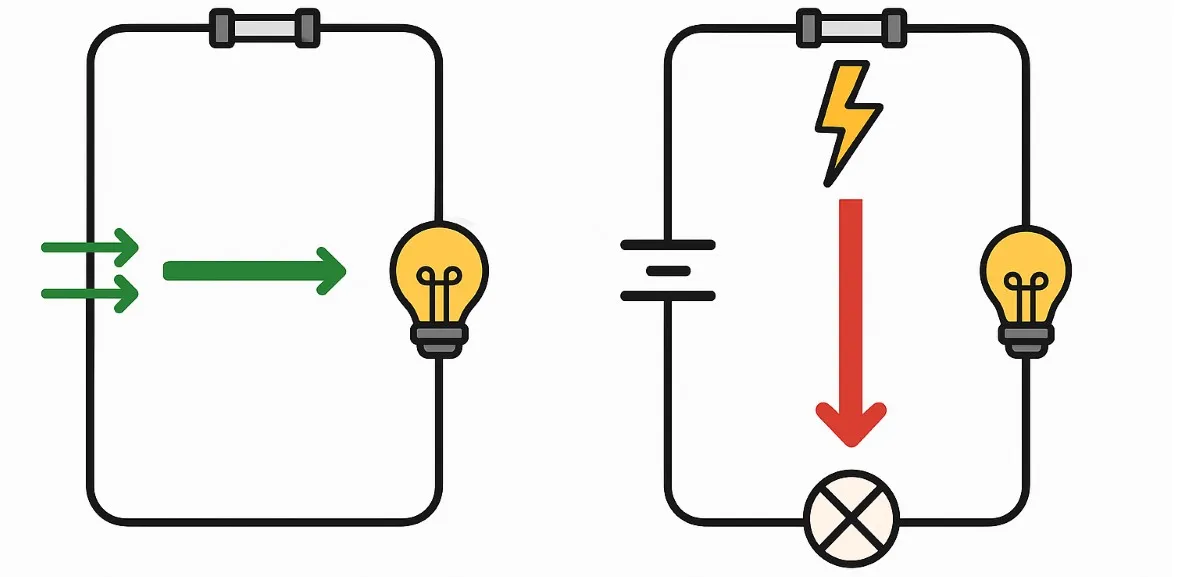
Before the fault: A supply, a lamp and a return conductor form a complete circuit. Current flows through the lamp, which operates normally under suitable conditions.
When a low-resistance path appears across the lamp: Much of the current may flow through that new branch. Current does not choose one route and ignore every other route. It divides between conductive paths according to their electrical characteristics. Whether the lamp dims or goes out depends on the voltage remaining across it.
When the series fuse opens: In this simple example, the supply is disconnected from both branches, so source current stops flowing through the lamp and the fault path. Opening the fuse interrupts the fault; it does not repair the damaged circuit.
What fuses, breakers and residual-current devices protect against
A suitable fuse or circuit breaker interrupts excessive current to limit dangerous heating and damage. Selection must consider the current-carrying capacity of the cables, operating voltage, trip characteristics and available fault current. Successful interruption does not guarantee that every component remains undamaged.
Ground-fault protection addresses a different hazard. A residual current device, or RCD, detects an imbalance between the currents in the conductors passing through it. An RCCB without overcurrent protection does not provide overload or short-circuit protection by itself. An RCBO combines residual-current and overcurrent protection. The differences between MCBs, RCDs and RCBOs matter when assessing a protective device.
During a line-to-neutral short circuit, current may leave and return through the same residual-current device without producing the imbalance needed to operate its residual-current function. Having an RCD does not mean every short circuit will trip it. The required functions must be provided by a correctly coordinated protection scheme.
Why 16 A and 6 kA mean different things
Rated current and short-circuit breaking capacity are separate characteristics. A marking of 16 A concerns rated current; a marking of 6 kA describes a breaking capability of 6000 A under specified test conditions. It does not mean the device can carry 6000 A continuously.
The breaking capacity must be appropriate for the prospective fault current, taking account of any verified coordination with other protective devices. These example ratings are not a device-selection recommendation. Increasing the current rating to stop repeated trips can leave the circuit inadequately protected.
Common causes: Damaged insulation, faulty connections and components
Crushed cables, worn insulation, incorrect wiring, exposed strands and conductive debris can create an unintended connection. Moisture can also compromise insulation. On electronic assemblies, failed power devices such as a MOSFET or IGBT may develop a low-resistance failure path.
A loose connection is not automatically a short circuit. It may first increase contact resistance, causing local heating or arcing, which can subsequently damage insulation. Suitable connectors and terminal blocks, correct assembly and the manufacturer’s tightening requirements help prevent these failures.
Does a short circuit always produce a bang or sparks?
No. Some faults are interrupted quickly with little visible evidence; others produce severe heating, arcing or equipment damage. The absence of noise, sparks or a burning smell does not prove that a circuit is safe. A fault involving an exposed metal enclosure can also create an electric-shock hazard.
A tripped protective device is not, on its own, a short-circuit diagnosis. Overload, starting current and equipment faults can require different investigations. The reasons an RCD trips are assessed differently from overcurrent trips. Identify the device and the protective function before drawing conclusions from a trip.
A continuity beep does not prove there is a short
A digital multimeter performing a continuity test indicates a resistance below its particular beeper threshold. A sound cable or an electric motor winding can legitimately have low resistance. A beep alone is not evidence of a fault. The measurement has to be compared with the expected circuit arrangement.
Resistance and continuity tests require a de-energised circuit. Disconnect the energy sources, verify absence of voltage using an appropriate procedure and ensure stored energy has been safely discharged. Parallel paths in an assembled circuit can affect the reading. Connecting a meter’s current input directly across a voltage source can itself create a short circuit.
Short-circuit alarms on a variable frequency drive
An AC drive reporting an output short circuit may have a problem involving motor wiring, connections, the motor or its power stage. The alarm label does not identify the failed component by itself. Use the exact fault code, operating conditions and manufacturer’s diagnostic procedure. Repeatedly resetting an unresolved fault is not a repair.