
Why is the defrost control mechanism important?
Why is defrost control important?
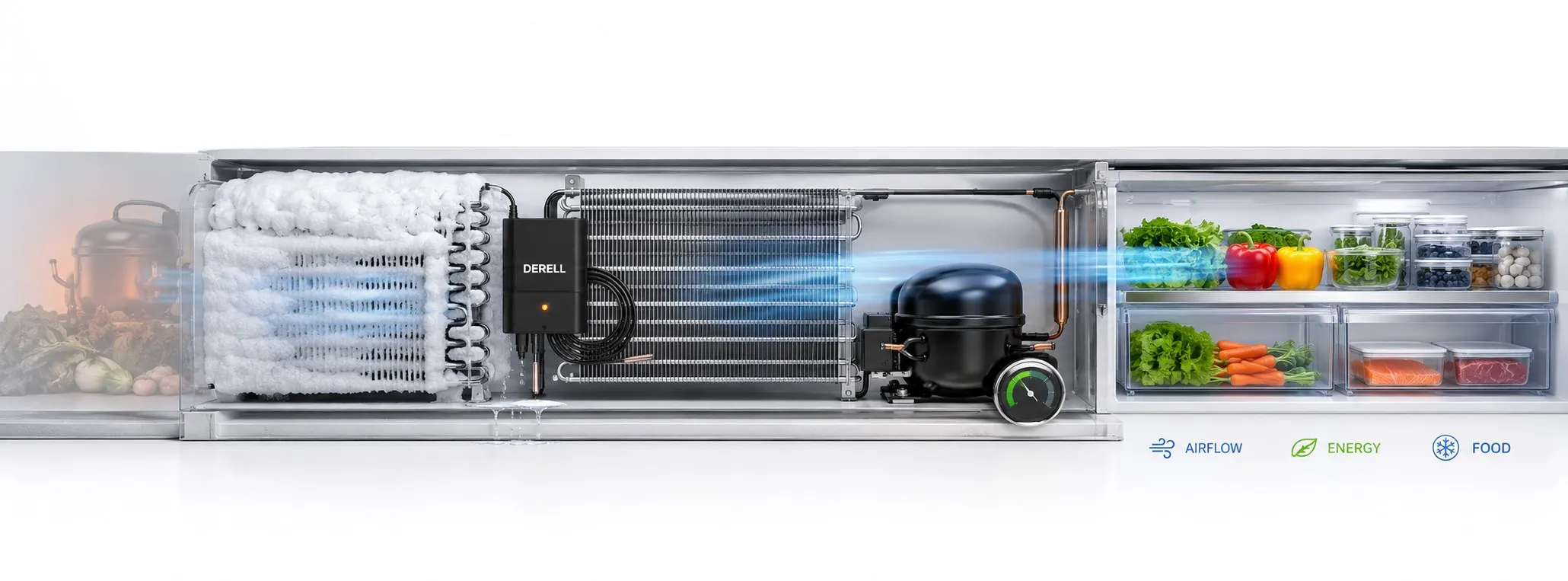
Defrost control manages the removal of frost and ice from the evaporator. In refrigeration systems, its value goes beyond melting ice: it coordinates heat transfer, airflow and the return to cooling. The purpose of defrost is to clear the coil as needed while limiting unnecessary heat input.
It preserves airflow and cooling capacity: Thick frost narrows the passages between evaporator fins, while the ice layer also hinders heat transfer. A running fan does not guarantee adequate airflow. During a refrigerator’s operating cycle, this can contribute to uneven or inadequate cooling. The issue is not simply the presence of frost, but accumulation that impairs performance.
It balances energy use: Insufficient defrost can reduce cooling capacity and make the target temperature harder to reach. Excessively frequent or prolonged defrost uses heater energy and adds heat that must subsequently be removed. For energy consumption, the aim is adequate frost removal without unnecessary cycles. There is no single interval or duration suitable for every cabinet; defrost settings must match the application.
It ends the cycle at the appropriate point: Where supported, an evaporator probe monitors the defrost termination temperature, while maximum duration provides a time limit. The NTC or PTC probe must have the correct characteristics and placement. A poorly positioned probe can terminate defrost before the ice has cleared or allow unnecessary heating.
It manages drainage and fan restart: Melting the ice is only part of the cycle. Drip time allows meltwater to drain; appropriate fan delay limits airflow from a still-warm, wet evaporator into the cabinet. The operating sequence varies with the defrost method, including electric, hot gas and off-cycle defrost. Do not assume that the compressor and fans stop in the same way for every method.
It supports suitable compressor operating conditions: “Frost always overloads the compressor” is an inaccurate generalisation. The effect depends on airflow, pressures and refrigerant feed. In some systems, liquid refrigerant returning to the compressor during or after defrost can also impair lubrication. Assess the technical specifications alongside the system sequence; the controller’s relay outputs do not replace every protective measure.
It helps maintain product temperatures: Keeping the evaporator clear supports airflow to the stored products. However, food storage life depends on more than defrost settings. Assessing food safety during defrost requires attention to product temperature and time at temperature. A momentary air-temperature reading does not establish that every product is at that temperature.
It helps distinguish faults: Fault symptoms can include recurring heavy frost, weak airflow and poor temperature recovery; none proves that the controller itself has failed. Moisture entering through doors, fan faults and drainage problems also need investigation. Simply extending defrost before assessing the effects of defrost failure can conceal the underlying cause. Decisions about repair or replacement should follow measurements and functional checks.
Automatic control still requires maintenance: Automatic and manual defrost describe different ways of initiating a cycle; some controllers also use demand algorithms. An automatic function does not necessarily measure ice thickness directly. For equipment without a defrost function, follow the manufacturer’s specified thawing procedure; adding an external controller is not appropriate for every unit.
Selection starts with operating conditions: When choosing a control technology, consider operating temperature, moisture load, door-opening frequency, the evaporator and the defrost method together. Compare brands and models against those needs. Avoiding unnecessary cycles may help reduce environmental impact, but a fixed energy saving or service-life increase cannot be promised for every system.