
How does defrost control work in a refrigerator?
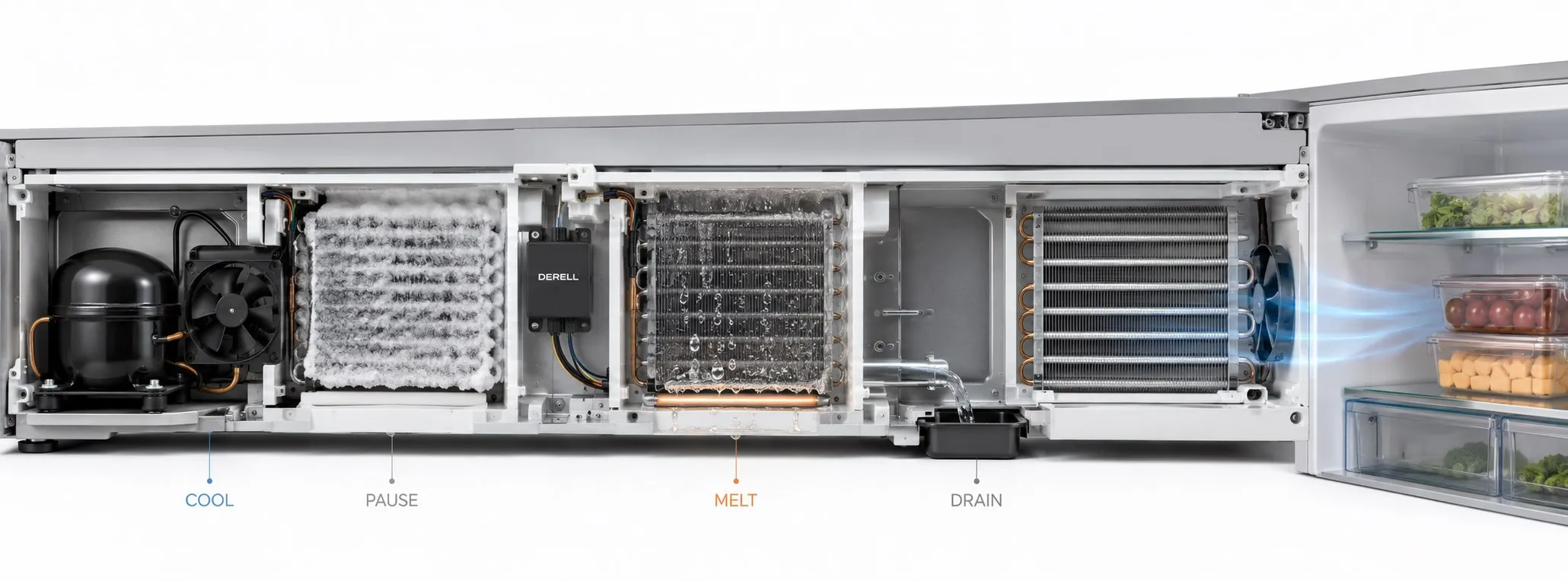
A controlled defrost cycle that keeps cooling effective
Hello, defrost control removes frost and ice from a refrigerator's evaporator under defined conditions, then returns the appliance to cooling. Its main purpose is to maintain heat transfer and airflow through the evaporator. In a typical frost-free refrigerator with electric defrost, the control coordinates the compressor, evaporator fan and defrost heater. Refrigerators use different arrangements, so the sequence below applies specifically to this type of design.
Where does the frost come from, and why remove it?
Moist air entering through an open door, along with moisture inside the cabinet, can form frost on an evaporator operating below freezing. As the layer thickens, heat transfer deteriorates and the air passages between the fins narrow. Less cold air may then reach the storage compartments. The purpose of defrost is to remove this buildup regularly. The importance of the defrost mechanism therefore extends beyond melting visible ice: it helps maintain consistent cooling and air circulation.
What happens between normal cooling and the return to refrigeration?
Cooling and the decision to start: During normal operation, the heater is off; the compressor and fans are managed according to cooling demand. Depending on the control technology, a defrost cycle may be triggered by elapsed time, accumulated compressor run time or an adaptive calculation. Four hours of compressor operation, for example, is different from four hours since the refrigerator was plugged in.
Melting the frost: In a typical electric defrost cycle, the compressor and evaporator fan stop and the heater is energized. Heat melts the buildup on the evaporator. Stopping the fan limits the amount of warm air circulated into the cabinet. This temporary pause does not by itself indicate a fault; the appliance is carrying out its defrost function.
Ending the heating stage: Depending on the design, heating ends when the evaporator sensor reaches the termination temperature, the defrost thermostat opens, or the maximum permitted time expires. These are different conditions. In particular, reaching the time limit does not prove that all the ice has melted successfully.
Drainage and cooling recovery: After the heater switches off, a drip period may allow meltwater to drain. Cooling then resumes; suitable designs delay the evaporator fan by time or temperature. This reduces the circulation of air over an evaporator that is still warm. The heater switching off does not mean the compressor and fan restart simultaneously.
Editor's note: A defrost sensor usually monitors the evaporator temperature at its mounting point rather than detecting ice directly. Its role differs from that of the cabinet air sensor. Incorrect positioning can cause the termination condition to be reached before the entire evaporator is clear.
Do the sensor, thermostat and thermal fuse perform the same task?
An NTC temperature sensor changes resistance with temperature, allowing the control board to interpret the reading. A bimetal defrost thermostat can open its contacts at a specified temperature to interrupt heater operation, depending on the circuit design. Some systems also include a thermal fuse or independent temperature limiter for overtemperature protection. A thermal fuse is a one-time safety device; it does not replace normal cycle control. When checking technical specifications, use the model's sensor curve, contact ratings, switching temperatures and wiring diagram. Similar-looking parts are not necessarily interchangeable.
What changes with adaptive defrost?
Adaptive control adjusts the timing to appliance usage rather than starting every cycle at an unchanging interval. It may consider door openings, compressor run time and, in some designs, the duration of previous defrost cycles. Not every model uses all these inputs. A refrigerator that is rarely opened can have different requirements from one in frequent use. Optimizing defrost settings therefore requires more than copying another refrigerator's timing values.
Where does the meltwater go, and when does frost suggest a fault?
Meltwater normally passes through a drain channel and tube into a collection pan beneath or behind the appliance, where it evaporates. A blocked or frozen drain can cause water inside the cabinet or ice on its floor even when the heater works. Water accumulation therefore does not automatically mean the control board has failed.
When assessing a possible defrost fault, consider recurring heavy frost, reduced airflow and progressively weaker cooling together. These can be effects of failed defrost operation, but door seals, a door left open, fan problems and obstructed air passages also require attention. Before deciding on a repair, evaluate the heater, thermostat, sensor, wiring and board output against the appliance's service data. Disconnect power before electrical work, and do not bypass safety devices.
How should timing, temperature and energy use be balanced?
Defrost interval, termination temperature, maximum duration, drip time and fan delay are separate settings. Insufficient heating can leave ice behind; excessive heating can add energy use and increase the subsequent cooling demand. For a simple energy consumption example, a 300 W heater running continuously for 20 minutes uses 0.10 kWh. This is an illustrative calculation; actual power and operating time depend on the model. Suitable control can also help reduce the environmental impact by avoiding unnecessary cycles.
Does every refrigerator have a defrost button or heater?
No. Automatic and manual defrost designs differ, and some compartments defrost naturally while the compressor is off. A frost-free refrigerator does not necessarily have a separate user-operated defrost button; its board may manage the process automatically. If an appliance appears to have no defrost feature, check its model-specific owner's manual first. Domestic refrigerator service settings should not be treated as equivalent to the user parameters on a commercial refrigeration controller.
Related topics
Explore refrigeration and defrost controllers, NTC sensors and choosing a defrost technology to consider control and measurement together. Other questions are covered in the defrost control FAQ.
Technical references
GE Appliances: Types of defrost systems
GE Appliances: How adaptive defrost works
Whirlpool: Defrost sequence and model-specific service data
Danfoss: ERC 112: termination temperature, drip time and fan delay
Samsung: Defrost water and drainage problems
Whirlpool: Normal moisture, frost and airflow