
How should I choose among different defrost control technologies?
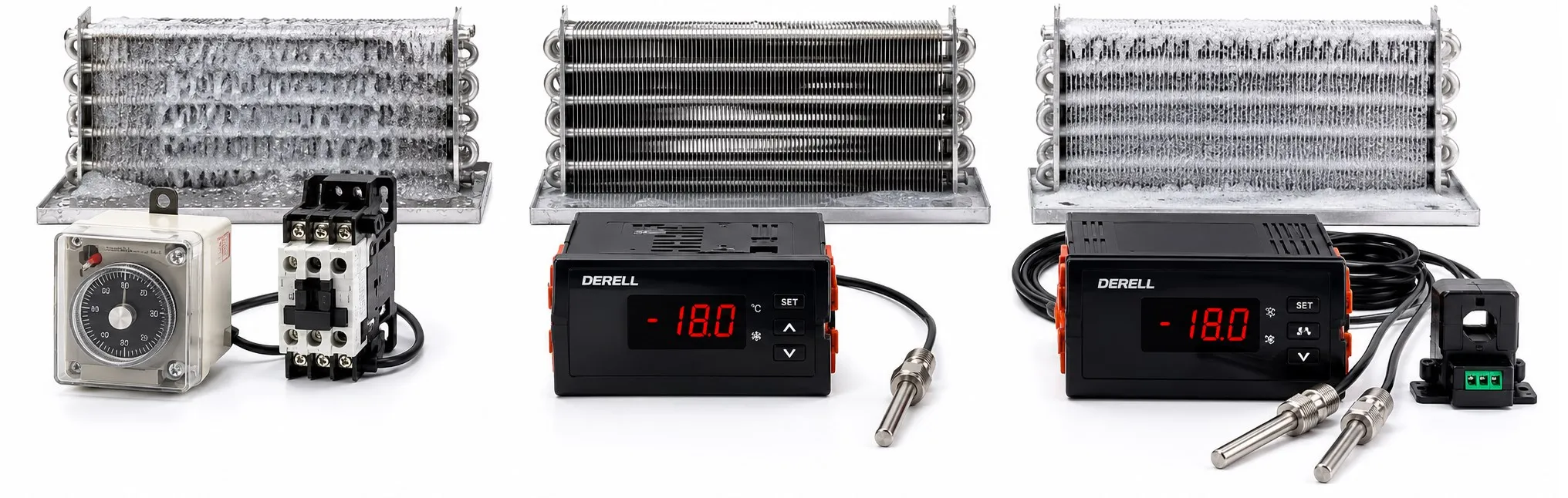
How to Choose a Defrost Control Technology
When choosing defrost control, first establish the defrost needs and existing circuit of the refrigeration system. How the ice is melted, when the cycle starts and what ends it are three separate choices. The selected temperature controller must support the application's defrost sequence and return to cooling.
Choose the defrost method first
The defrost technology must suit the existing system. Off-cycle defrost can be used when enough heat is available from the surroundings. Electric defrost requires heaters and a suitable control circuit. Hot-gas defrost requires a compatible refrigerant circuit and valve sequence. Finding a method in a controller's menu does not establish that the installed equipment can use it.
In a heat pump, particularly a reverse-cycle design, defrost may reverse refrigerant flow to heat the outdoor coil. The compressor, fans and reversing valve operate as a coordinated system. Choose heat-pump controls according to the equipment manufacturer's permitted control arrangement. A controller intended for a refrigerated cabinet must be checked separately for the functions required by the heat pump.
Separate initiation from termination
A time relay or the controller's internal schedule can start defrost at set intervals; some systems use accumulated compressor running time. Demand-based or adaptive control assesses defrost needs using sensor data and a supported algorithm. Timed initiation and temperature-based termination can work together in the same controller. Falling coil temperature is not a universal defrost start rule.
In many applications with an evaporator probe, the termination temperature is used to end defrost. On supported systems, a maximum duration limit provides a backup termination condition. Water drainage, drip time, fan restart conditions and compressor restart delay also belong in the review of defrost settings. Changing how the cycle starts does not remove the need to configure termination and the return to cooling.
Match sensors, supply and outputs
When selecting NTC or PTC probes, check sensor type, nominal resistance, characteristic and measurement range. There must be enough inputs to monitor cabinet and evaporator probes separately where required. A temperature sensor and a thermostat perform different tasks; reading cabinet temperature and terminating defrost are separate functions. Matching connectors or panel dimensions does not establish electrical or functional compatibility.
Verify supply voltage and output assignments against the wiring diagram. Assess each relay output for the load current, load type and any starting current; a contactor may be required. Fuses and other protective devices must suit the circuit design. Output count matters, along with which load each output controls and the required operating sequence.
Check the installation environment
The controller's operating temperature and humidity limits differ from the probe's measurement range. A probe that measures a cold environment does not establish that the controller can operate there. When assessing IP protection, check the front panel, rear enclosure, terminals and mounting conditions separately. A high front-panel IP rating does not apply automatically to the whole controller; condensation conditions also need a separate check.
Select the monitoring and coordination the operation needs
If multiple evaporators require coordinated or staggered defrost, central commands or alarm monitoring, verify support for those functions. Coordination through a PLC, operation from an HMI and central monitoring through SCADA require suitable interfaces and programming. A data logger can help assess temperature and cycle behaviour. Define the communication and recording functions you need before purchasing.
Assess operating costs alongside the purchase price
Heater power in kW and total system consumption in kWh describe different quantities. Adaptive control that reduces unnecessary defrosts may provide a benefit, but assess that benefit under comparable load and ambient conditions. Include cooling recovery, product temperature recovery and maintenance and service requirements in the comparison. Clear technical documentation, accessible service, compatible replacement probes and usable warranty terms are concrete criteria for evaluating a supplier.
You may share this content with attribution.