
What technologies does the defrost control mechanism use?
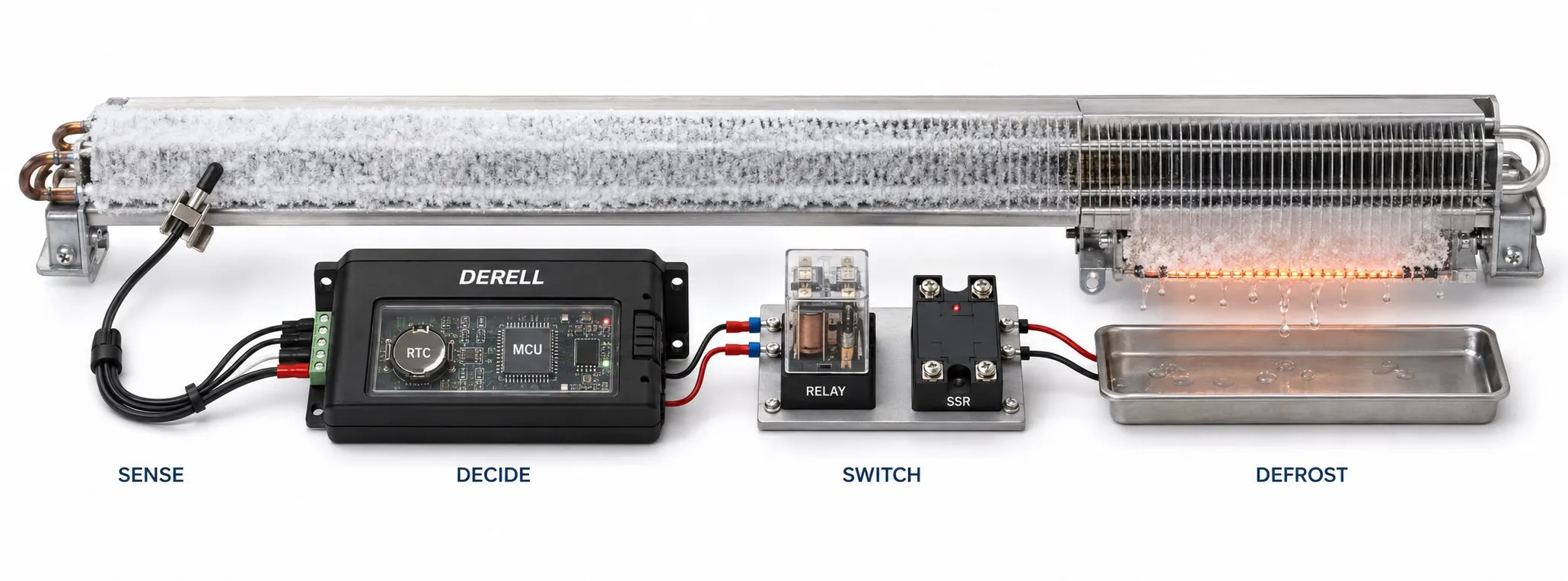
Which technologies are used in defrost control?
Defrost control combines measuring devices, timing logic and outputs. In a refrigeration system, distinguish three questions: how the frost is removed, when the cycle starts and what ends it. Although the purpose of defrost remains the same, the technology depends on the equipment design.
Frost-removal method: Electric defrost uses heaters at the evaporator. Hot gas systems direct hot refrigerant to the evaporator through a suitable valve and piping arrangement. Off-cycle defrost stops refrigeration and uses heat available under suitable ambient conditions. Not every defrost system has electric heaters, and off-cycle defrost is unsuitable for some temperature applications.
Heat pumps may reverse the cycle: In some air-source heat pumps, frost on the outdoor coil during heating is removed by temporarily reversing the refrigeration cycle through a four-way valve. The compressor can remain running. “The compressor always stops during defrost” is an inaccurate generalisation. This process does not use the same wiring and sequence as electric defrost in a cold room.
Temperature measurement: Cabinet and evaporator measurements may use NTC, PTC or other probes supported by the model. Verify probe compatibility using input type, reference resistance and the temperature curve. The difference between a sensor and a thermostat matters here: the probe measures, while the controller interprets the reading. An evaporator temperature below 0 °C alone does not establish that defrost is needed or indicate ice thickness.
Timers and initiation commands: A mechanical timer or electronic clock can initiate cycles at set intervals. Some controllers use schedules, accumulated compressor runtime or an external input. Automatic and manual defrost describe initiation methods. In defrost settings, the initiation interval and cycle duration are separate parameters. A cycle started by time can terminate on temperature.
Demand-based control: Some algorithms assess changes in evaporator temperature, cooling runtime or other operating data. Depending on the design, they may bring a cycle forward or skip an unnecessary one. This does not necessarily require a sensor that detects frost directly. The effect on energy consumption depends on how well the algorithm matches the application; not every sensor-based system outperforms every scheduled system.
Termination and time limits: The controller may monitor whether the evaporator reaches its termination temperature or whether a defined time has elapsed. In temperature-terminated systems, maximum duration provides an additional limit. Termination-probe placement matters: an unsuitable location can end the cycle before the entire evaporator is clear.
Drip time and fan management: Returning to refrigeration involves more than switching off the heater. Controls may include drip time for drainage, time or temperature conditions for fan restart, and a compressor restart delay. The fan and compressor sequence depends on the defrost method and the model’s control logic.
Control board and power switching: The electronic board processes inputs; relay outputs can control compressor, fan, heater or valve functions. Use a contactor where the load requires one. The difference between a relay and a contactor is especially relevant to motor starting loads. Software support for an output does not establish that its relay can switch every load directly.
Communications and logging: Compatible controllers may provide temperature, alarm and cycle information over RS485 communication using Modbus RTU. The interface may be built in or require an additional module. A programming key or TTL socket is not a direct RS485 port. Remote monitoring and local defrost control serve different functions.
Alarms and protection: Probe errors, high-temperature alarms and digital-input alarms can support fault diagnosis. Output behaviour following a probe failure varies by model. A controller’s maximum-duration function does not automatically replace independent thermal protection. During repair or replacement, assess measurement, outputs and protective arrangements together.
Which technology should you choose? Use the technical specifications to verify probe count, output ratings, defrost method and communication support. Base technology selection on application requirements, and compare brands and models against the same needs. The importance of defrost control lies first in correct measurement and a suitable operating sequence, rather than the number of available features.