
What brand and model of defrost control systems do you recommend?
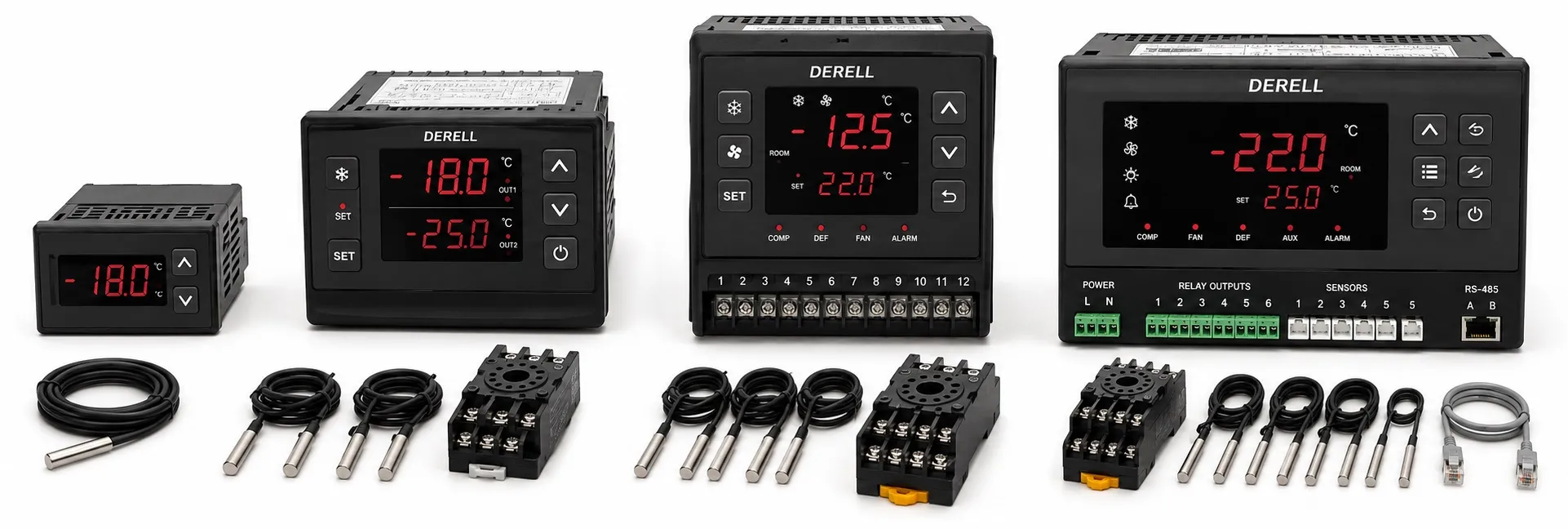
Which brands and models should I consider for defrost control?
The right controller for a refrigeration control system manages defrost to suit the equipment. Start with the way the compressor, evaporator fan and defrost heater or valve operate. The purpose of defrost is to remove ice from the evaporator and maintain heat transfer. The models below form an application shortlist based on documented functions; their suitability depends on the installation.
Identify the application first. Panel controllers for commercial cabinets and cold rooms should not be treated as direct replacements for a domestic refrigerator’s defrost circuit or a heat pump control board. A heat pump may coordinate reverse-cycle operation, pressure conditions and compressor limits. Understanding the difference between a temperature sensor and a thermostat also matters: a temperature probe does not manage the complete defrost sequence on its own.
Check probe compatibility before choosing a model. NTC and PTC probes are not interchangeable. Even probes of the same type can have different reference resistance values and resistance–temperature curves. Check PTC–NTC probe compatibility, cable length and measuring range together. The cabinet probe measures the air in the storage space; the evaporator probe monitors the point used to terminate defrost. These measurements serve different purposes.
Match the outputs to the actual loads. A system with separately controlled compressor, electric defrost and evaporator fan typically needs three independent outputs. A relay’s resistive-load rating does not establish its ability to switch a compressor’s starting load. Use a suitable contactor where the load exceeds the manufacturer’s applicable motor or heater rating. The difference between a relay and a contactor involves the nature and capacity of the switched load as well as physical size.
Which brands and models are worth comparing?
Danfoss ERC 213 / ERC 214: Candidates for commercial cabinets and suitable cold-room applications. The ERC 213 has three relay outputs; the ERC 214 has four. Consider the ERC 214 when lighting or an external alarm needs an additional output alongside compressor, defrost and fan control. Match the selected defrost technology and application preset to the equipment; defrost-on-demand is also relevant when assessing energy consumption.
Dixell XR60CX — Copeland: Designed for medium- and low-temperature ventilated refrigeration units, with three relay outputs for compressor, fan and defrost. It supports electric or hot-gas defrost. It can be considered where an evaporator probe is needed to monitor the defrost termination temperature and manage fan operation. Confirm the supply variant, probe type and defrost settings against the complete ordering code.
Eliwell IDPlus 974: Another candidate for commercial refrigeration requiring compressor, defrost and evaporator fan control. The manufacturer’s manual identifies these outputs on the IDPlus 974 SMPS variant. When assessing automatic and manual defrost requirements, check the chosen variant’s probe inputs, digital-input functions and wiring diagram. Do not assume that every controller in the 974 family has the same terminal arrangement.
DERELL RES-37-D-220 / RES-37F-220: The DERELL cooling and defrost controller catalogue lists the RES-37-D-220 as a two-contact controller and the RES-37F-220 with three relay outputs and two probe inputs. The first can be examined where two outputs suffice; the second where separate fan management is required. Confirm the technical specifications, including each output’s function and load rating, before selecting either model.
How should the application guide your choice?
When choosing between defrost technologies, identify the controlled loads and required measurements first. This gives you a functional requirement to compare across brands.
A positive-temperature cabinet: Where off-cycle defrost is sufficient, stopping the compressor may allow the evaporator to thaw. A dedicated electric-heater output may be unnecessary, but fan operation and operating conditions still need review. A positive storage temperature does not, by itself, establish which defrost method will work.
A freezer with electric defrost: For an illustrative −18 °C application, assess cabinet and evaporator measurements, compressor restart protection, the defrost output and fan restart conditions together. Defrost termination temperature and maximum duration serve different purposes. Maximum duration is an upper limit; the controller does not need to use that entire period in every cycle.
Multiple evaporators or central monitoring: Calculate the required probe count and independent outputs, defrost coordination, alarm transmission and communications support. A more extensive control platform may be needed when the system exceeds a basic cabinet controller’s capabilities. Establish whether communications are built in or require an additional module before ordering.
Good control manages the entire sequence. The importance of the defrost mechanism extends to drainage and the return to cooling. A typical sequence in a ventilated system includes defrost, a drip period and appropriate fan restart conditions. No single duration or termination temperature suits every installation: evaporator construction, moisture load and equipment instructions determine the settings.
Separate the fault from the controller before buying a replacement. Defrost fault symptoms can also result from a failed probe, heater, connection, fan or drainage problem. Check the measurement and load circuits before replacing the controller. Understanding the effects of failed defrost helps relate icing to restricted airflow. A replacement that fits the same panel opening may still have a different electrical arrangement.
Consider product temperature and operating cost together. Food storage life and food safety during defrost cannot be assessed solely from the air temperature shown on the controller. Appropriate product-temperature monitoring and the required storage conditions remain essential. When assessing environmental impacts, consider unnecessarily long defrost cycles, the subsequent cooling demand and maintenance conditions together.
Complete the purchase decision with the following information: the existing controller’s full code, supply voltage, probe type and curve, output functions, running and starting loads, defrost method, panel opening, alarm requirements and available technical support. A comparison made against the same requirements provides a sound basis for choosing a brand and model.