
What is Defrost control?
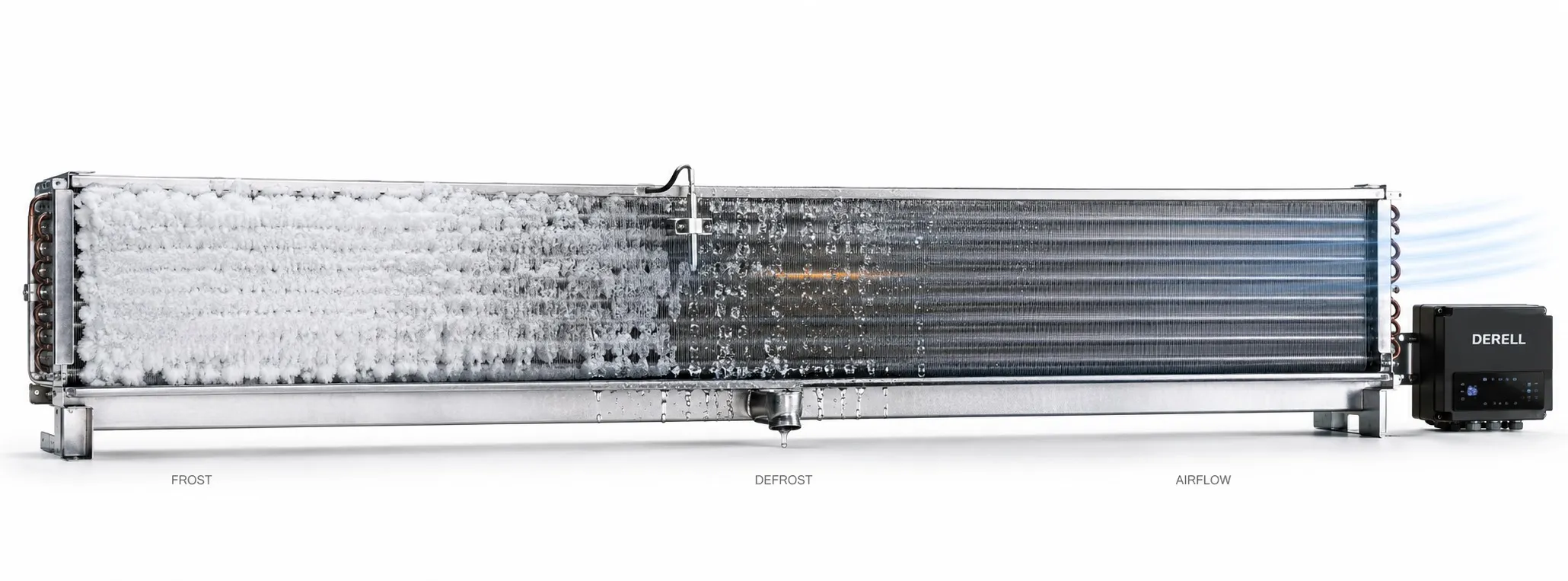
What is defrost control?
Defrost control manages the start of defrost, its termination and the return to cooling so that frost and ice can be removed from a refrigeration system’s evaporator. The purpose of defrost is to maintain heat transfer and airflow through the coil. It is used in commercial refrigerators, freezers, cold rooms and suitable air-conditioning applications.
Why does frost form? When moist air meets a sub-zero evaporator surface, frost can form or condensed water can freeze. Door openings and air leaks increase the moisture load. Accumulating ice restricts the passages between the fins and impairs heat transfer. The importance of the defrost mechanism lies in managing this build-up before it disrupts operation.
How is defrost carried out? The appropriate defrost technology depends on the evaporator and its operating temperature. Common methods include off-cycle defrost, electric defrost and hot-gas defrost. A separate electric heater is not required for every method.
Off-cycle defrost: In suitable positive-temperature applications, refrigeration stops and heat from the surrounding air allows the frost to melt. Fan operation depends on the application. Suitability should be established by checking whether the evaporator actually clears, rather than relying on cabinet temperature alone.
Electric defrost: Heating elements melt the ice on the evaporator. The controller’s relay output can operate a suitably rated heater or control a contactor. Refrigeration is normally stopped during electric defrost. Heater loading and any required independent temperature protection must follow the equipment and installation specifications.
Hot-gas defrost: Heat from hot refrigerant is directed to the evaporator. Valve arrangements, pressure conditions and compressor operation depend on the system design. Hot-gas defrost cannot be added to an existing installation simply by changing a controller setting.
What starts defrost? Automatic or manual defrost may be available. Automatic initiation can use an interval, a schedule, accumulated operating time or a demand algorithm supported by the controller. When choosing defrost settings, consider moisture load, door usage and evaporator condition.
Not every controller measures ice thickness. Basic controllers commonly work from time and temperature information. Some advanced controllers assess defrost demand from the evaporator’s temperature behaviour. Defrost on demand does not necessarily mean that a sensor measures ice thickness directly.
What ends defrost? A cycle can finish when a set time expires or when the evaporator probe reaches the selected defrost termination temperature. In temperature-terminated applications, a maximum defrost duration also provides an upper limit. Cabinet storage temperature and evaporator defrost termination temperature are different settings.
The sequence continues after the heater switches off. A drip period may be needed to allow melted water to drain. In ventilated systems, fan restart can depend on elapsed time or evaporator temperature. Compressor restart protection may also apply. The controller features supporting this sequence help the equipment return to normal cooling.
The probes serve different purposes. The cabinet probe measures storage-space air temperature; the evaporator probe monitors the point used for defrost and fan management. Check probe compatibility when selecting NTC or PTC probes. This illustrates the difference between a temperature sensor and a thermostat: the sensor measures, while the controller manages outputs using the measurements and settings.
How does defrost affect energy use? Inadequate defrost can reduce airflow and cooling performance. Excessively long defrost adds heat to the system. Assess energy consumption across both defrost and the subsequent recovery to storage temperature. When considering environmental impacts, the aim is an appropriate cycle that clears the evaporator sufficiently.
What indicates a fault? Heavy icing, reduced airflow and failure to reach the target temperature can be symptoms of a defrost fault. However, problems associated with failed defrost can also arise from a faulty probe, heater, fan, drain or connection. Identify the cause before replacing or repairing the controller.
A domestic refrigerator may work differently. A refrigerator’s defrost operation is designed around its electronic board and sensor arrangement. It does not necessarily have a user-accessible defrost button. For a refrigerator without automatic defrost, follow the manufacturer’s manual-defrost instructions; adding an external controller is not a direct equivalent.
Food temperature needs separate consideration. Food storage life and food safety during defrost cannot be determined from displayed air temperature alone. Monitor product temperature, cycle duration and the required storage conditions together. Some controllers hold the displayed value during defrost; this does not prove that product temperature remains constant.
How should a controller be selected? When choosing a defrost method, review supply voltage, probe inputs, independent outputs, load ratings, drip time and fan delays. A brand and model comparison becomes useful once these requirements are established. Effective defrost control starts the thawing process and manages the equipment’s return to cooling.