
AS/NZS Standards for Fuses
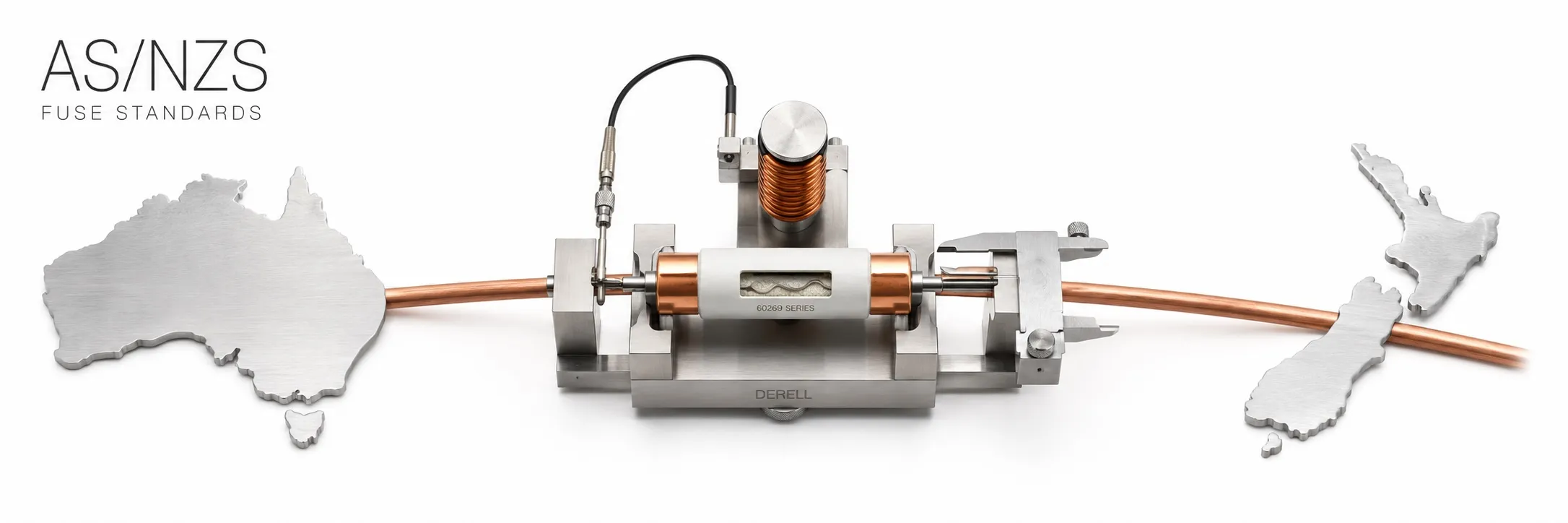
Effective protection starts with understanding each standard's scope
Selecting electrical protection for Australia and New Zealand involves more than checking a single standard number. Within the AS/NZS standards framework, product safety, installation design, cable selection and specialised applications are addressed by different documents. A fuse that has passed its product tests does not, by itself, establish that the circuit in which it is installed has been designed correctly.
Start by identifying the protective function. The basic purpose of an electrical fuse is to interrupt overcurrent, but fuse-links, circuit breakers and residual current devices differ in construction and function. Select the standard together with the correct device type and application.
Editor's note: AS/NZS 3000, 3008.1.1, 3012, 3190, 4509.1 and 60335.2.40 are not different versions of the same fuse standard. They address installations, cable selection, particular products or specialised applications. Do not treat these references as interchangeable evidence of conformity.
Assess the fuse product standard separately
The 60269 family is an important reference for low-voltage fuse-links. IEC 60269-1:2024 sets general requirements for fuses incorporating enclosed, current-limiting fuse-links. Depending on the relevant part and product design, assessment covers marking, temperature rise, insulation, time-current behaviour and breaking performance. Its scope should not be assumed to cover every small glass fuse or every circuit breaker.
The document prefix also matters. For example, MBIE Building CodeHub identifies AS 60269.1-2005 as an Australian Standard; its designation should not be casually changed to AS/NZS. Likewise, publication of a new IEC edition does not automatically make that edition mandatory in both countries. Check the full standard designation, edition year and local adoption against the product documentation.
Current rating is only one part of safe selection
Assess the rated current alongside the load, starting current, and cable cross-section and installation conditions. Fitting a higher current rating to stop repeated operation can compromise cable protection. The rated voltage, AC or DC suitability, breaking capacity and operating characteristic also require verification.
For example, assume a prospective short-circuit current of 10 kA at the installation point. A fuse with a 6 kA breaking capacity cannot be accepted as adequate there without another verified protective coordination arrangement. These are illustrative values, rather than a prescribed standard requirement: load current and fault current are different selection criteria. For DC fuses, an AC voltage rating alone is insufficient evidence of suitability.
The utilisation category also determines the protection provided. gG denotes general-purpose, full-range overcurrent protection, while aM provides partial-range short-circuit protection for motor circuits. An aM fuse requires separate overload protection. For motors and other high-power loads, tolerating starting current and protecting the cable and motor against overload are separate considerations.
Residual-current protection performs a different function
An RCD detects residual current; it does not necessarily perform the overcurrent functions of a fuse or ordinary circuit breaker. The distinction between MCBs, RCCBs and RCBOs matters: an RCCB has no integral overcurrent protection, whereas an RCBO combines residual-current and overcurrent protection. An appropriate RCD does not replace protective earthing or other installation requirements.
How the related standards work together in practice
AS/NZS 3000 provides the framework for the design, construction and verification of electrical installations. Protective device selection, earthing and circuit arrangements form part of that assessment. It should not be read simply as a fuse manufacturing standard.
AS/NZS 3008.1.1 supports cable selection under typical Australian conditions, addressing current-carrying capacity, voltage drop and short-circuit temperature limits. Cable capability and protective device behaviour must be assessed together. For typical New Zealand conditions, assess AS/NZS 3008.1.2 separately.
AS/NZS 3012 addresses electrical installations on construction and demolition sites, including inspection and testing requirements for equipment used there. Temporary distribution arrangements cannot simply be assessed as though they had the same operating conditions as a permanent switchboard in an ordinary building.
AS/NZS 3190 concerns approval and testing requirements for current-operated residual current devices. An RCD's conformity to this standard does not verify the complete installation; its suitability for the particular circuit and load still requires assessment.
AS/NZS 4509.1 covers safety and installation requirements for stand-alone power systems. Where batteries and inverters are present, assess the different fault conditions on both the AC and DC sides.
AS/NZS 60335.2.40 addresses particular appliance safety requirements for heat pumps, air conditioners and dehumidifiers. It is not a general-purpose fuse standard. Their supply circuits must also meet the relevant installation requirements and the manufacturer's specified protection conditions.
Check conformity evidence alongside suitability on site
For purchasing and replacement, match the exact model code, technical data sheet, standard edition, test or conformity documents and manufacturer's installation conditions. The same current rating and dimensions do not establish that two fuses are interchangeable in every application. The fuse holder, connections and ambient temperature also matter. During switchboard maintenance, signs of overheating or damage require investigation rather than simply replacing a fuse.
For equipment within EESS scope, assess compliance evidence, the responsible supplier, and registration or certification requirements associated with its risk level. A standard number alone is not approval to sell a product. Installation work must use the edition and transition arrangements accepted by the relevant country or state. When replacing a fuse, establish the fault cause and required protective characteristics; authorised personnel must perform the work with the necessary isolation and verification.
Related guides
Key criteria for selecting electrical protection
Overview of fuse standards
Fuse products
Sources
IEC: scope of IEC 60269-1:2024 low-voltage fuses
MBIE Building CodeHub: AS 60269.1-2005 record and scope
Standards Australia: Wiring Rules and installation safety
ETI: protection differences between gG and aM fuse-links
Victron Energy: DC voltage, interrupt ratings and fuse selection
Queensland Electrical Safety Office: safety switches and circuit breakers
EESS: compliance evidence and registration for in-scope equipment
EWRB: standard editions, transition arrangements and documentation
This overview uses publicly accessible scope information and guidance. Detailed application requires the relevant full standard and local requirements.