
AS/NZS 3012
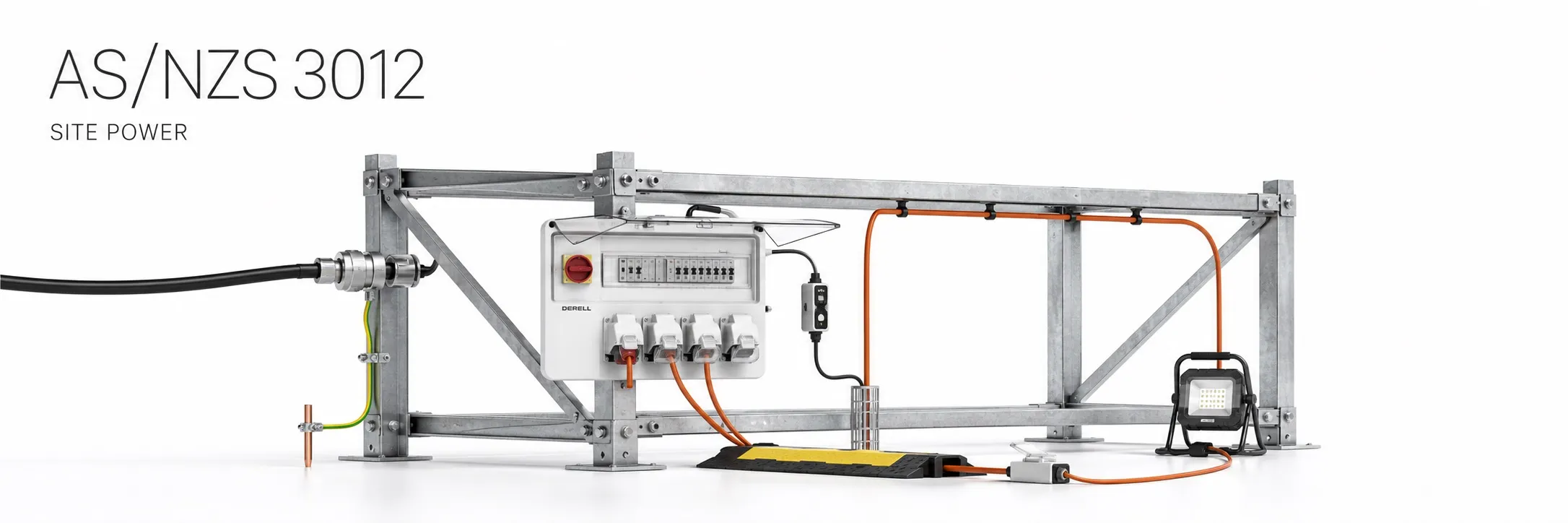
Safe site power requires more than a temporary connection
AS/NZS 3012 addresses the design, construction and testing of electrical installations supplying construction and demolition sites, together with in-service testing of electrical equipment used there. It is a joint Australian and New Zealand standard used alongside the general installation requirements in AS/NZS 3000. With cable routes and loads changing throughout a project, the aim is to keep an initially safe arrangement safe as work progresses.
The scope extends beyond hand tools and temporary sockets. It covers site switchboards, supply circuits, lighting, relocatable structures and testing of portable, relocatable and fixed equipment. Appendix B varies the requirements for single domestic residences and certain adjoining residential units; one identical arrangement cannot be assumed suitable for every site.
Editor's note: A drill with a current test tag does not automatically make its extension lead and supplying switchboard compliant. Equipment testing, installation verification and routine user checks are separate responsibilities.
Start with the supply source and switchboard location
Power may come from the electricity network, an existing installation switchboard or a suitable generator. Locate boards so work areas can be supplied without excessive reliance on extension leads. Switchboard placement and maintenance must account for access, vehicle impact, standing water and cable strain. Energy Safe Victoria specifically requires construction-site switchboards to be securely fixed to a rigid, stable structure or otherwise securely fixed in place.
The enclosure's IP protection rating must suit the environment. SafeWork NSW specifies a minimum IP23 rating for switchboards, but this minimum does not establish suitability for every rain or water-jet exposure. Cable entries, covers and doors must maintain the necessary protection during use.
Assess cable selection, routing and voltage drop together
Construction wiring must be distinguishable from permanent wiring, protected against mechanical damage and kept off unsupported temporary fence panels. Traffic routes, sharp edges, moving scaffolding and mobile plant influence the route. Raising a cable off the ground does not remove the need for suitable supports and mechanical protection.
Installation-cable selection considers relevant AS/NZS 3008.1.1 provisions, current-carrying capacity and voltage drop together. Permitted extension-lead length must also be checked against its conductor size, current rating and applicable rules. Joining two 25-metre leads, for example, does not remove the need to assess the resulting 50-metre run: voltage drop in a long cable depends on the complete route.
Residual-current and overcurrent protection perform different jobs
RCD protection disconnects the supply in response to a dangerous residual current. Site guidance specifies a rated residual operating current no greater than 30 mA; a 300 mA device does not provide equivalent protection. An RCD alone does not cover every overload or short-circuit condition, so the distinction between MCBs, RCCBs and RCBOs matters.
AS/NZS 3190 addresses product safety and testing, while AS/NZS 3012 addresses the site application. The RCD waveform classification also matters: SafeWork NSW's summary specifies Type A. This requirement should not be extended to every AS/NZS jurisdiction without checking the relevant national modifications.
Protective earthing requires separate verification; an RCD does not replace it. Neutral and the protective conductor are not interchangeable. A generator or inverter supply also requires its own assessment of separation and earthing arrangements; connections used in a mains-supplied board must not simply be copied onto another source.
Test intervals depend on what is being checked
Initial verification, visual inspection, push-button checks and instrument tests are different activities. Queensland's construction-work table gives 3 months for portable equipment and extension leads, and 6 months for relevant groups such as transportable structures, fixed and transportable equipment. Construction wiring is verified before first energisation and visually reinspected at intervals not exceeding 6 months.
The same Queensland table gives monthly push-button checks and 12-monthly operating-current/time tests for fixed RCDs, with 3-monthly instrument testing for portable RCDs. Portable-device push-button checks are treated separately under daily or before-use requirements. A test button that fails to operate is not a minor maintenance issue to leave unresolved.
These intervals are examples from the identified jurisdiction's guidance. Check the country, equipment class, hire conditions and current rules. Visible damage takes priority over the date on a tag. Remove defective equipment from service and link test records to the equipment identifier, date, result and next inspection information.
Lighting, site changes and responding to a trip
A faulty tool should not leave every access route in darkness. Where there is more than one lighting circuit, distribute the circuits between RCDs and plan lighting for safe access and exit. Adding a switchboard or relocating an existing one also calls for reassessment of the protective arrangement.
Do not repeatedly reset an RCD that trips without investigating the cause. Establish who may investigate a fault and who is authorised to restore the supply. A subcontractor bringing their own equipment does not remove the need to manage the shared electrical supply.
Checking the edition and local adoption
At the catalogue check on 15 October 2026, ANSI listed AS/NZS 3012:2019 (R2026) as the most recent entry. R2026 indicates reconfirmation; the underlying edition remains 2019. Check applicable amendments, national differences and regulatory references separately. Catalogue status does not establish an identical legal transition timetable in every jurisdiction.
Related guides
Did the circuit breaker or the RCD trip?
Verifying earthing at a socket
Choosing electrical protection
Related AS/NZS standards
Sources
EWRB: AS/NZS 3012 scope and its relationship with AS/NZS 3000
ANSI: AS/NZS 3012:2019 (R2026) catalogue entry
WorkSafe Queensland: construction wiring and risk management
Energy Safe Victoria: secure mounting of construction-site switchboards
SafeWork NSW: switchboards, RCDs, leads, lighting and testing
WorkSafe Tasmania: RCD protection limits and response to tripping
WorkSafe Queensland: equipment and RCD testing intervals
WorkSafe New Zealand: supply arrangements and responsibilities on small construction sites
This overview uses publicly accessible scope information, catalogue records and regulatory guidance. Consult the applicable full standard and local rules for detailed requirements.