
AS/NZS 3000
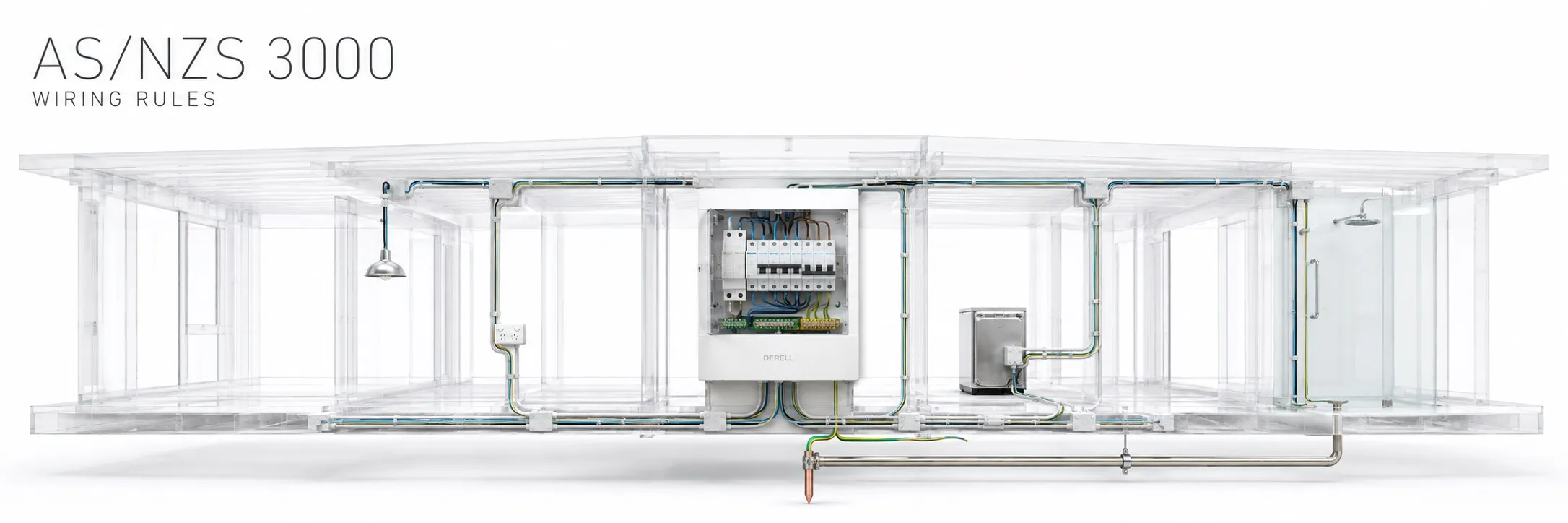
Assessing an electrical installation from design through final verification
AS/NZS 3000, commonly called the Wiring Rules, is the joint Australian and New Zealand electrical installation standard. It addresses design, construction and verification, including the selection of equipment forming part of the installation. For residential, commercial and industrial applications, its purpose is to bring cables, switchboards, protection and connections together as a safe system.
The two main parts have different roles. Part 1 sets fundamental safety requirements, while Part 2 describes installation methods deemed to satisfy those requirements. The assessment therefore concerns both the equipment installed and the safety of the completed installation.
Editor's note: Using an RCD compliant with a product standard such as AS/NZS 3190 does not establish that the entire switchboard and its circuits comply with AS/NZS 3000. Product conformity, installation design and verification after installation are separate assessments.
Select the load, cable and protection together
Cable cross-section selection involves more than the current on an equipment label. Current-carrying capacity depends on installation and environmental conditions, while voltage drop depends on current, route length and circuit characteristics. Cable calculations use the appropriate part and edition of supporting standards such as AS/NZS 3008.1.1.
The protective device's operating characteristics must coordinate with the cable's withstand capability. For example, spare space in a switchboard is insufficient justification for adding an EV charging circuit. Supply capacity, simultaneous loads, protection and the effect on the existing installation all need assessment. A functioning appliance does not prove that its supplying circuit has been correctly designed.
RCDs, overcurrent protection and earthing perform different functions
Residual-current protection disconnects the supply when residual current reaches the operating threshold. Overload and short-circuit protection are separate functions, making the distinction between MCBs, RCCBs and RCBOs important. An RCCB has no integral overcurrent protection; an RCBO combines both protective functions.
The device's load-current rating and a residual-current sensitivity such as 30 mA describe different characteristics. Type AC, A, F and B RCDs also detect different waveforms. RCD type and circuit coverage depend on the loads, applicable edition and local requirements. The presence of a test button alone does not establish suitability.
Earthing and neutral arrangements form a coordinated system
Protective earthing, equipotential bonding and automatic disconnection work together. Neutral and protective conductors are not interchangeable. A designated neutral-to-earth connection in an MEN system does not permit arbitrary additional links elsewhere in the installation.
Adding a battery inverter or backup supply can affect this arrangement. Energy Safe Victoria specifically addresses neutral continuity, correct RCD operation and preventing neutral and earth conductors from operating in parallel when changing to an alternative supply. Assessment must cover the alternative operating mode as well as normal grid operation.
Switchboard location and environmental conditions also matter
Switchboard placement and maintenance must account for access, isolation, circuit identification, cable entries and protected connections. The IP protection rating must suit the environment. An arrangement suitable for a dry room cannot simply be copied into a wet location, outdoor area or place exposed to mechanical damage.
AS/NZS 3000 does not provide every detail for specialised installations on its own. Additional requirements include AS/NZS 3003 for patient areas, AS/NZS 5033 for PV arrays and AS/NZS 5139 for battery systems. Depending on the application, consider standards such as AS/NZS 3012 for construction sites and AS/NZS 4509.1 for stand-alone power systems.
Verification combines visual inspection and testing
Completed, altered or repaired work must be verified as safe before being placed in service. Visual inspection first checks equipment selection, connections, identification and protective arrangements. Inspection may need to be planned during construction for connections and routes that will later be concealed.
Section 8 test categories include earthing continuity, insulation resistance, polarity, correct circuit connections, fault-loop impedance required for automatic disconnection, and RCD operation. Applicability and methods are determined by the relevant provisions; AS/NZS 3017 supports detailed testing methods. Verifying earthing at a socket requires more than observing a wire colour or an indicator lamp.
A working RCD test button does not establish that every installation test has passed. Each measurement should answer a specific safety question: is the protective conductor continuous, are connections correct, and will protection operate under fault conditions? Energising a circuit and running its load do not replace verification. Record the results and the scope of the work.
Distinguish catalogue status from the locally adopted edition
At the catalogue check on 15 October 2026, AS/NZS 3000:2018 was listed as current. Its publication history includes Amendment 1:2020, Amendment 2:2021, Amendment 3:2023 and Ruling 1:2024. An amendment or reissue date does not turn the underlying standard into a new 2024 edition.
For New Zealand, EWRB's March 2026 guidance explains that new installations begun before 13 November 2025 may be completed to the previous standards without a completion deadline. For work begun after that date, choosing the previous standards requires completion by 12 November 2026. New work begun on or after 13 November 2026 must use the updated references. These transition arrangements must not be generalised to every Australian jurisdiction.
The same EWRB guidance does not require safe existing installations to be upgraded solely because standards have changed; the altered parts and work dates need assessment. Project records should identify the country or state, edition and amendments used, circuit information, test results and required certification.
Related guides
Circuit protection, residual current protection and electrical safety
Did the circuit breaker or the RCD trip?
Choosing electrical protection
Related AS/NZS standards
Sources
Standards Australia: Wiring Rules and the two-part structure
NSAI: AS/NZS 3000:2018 scope, amendments and Ruling 1
EWRB: New Zealand transition arrangements and existing installations, March 2026
WorkSafe Queensland: visual inspection and installation verification tests, 2026
Energy Safe Victoria: general verification and special-installation requirements
Energy Safe Victoria: neutral continuity and MEN connections in battery installations
Queensland Electrical Safety Office: safety switches and circuit breakers
This overview uses publicly accessible scope information, catalogue records and regulatory guidance. Apply the relevant full standard together with local regulations for detailed requirements.