
AS/NZS 3190
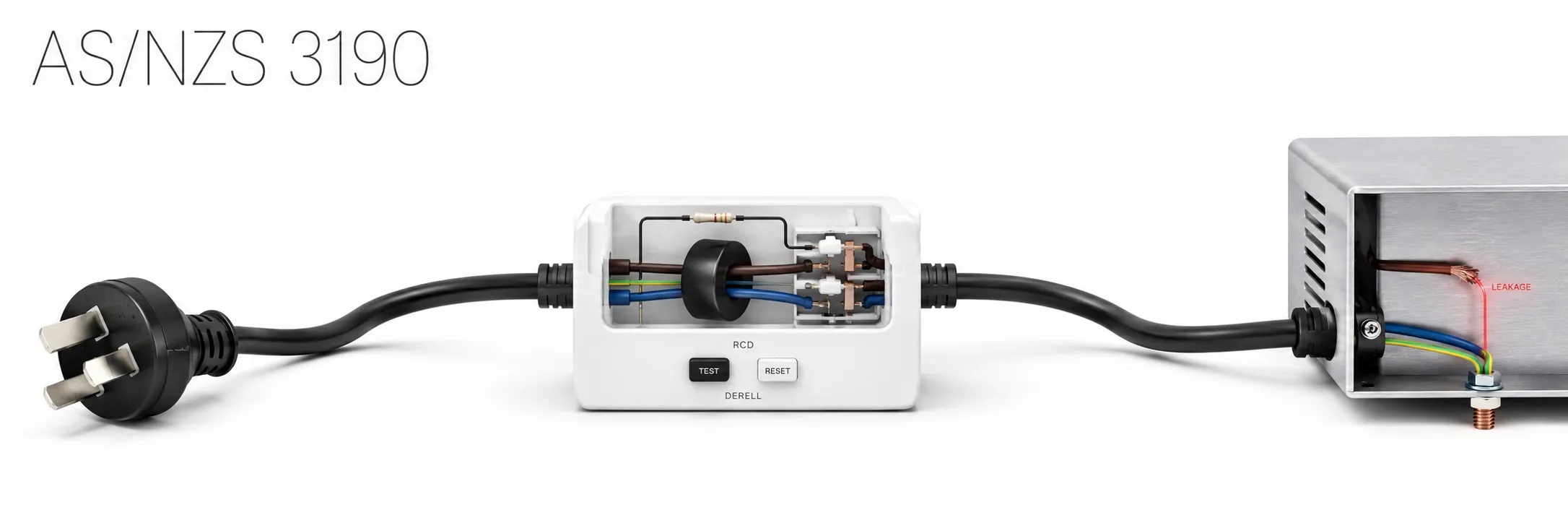
Choosing the right residual current protection and checking its certification
AS/NZS 3190 is a joint Australian and New Zealand standard covering safety requirements and test methods for residual current devices. These devices, commonly called RCDs, may be fixed or portable. Treating it as a general safety standard for all portable electrical tools can lead to incorrect assumptions about the protection a product provides.
Its scope includes low-voltage devices and residual current relays with rated residual currents up to 300 mA and rated AC load currents up to 125 A, subject to the stated conditions. A device may disconnect the supply or initiate a signal that causes disconnection. These upper limits do not mean that every model has the same sensitivity or intended application.
Editor's note: Do not confuse Type I and Type II classifications with the AC, A, F and B waveform classifications. An AS/NZS 3190 marking alone also does not establish that a device includes overcurrent protection.
Why 40 A and 30 mA describe different characteristics
In a single-phase circuit, residual current protection compares the outgoing active current with the returning neutral current. For example, 10 A outgoing and 9.97 A returning produce a 30 mA residual current. This illustrates the principle; the precise operating threshold and time depend on the test conditions.
A marking of In = 40 A identifies the rated current under specified conditions, while IΔn = 30 mA identifies the rated residual operating current. Current capacity and residual-current sensitivity are separate selection criteria. This is why the difference between 30 mA and 300 mA matters: a 300 mA device is not a direct substitute where 30 mA additional personal protection is required.
Understanding RCCBs, RCBOs and circuit breakers
MCBs, RCCBs and RCBOs provide different protective functions. An RCCB has no integral overcurrent protection; an RCBO combines residual-current and overcurrent protection. Protection against short circuits and overloads therefore cannot be determined from RCD sensitivity alone. Coordination with the fuse or circuit breaker used alongside an RCCB must be assessed separately.
Energy Safe Victoria's RCD classification lists AS/NZS 3190 or AS/NZS 61008.1 for devices without integral overcurrent protection. For devices with integral overcurrent protection, it lists AS/NZS 3190 together with AS 3111, or AS/NZS 61009.1. The appropriate standards route depends on the product's construction and the applicable acceptance requirements.
Load waveforms and the position of the protection
The choice between Type AC, A, F and B RCDs relates to the expected residual-current waveform. Loads containing power electronics may produce pulsating DC, different frequency components or smooth DC. Two devices marked 30 mA do not necessarily have the same detection capability. For equipment with electronic drives in particular, check the RCD type specified by the equipment manufacturer.
A portable RCD protects the section downstream of it. Fitting one at the far end of an extension lead does not bring the preceding lead within that RCD's protection. The position of a switchboard, socket-outlet or portable RCD therefore matters. Providing a portable device does not automatically satisfy requirements for fixed-installation protection.
A test-button check is different from instrument testing
The T or TEST button checks the tripping function through the device's test circuit. If the test button does not work, do not rely on the protection; arrange for the device to be checked. Successful button operation does not verify earthing at the socket or establish that all operating-current and trip-time measurements have been completed.
WorkSafe Queensland treats push-button checks separately from operating-current and operating-time tests. Test intervals depend on the work, environment and local rules. AS/NZS 3190 addresses product testing, while installation requirements under AS/NZS 3000, construction-site requirements under AS/NZS 3012 and applicable AS/NZS 3760 provisions for in-service inspection and testing must also be considered.
Protection limits and repeated tripping
An RCD does not replace protective earthing or sound insulation. It may not trip if someone contacts active and neutral together without creating a current imbalance. Its ability to operate without an earth connection does not make earthing unnecessary; neutral and the protective conductor are not interchangeable.
Repeated RCD tripping needs investigation. Leakage from filters in electronic loads can contribute to the total residual current. Bypassing protection or arbitrarily reducing its sensitivity is not a suitable remedy. A competent person should first establish which protective device operated, assess the connected loads and check the condition of the installation.
Read the edition, model details and compliance records together
At the catalogue check on 15 October 2026, AS/NZS 3190:2016 was listed as current, with Amd 1:2020, Amd 2:2024 and Amd 3:2025 recorded in its amendment history. Check the edition and amendments stated in the model's certification against the relevant country's acceptance and transition provisions.
The RCD equipment class defined by Energy Safe Victoria is listed as Level 3. For in-scope Level 3 equipment supplied under EESS, a valid Certificate of Conformity, responsible-supplier and equipment registration, and RCM marking requirements all matter. A standard number on the label does not prove that every compliance step is complete. Match the documentation to the exact product model.
Related guides
Did the circuit breaker or the RCD trip?
Repeated tripping at night or in wet weather
Choosing circuit protection
Electrical protection standards
Sources
NSAI: AS/NZS 3190:2016 scope and amendment history
Energy Safe Victoria: RCD classification and applicable product standards
Safe Work Australia: RCD operation, classes and portable protection
WorkSafe Queensland: push-button tests and operating current/time tests
Schneider Electric: residual-current waveforms and RCD selection
EESS: certification, registration and RCM requirements for Level 3 equipment
Queensland Electrical Safety Office: protection limits and test-button checks
This overview draws on publicly accessible scope information and regulatory guidance. Consult the full standard for detailed test conditions and acceptance limits.