
AS/NZS 60335.2.40
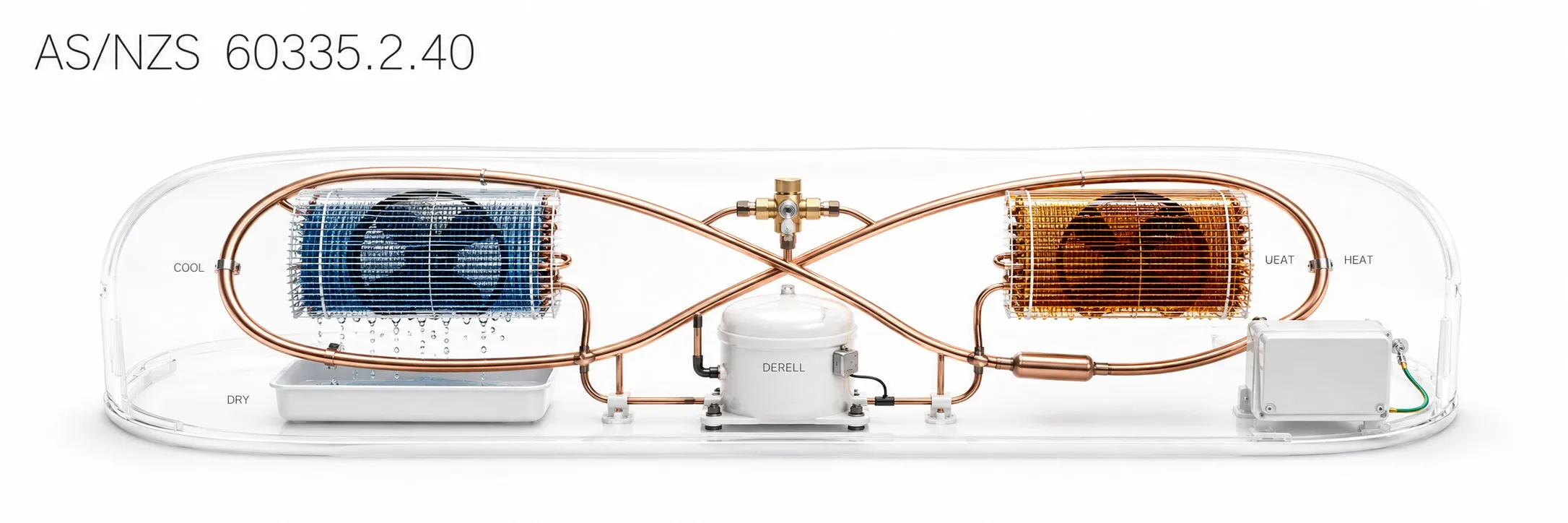
Assessing safety across heating and cooling appliances
Hello everyone. AS/NZS 60335.2.40 is a joint Australian and New Zealand standard addressing particular safety requirements for electric heat pumps, air conditioners and dehumidifiers. Its concerns extend beyond electric shock: heating, mechanical hazards, pressure and refrigerant-related risks are assessed as part of the appliance design. The aim is to limit hazards during normal use and under the abnormal conditions addressed by the requirements.
Scope and the relationship with general safety requirements
The 2025 scope description also includes sanitary hot-water heat pumps, hydronic fan-coil units, dehumidifiers with or without motor-compressors, thermoelectric heat pumps and partial units. Rated-voltage limits are 300 V for single-phase appliances and 600 V for other appliances, with DC-supplied and battery-operated appliances included. Certain similar commercial applications can fall within scope; equipment designed exclusively for industrial processing is not automatically covered.
This particular part follows the general approach of the IEC 60335 safety family and is applied together with the relevant AS/NZS 60335.1 general requirements. Part 2 adds to or modifies the general rules. The designation IEC 60335-2-40:2024, MOD identifies the 2025 edition as a modified adoption of the IEC publication. Consequently, an IEC test report and AS/NZS compliance are not automatically equivalent: national differences and the editions used must be compared.
Editor's note: This is an appliance safety standard. It does not replace fuse standards or energy-efficiency assessment. Fitting an appropriate fuse to an air conditioner does not establish that all appliance hazards, including refrigerant leakage and ignition risks, have been assessed.
The 2025 edition and the 2026 transition bulletin
Checked on 15 October 2026: the catalogue lists the 2025 edition as current. EESS bulletin 26-090, approved on 13 July 2026, accepts either the 2023 edition with Amd 1:2025, until 27 November 2028, or the 2025 edition for portable air conditioners and dehumidifiers. It permits a limited alternative involving GG.7.3 of the 2019 edition for compressor vibration testing under specified conditions. This does not make the entire 2019 edition acceptable again for new registrations.
What does electrical and mechanical assessment examine?
Assessment topics include protection against access to live parts, leakage current and electric strength, internal wiring, cable entries, protective earthing, temperature rise and mechanical strength. Moisture and condensation also matter. An IP protection rating does not, by itself, establish the appliance's overall electrical safety.
Protection involves more than waiting for a short circuit. A stopped fan or incorrect temperature feedback are examples of fault scenarios that can be considered during design assessment. A temperature sensor and a thermostat may perform different functions; the presence of an NTC or PTC device is not sufficient evidence of effective protection. The control system's response to faults and any necessary protective arrangement must be evaluated.
Why do flammable refrigerants require particular attention?
Low global warming potential does not mean that a refrigerant is non-flammable. In particular, class A2L indicates lower flammability, rather than the absence of flammability. Refrigerant type and charge must be considered alongside possible leakage, accumulation, ignition sources and installation conditions. Any necessary leak detection or mitigation arrangement depends on the particular design.
There is no single safe refrigerant charge for every appliance. Room size and installation arrangements can affect the assessment. The same released quantity can produce a higher concentration in a smaller volume. Manufacturer restrictions on refrigerant, charge and installation must be observed. Changing to another refrigerant can invalidate the coverage of existing tests and certification.
Documentation must match the model and refrigerant
Finding the standard number in a compliance file is only a starting point. Compare the model and variants, edition and amendments, refrigerant, relevant compressor and test-report coverage. In split systems, the assessed indoor/outdoor unit combination matters. A different pairing that appears to operate at a similar capacity is not thereby covered by the original safety assessment.
Under Australia's EESS arrangements, equipment definitions and refrigerant classification affect the compliance route. Energy Safe Victoria's current list places air conditioners meeting the relevant definitions and using class 1 or 2L refrigerants in Level 2, and those using class 2 or 3 refrigerants in Level 3. A single third-party certification rule therefore cannot be applied indiscriminately to all air conditioners. The RCM is also a compliance mark, not a test standard; the logo alone does not reveal all supporting evidence for a model.
Separate appliance safety from installation safety
Product assessment does not remove the need to design the building supply circuit correctly. Protective-device selection and the MCB, RCCB or RCBO arrangement depend on the load and installation conditions. AS/NZS 3000 concerns installation rules, while AS/NZS 3008.1.1 concerns cable selection. Particularly for high-power appliances, product safety and supply-circuit protection must be considered together.
Heating or cooling capacity is not electrical input power. For example, a stated heating capacity of 3.5 kW does not necessarily mean an electrical input of 3.5 kW. Supply calculations use rating-plate and manufacturer data, with volts, amperes and watts correctly distinguished. Energy efficiency and energy labelling are assessed under their separate performance requirements.
Practical implications for production and servicing
Type testing assesses a design and the models represented, while routine production checks monitor conformity during manufacture. This distinction does not mean that every appliance sold undergoes every type test individually. When servicing changes the refrigerant, compressor or another safety-critical component, the resulting configuration must be checked against the existing assessment. A similar replacement part is not automatically a verified equivalent.
Related technical guides
Understanding AS/NZS standards
The IEC 60335 appliance safety family
AS/NZS 3000 installation rules
AS/NZS 3008.1.1 cable selection
Understanding the RCM
Sources
Based on publicly available scope information and official notices. Detailed test limits must be checked in the full text of the applicable edition.
NSAI catalogue: 2025 edition, scope and transition information
IEC: scope of IEC 60335-2-40:2024 and its relationship with Part 1
IEC publication preview hosted by ANSI: safety assessment topics
EESS 26-090, July 2026: portable air conditioners and dehumidifiers
EESS: air-conditioner certification and changes of refrigerant
Energy Safe Victoria: current equipment definitions and risk classifications
Energy Rating: air-conditioner energy performance and labelling requirements