
Solar energy standards
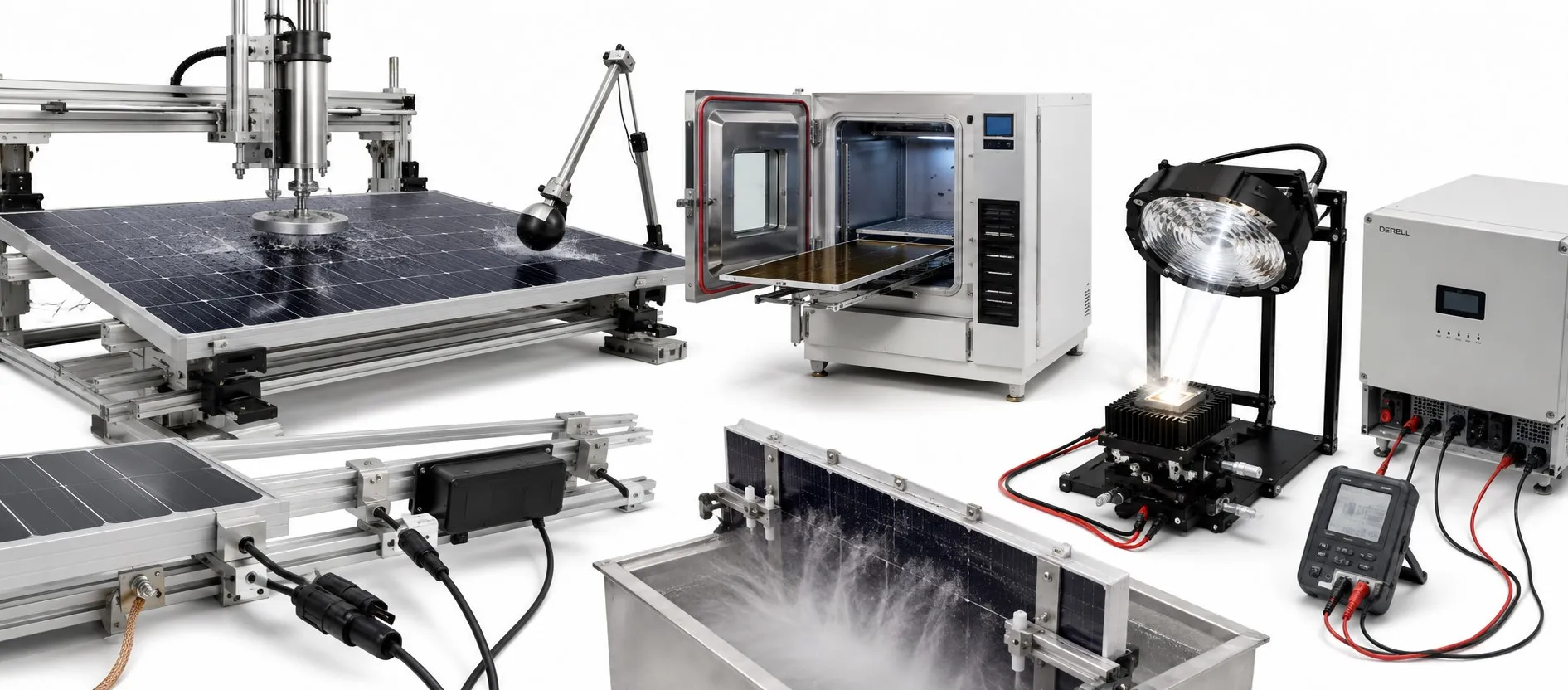
Solar energy standards: What does each standard cover?
No single standard covers an entire solar installation. Module safety, inverter safety, DC array design and commissioning checks are separate subjects. To request the right documentation, first identify the product or activity being assessed.
IEC standards establish common technical requirements and assessment methods. Compliance does not establish compatibility with every system, a guaranteed service life or a guaranteed annual yield. The solar modules, inverter and installation must be assessed together.
Module safety and design qualification
IEC 61730: Covers PV module safety qualification. Part 1 addresses construction requirements; Part 2 addresses safety testing. The assessment includes protection against electric shock, fire and mechanical hazards.
IEC 61215: Addresses design qualification and type approval of terrestrial PV modules. Its scope extends beyond crystalline silicon, with parts addressing thin-film technologies too. Passing these tests does not measure or guarantee a module's lifetime in years.
IEC 61646: May appear in older thin-film module documentation. This withdrawn standard's essential subjects were incorporated into the IEC 61215 family. For a new purchase, check the document's date, scope and acceptance requirements rather than relying on the old reference alone.
IEC 62108: Addresses design qualification and type approval of concentrator photovoltaic (CPV) modules and assemblies. CPV and ordinary flat-plate modules are different product categories; this standard is not a general requirement for every rooftop module.
Environmental resistance and field measurement
IEC 61701: Covers salt mist corrosion testing of PV modules. For coastal applications, the relevant test method and scope matter. A module passing the test does not establish that its mounting hardware or inverter is suitable for the same environment. An IP rating does not establish corrosion resistance either.
IEC 61829: Addresses on-site measurement of PV array current–voltage (I–V) characteristics, accompanying weather conditions and translation of results to reference conditions. Record measurement conditions rather than judging module quality from a single watt reading. Shading and module angle also affect production comparisons.
Does inverter safety establish efficiency?
IEC 62109: Addresses safety requirements for power converters used in PV systems. Part 1 covers general requirements; Part 2 covers particular requirements for inverters. Compliance alone does not establish high conversion efficiency or greater annual energy yield.
MPPT is a function that tracks the array's operating point. Its presence does not automatically provide battery compatibility, permission to connect to the grid or backup power during an outage. Check system compatibility against the exact model's input and output specifications.
DC array design, commissioning and maintenance
The IEC 62548 family: Addresses PV array design requirements. IEC 62548-1 covers subjects including DC wiring, electrical protection, switching and earthing arrangements. Describing it solely as a roof or mounting-structure standard misses its broader scope. Structural capacity and local building requirements require separate assessment.
Series and parallel connections change array voltage and current. Select cable sizes, protection devices and grounding arrangements as part of that design, rather than from total module wattage alone.
The IEC 62446 family: IEC 62446-1 addresses handover documentation, commissioning tests and inspection requirements for grid-connected PV systems. IEC 62446-2 focuses on maintenance. A product certificate alone does not show that the completed installation passed those checks. Retain installation and maintenance records throughout operation.
Where do UL 1703 and UL 1741 apply?
UL 1703: Appears in older safety documentation for flat-plate PV modules serving the North American market. New product evaluations have moved to UL 61730-1 and UL 61730-2. Verify acceptance of an older certificate with the relevant certification body and project requirements.
UL 1741: Covers inverters, converters, controllers and interconnection equipment used with distributed energy resources. Relevant supplements and grid rules also matter for grid-support functions. A UL certificate does not automatically authorize connection in another country. Grid-connected and off-grid systems have different requirements.
How should you check the documentation?
Check the exact model or covered model family, standard part and publication year, amendments where applicable, document number and issuing organization. A laboratory test report, a manufacturer's declaration and a product certificate are different documents. Where certification is claimed, match it to the issuing body's verification record.
The required standard and edition depend on the product, market and project. A standard number in a brochure does not establish that every legal and technical requirement has been met. Inverter selection also requires review of the manufacturer's instructions, connection requirements and necessary accessories. Environmental subjects such as electronic waste and RoHS must be assessed separately from product safety and energy efficiency.