
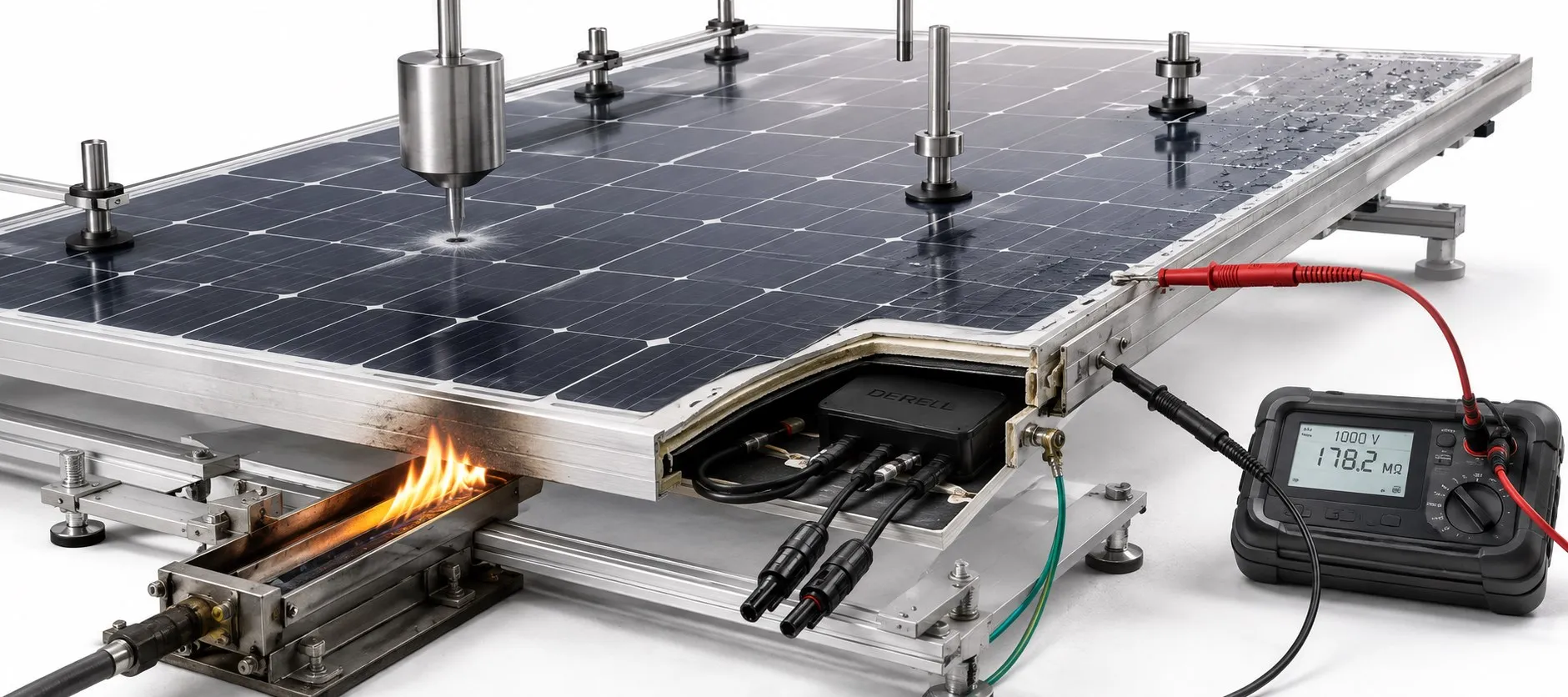
UL 1703 Explained: PV Module Safety and Legacy Certification
UL 1703 is a safety standard for flat-plate photovoltaic modules and panels. It addresses products installed on buildings, integrated into buildings or supported by freestanding structures. Its purpose is to assess safety concerns associated with a solar panel’s construction and operation.
When UL 1703 appears on a label or specification sheet, three questions matter: Does the certification cover this exact model? Is the certification still valid? Does the proposed installation fall within the approved conditions? Simply quoting a UL standard number does not answer those questions.
Why UL 61730 Now Matters
UL 61730-1 and UL 61730-2 align the U.S. approach with IEC 61730, while incorporating U.S. national differences. Part 1 addresses construction; Part 2 addresses testing. The relationship between these standards does not make an IEC certificate automatically interchangeable with a UL certification.
UL Solutions’ transition guidance allows previously certified UL 1703 products to continue bearing the UL Mark under the stated conditions. Changes to critical components or materials can trigger a new evaluation to UL 61730. A legacy certification reference is a reason to inspect the records, rather than automatic evidence that a module is unsafe.
What Does Module Safety Involve?
Insulation and electrical connections: The cell circuit, junction box, leads, accessible metalwork and insulation system all contribute to electrical safety. Where required by the product design, protective grounding and bonding must follow the approved installation method.
Mechanical integrity: Glass, frames, junction boxes and attachment points must remain suitable for their intended use. A stated mechanical load rating can depend on a particular mounting arrangement. Moving the clamps to a more convenient position may change the conditions under which that rating applies.
Materials and construction: Different solar panel technologies use different cell structures, encapsulants, glass arrangements and backsheet materials. Certification needs to cover the supplied construction, not simply another module sold under the same brand.
Fire Classification Depends on the Installation
For rooftop PV, the module is part of a larger assembly. The racking, roof covering and permitted installation arrangement affect the system’s fire performance. Assessing roof suitability for solar panels therefore requires more than checking the module’s label.
UL 2703 addresses PV mounting equipment and related bonding and grounding provisions. It is also used in determining the fire classification of rooftop PV systems involving specific modules and mounting systems. A module’s fire designation should not be assumed to establish the same result on every roof or with every rack.
For example, replacing an approved mounting arrangement with another system may require the combination to be checked again. The relevant evidence is the documented assembly and its installation limits.
Safety Certification, Design Qualification and Energy Output
These are separate questions. IEC 61215 addresses design qualification and type approval for terrestrial PV modules. Environmental and mechanical test results should be read with their applicable standard, edition and test sequence, rather than grouped together as a generic “panel quality certificate.”
A safety certification does not establish a particular module efficiency. Nor do qualification tests provide a precise prediction of service life. Product warranty, power-output warranty and certification scope should each be reviewed on their own terms.
Two modules with the same nameplate wattage can produce different amounts of energy at a particular site. Temperature coefficients, orientation and operating conditions contribute to the result. Understanding weather-related performance changes requires information beyond a safety mark.
Check the Environment as Well as the Certificate
A coastal installation may call for evidence relevant to IEC 61701 salt-mist corrosion testing. Agricultural sites may introduce ammonia exposure, while high-altitude or heavy-snow locations raise other application questions. A general claim that a module is certified does not establish suitability for every environment.
Ask for evidence that addresses the actual site conditions. Confirm the tested model, the scope of the assessment and any restrictions in the installation manual. This is more useful than collecting a long list of standard numbers without knowing what each one covers.
UL 1703 and UL 1741 Cover Different Equipment
UL 1703 concerns the module side of the system. UL 1741 addresses inverters, converters and associated equipment used with distributed energy resources. A module certificate does not establish the safety or grid-interconnection capability of the connected solar inverter.
Other standards, including IEC 62109, address photovoltaic power converter safety. Module, inverter and mounting-system documents serve different purposes. Approval of one component cannot be treated as certification of the entire installation.
How to Review a Panel’s Certification
Match the model: Compare the quotation, module label, datasheet and certification record. Similar model names, different power bins and revised product families should be checked against the actual scope of the record.
Verify the issuer: Request the certification body’s name and a traceable file or certificate number. Product iQ provides information for products certified by UL Solutions. Where another body issued the certification, use that body’s official records. Certification to a UL standard and certification by UL Solutions are different statements.
Review electrical ratings: Maximum system voltage, open-circuit voltage, short-circuit current and permitted protective-device ratings must fit the design. The PV array design still needs to establish suitable string lengths, conductors and protection. A certified module does not make those calculations unnecessary.
Keep the installation evidence: Retain the mounting instructions, component details and commissioning results. The IEC 62446 series provides relevant references for PV documentation, verification and maintenance. These records support later panel maintenance and help identify changes made after commissioning.
Can an Older UL 1703-Certified Module Still Be Used?
The standard number alone is insufficient for an acceptance decision. Check the certification status, physical condition, manufacturer’s instructions and project requirements. An original label on a used module cannot establish that its glass, junction box or insulation remains undamaged.
For new purchases, ask explicitly about current UL 61730 certification and any additional project requirements. For an existing installation, base the assessment on verified records, the condition of the equipment and appropriate inspection and electrical testing.