
Simatic S5 Memory Card
Siemens SIMATIC S5 Memory Cards and Memory Submodules
Siemens SIMATIC S5 memory cards include EPROM, CMOS EPROM, EEPROM, Flash EPROM and RAM products used to store user programs, communication data or special-module settings. The 372, 373, 374 and 375 designations do not identify a single memory technology or CPU connection. Select the part together with its host controller and programming equipment.
Compare the complete order number, capacity, short/long format, BYTE/WORD organization, programming number and hardware version. The capacity printed on a card may exceed the program memory that a particular CPU can use. The “S5 90/110” category path does not establish compatibility of every model with those systems.
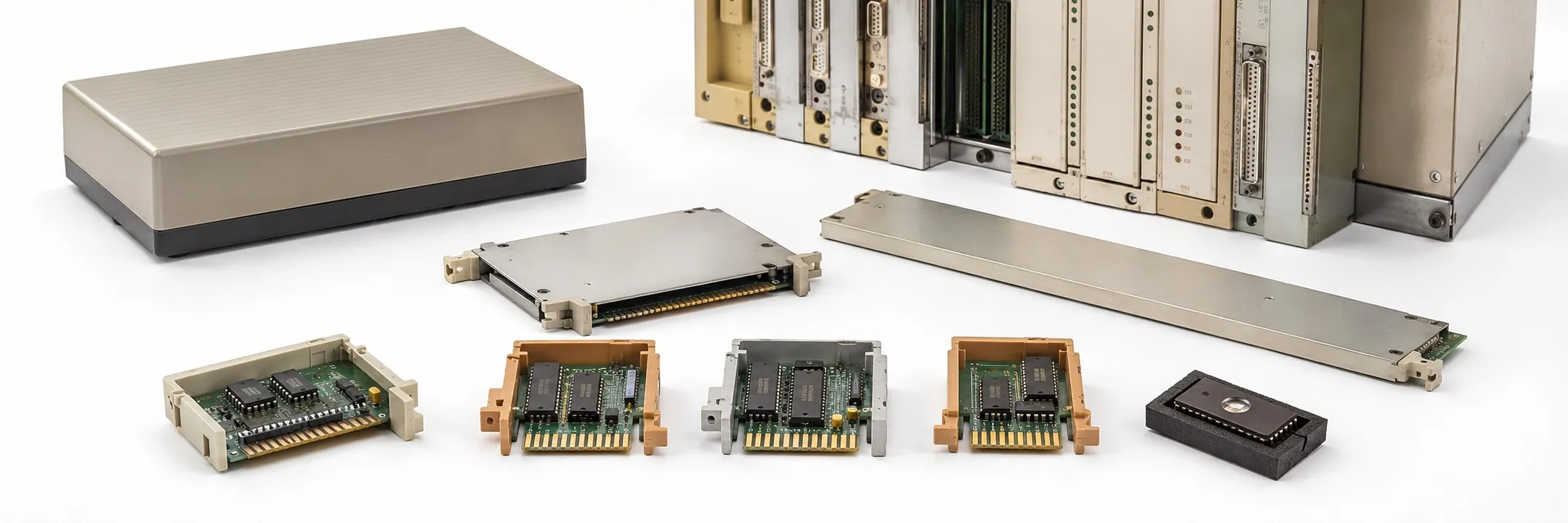
EPROM, EEPROM, Flash and RAM
UV-erasable EPROM is written with a suitable programmer and requires the appropriate UV erasing process before reuse. CMOS EPROM is not another name for EEPROM. EEPROM and Flash EPROM use electrical erasing/programming. RAM requires the host system’s applicable backup conditions to retain data when normal power is removed.
The submodule’s role also matters. A part used as CPU load memory may store message texts or CP configuration in another device. Copying from the card into internal RAM and evaluation at startup depend on the CPU/CP model and startup procedure.
372 and 373 EPROM submodules
6ES5 372-0AA51 is a 16 KB EPROM and 6ES5 372-0AA61 a 32 KB EPROM. Siemens’ legacy 372 table lists them as 8 K and 16 K instructions in WORD operation. Distinguish instruction/word capacity from byte capacity, and check the applicable older host and carrier arrangement.
6ES5 373-0AA21, 6ES5 373-0AA41, 6ES5 373-0AA61 and 6ES5 373-0AA81 provide respective 16 KB, 32 KB, 64 KB and 128 KB EPROM capacities. The 373-0AA81 capacity corresponds to 64 K 16-bit words. Determine the carrier, addressing and programmer organization from the exact documentation rather than capacity alone.
6ES5 373-1AA21, 6ES5 373-1AA41, 6ES5 373-1AA61 and 6ES5 373-1AA81 belong to the 373 CMOS EPROM group. The 1AA41, 1AA61 and 1AA81 versions provide 32, 64 and 128 KB respectively. NMOS and CMOS versions may use different programming numbers; preserve the setting required by the complete order number.
375 EPROM and CMOS EPROM options
6ES5 375-0LA11 and 6ES5 375-0LA15 are 8 KB EPROM versions. Although 0LA11 and 0LA15 have the same capacity, some programming arrangements distinguish their jumper configurations. 6ES5 375-0LA21 provides 16 KB and 6ES5 375-0LA41 32 KB EPROM. Equal capacity does not establish direct interchangeability in every device.
6ES5 375-1LA15, 6ES5 375-1LA21 and 6ES5 375-1LA41 are 8 KB, 16 KB and 32 KB CMOS EPROM options respectively. Check the supported CPU/CP and programming number for each model. In an S5-95F installation, also preserve the manual’s requirement for two memory submodules with identical order numbers.
375 EEPROM and RAM submodules
6ES5 375-0LC31 provides 8 KB and 6ES5 375-0LC41 16 KB EEPROM. Electrical erasing and programming require the appropriate PG and software. A writable EEPROM does not establish that every host CPU can update it in the same way during operation.
6ES5 375-0LD11, 6ES5 375-0LD21 and 6ES5 375-0LD31 are 8 KB, 16 KB and 32 KB RAM submodules respectively. Check the CPU or programmer, supported memory expansion and backup supply arrangement together. These parts must not be selected as direct substitutes for a nonvolatile EPROM backup.
374 short-format Flash cards
6ES5 374-1FH21 and 6ES5 374-1FJ21 are 256 KB and 512 KB short-format Flash EPROM cards. Distinguish the programming requirements of earlier Flash devices from the newer 5 V only generation. Reading voltage and programming voltage are different specifications.
6ES5 374-1KG11, 6ES5 374-1KH21 and 6ES5 374-1KK21 are 128 KB, 256 KB and 1 MB short-format 5 V only Flash EPROM options. The CPU 945 manual specifies programmer software version 6.6 or higher for these K-series cards. Compare the CPU’s supported organization and usable memory as well as card capacity.
374 long-format RAM and Flash cards
6ES5 374-2AH21 is a 256 KB long-format RAM card; 6ES5 374-2FH21 a 256 KB long-format Flash EPROM. Their data-retention and operating requirements differ despite equal capacity. In the CP 1430 TF, for example, a card stores the CP configuration database, which serves a different purpose from CPU program memory.
6ES5 374-2KG21, 6ES5 374-2KH21, 6ES5 374-2KK21 and 6ES5 374-2KL21 belong to the long-format 5 V only Flash EPROM group. The 2KH21 provides 256 KB, 2KK21 1 MB and 2KL21 2 MB. Select the complete card designation supported by the device; similar sockets are insufficient evidence that short and long cards are interchangeable.
IP 252 application-specific memory and controller structures
6ES5 374-0AA11 is associated with the IP 252 DR/SR drive and standard controller structures. 6ES5 374-0AB11 belongs to the DRS/SR extended controller structure with self-setting group. 6ES5 374-0BA11 is a separate IP 252 special memory version. These products must be evaluated as application-specific modules rather than general-purpose blank cards selected only by capacity.
Programming, backups and older carriers
Before programming, read and save the existing contents in a separate file. Select the exact model’s programming number, BYTE/WORD setting, PG adapter and software version. Perform a read-back comparison after writing. UV erasing applies to EPROM; EEPROM and Flash require their appropriate electrical process.
Older 340, 350 and 355 memory/carrier assemblies and 370, 376, 377 and 378 submodules require their own system arrangements. Check whether the carrier is empty or RAM-equipped, its submodule sockets and any required intermediate adapters. 985 erasing/programming equipment and 986 carrying accessories do not increase memory capacity.
Inspecting used memory cards
Provide the complete model, quantity, working/faulty condition, readable nameplate photographs and price. State whether a card is blank, programmed or has unknown contents. Identify contact condition, read/write test scope and RAM backup checks. An old program on a card does not establish that it is the correct program for your machine.
Editor’s note
Before removing a card from a working machine, back up the program and current settings. Do not rely on a single copy. The current CPU program may differ from an older card backup; record which machine and date each saved file belongs to.
Compare the complete order number before capacity. A 16 KB label alone is insufficient. Identify EPROM, EEPROM or RAM, short or long format, and BYTE or WORD organization. Missing one character can lead to testing a sound card in an unsuitable device.
Read and save an EPROM before erasing it. Erasing removes the previous program. Use the correct PG, programming number and erase method. For a card with modified jumpers, check the documented alteration as well as its label.
For RAM, check the backup supply and battery arrangement. Operation with power applied does not establish retention after a power failure. Follow the system maintenance procedure and obtain a backup before testing retention.
Check the programmer and software generation for Flash cards. Establish the requirements of a 5 V only card separately from an earlier version. Distinguish read-back verification from a loading test in supported hardware; reading a card alone does not prove that the machine will operate.
Agree the condition, contents and test scope before buying used memory. Workshop testing is possible, with the method determined by the hardware. All sales require an invoice; returns are not accepted. To offer S5 memory for sale, send the model, quantity, condition, nameplate photographs and asking price to otomasyonavm@gmail.com.
OtomasyonAVM resources and PDFs
For host-system selection, see About Siemens S5 PLCs, the SIMATIC S5 main page and S5 CPU models. Use the S5 system manuals and PDF files archive for programming and memory tables matching the complete CPU/CP code and document edition.
Related topics
Review S5 central and expansion units, S5 cables and connectors, S5 interface modules, S5 special modules, S5 racks and mounting frames and S5 power supplies when selecting memory equipment.
Browse SIMATIC S5
+ SIMATIC S5 | Siemens S5 PLCs | S5 module groups | Used Siemens equipment | All used equipment
Siemens and external references
+ S5-115U Programmable Controller Manual — EWA 4NEB 811 6130-02b, Edition 04; English.
+ S5-115U CPU 945 Manual — 6ES5998-3UF21, Edition 06; section 2.3.1; English.
+ CP 521 SI Communications Processor Manual — EWA 4NEB 812 6072-02b, Edition 03; English.
+ SIMATIC S5 PG 615 Manual — GWA 4NEB 810 1105-01; table 2.9; German.
+ WF 470 Technical Description — 6ZB5 440-0QS02; 12/1994, section 2.5.5; English.
+ S5-150U Manual — 350 Carrier and 370/372/373 Memory Submodules — C79000-B8500-C236-07 included in manual; German.
+ CP 1430 TF with COM 1430 TF — Volume 1 — B8976074/01; section 4.1.4; English.
+ IP 252 and COMREG Manual — EWA 4NEB 811 0480-02; section 4.1; English.
+ Siemens CP 516 Documentation and 5 V Memory Card Product Information — Siemens bulletin 4202137 in archive compilation; German/English; Siemens document, external archive copy.
+ S5-95F Programmable Controller Manual — EWA 4NEB 812 6220-02; section 2.5.6; English.