
How does changing defrost control settings affect the storage life of food?
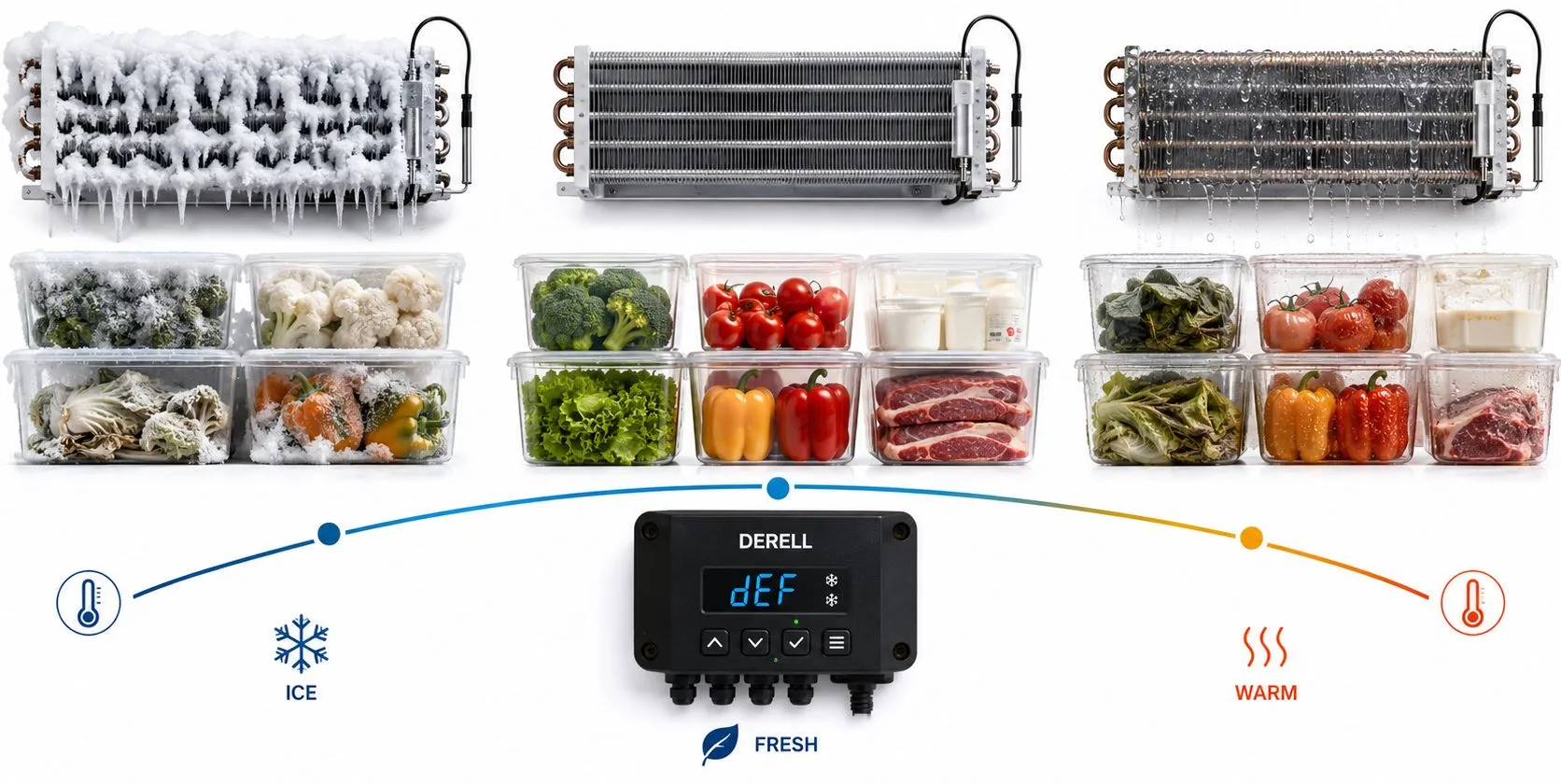
How do defrost settings affect food storage life?
Defrost control removes ice from the evaporator to support refrigeration system performance. The purpose of defrost is not to warm the food. Its effect on storage life depends on the temperature reached by the product, the time spent at that temperature and its storage conditions. A parameter change cannot be assumed to add the same storage time to every food.
Normal defrost does not necessarily thaw the food: A refrigerator’s operating cycle may produce brief changes in air temperature. Air, product surfaces and product cores do not change temperature at the same rate. Automatic defrost does not establish that food thaws and refreezes during every cycle. A rise in air temperature alone proves neither product thawing nor food safety.
Unnecessarily frequent or prolonged cycles: Excessive heating during electric defrost can increase the heat that must be removed and the associated energy consumption. If product temperatures leave their required range, assess the quality or safety implications. The aim of defrost settings is adequate frost removal and suitable temperature recovery, rather than the fewest possible cycles.
Insufficient defrost can also impair storage conditions: Thick ice restricts evaporator airflow and heat transfer. Some areas of the cabinet may receive inadequate cooling. Extending the defrost interval therefore does not always protect food better. Door openings, loading arrangements and blocked air passages can also affect the result.
Termination temperature is not food temperature: In suitable systems, defrost termination temperature is measured by the evaporator probe. Do not confuse it with the product’s storage target. Maximum duration, drip time and fan delay work together; changing the termination value alone does not establish a suitable cycle.
Measurement must be reliable: The type, temperature curve and placement of an NTC or PTC probe matter. Without confirmed probe compatibility, adjustments may be based on incorrect readings. Remember the difference between a sensor and a thermostat: a cabinet probe generally measures at its location, rather than directly representing every food’s temperature.
Interpret the display correctly: Some controllers can show the pre-defrost reading, setpoint or a “dEF” message during defrost. Returning to the actual temperature display may also be delayed. An unchanged number does not establish an unchanged cabinet temperature. Verify conditions with an appropriate independent thermometer and a temperature history where needed.
General guidance for domestic appliances: FDA guidance recommends 4 °C or below for the refrigerator and −18 °C for the freezer. These are not universal food storage times or defrost termination settings. Follow the product’s labelled temperature and time requirements. Commercial applications should follow product storage requirements and the business’s validated food safety plan.
Distinguish quality loss from safety risk: Actual thawing and refreezing can reduce quality through moisture loss and texture changes. Safety depends on the product’s temperature history. When assessing food safety during defrost, appearance or smell alone is insufficient. Cooling or freezing food again does not automatically remove risks caused by improper storage.
Assess humidity and packaging together: Humidity control depends on the product, packaging and storage method. “Meat and dairy products generally need low humidity” is not a reliable universal rule. Suitable containers and packaging help limit moisture loss and drying; the same humidity setting should not be applied to every product.
Records and alarms help validate settings: Suitable equipment can provide temperature and cycle data over RS485 communication using Modbus RTU. Assess fault symptoms and the effects of defrost failure using records from before, during and after the cycle. Review alarm delays too; the absence of an alarm alone does not establish safe storage. Any repair or replacement should follow measurements and functional checks.
How should a change be evaluated? Verify the technical specifications, probe assignments and existing cycle logic. Control technology selection and the controller model must suit the product requirements. After adjustment, assess frost removal, drainage, airflow and temperature recovery together. Success means verifying the required storage conditions, rather than estimating extra shelf life.