
What is a simple time relay?
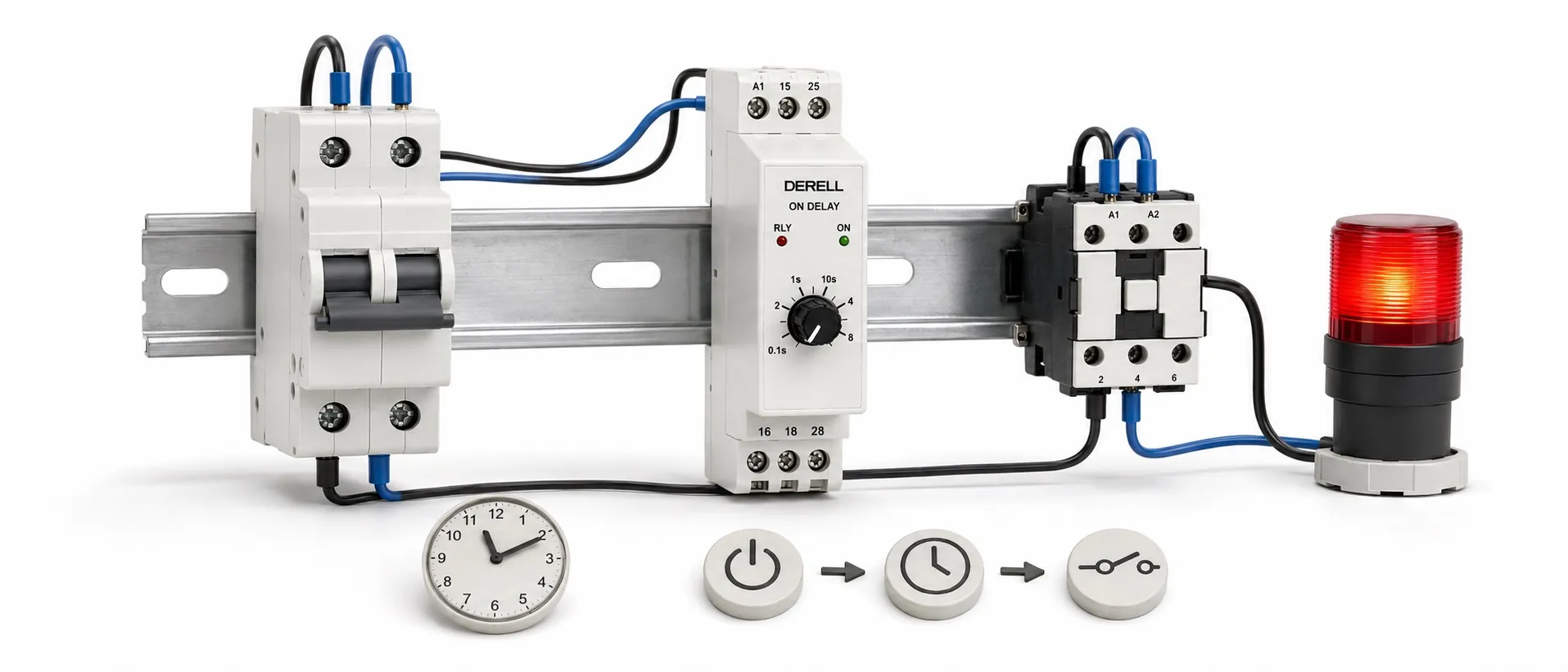
Giving a control signal a defined timing behaviour
Hello. A simple timer relay is a control device that establishes a defined timing relationship between a starting condition and a change at its output. It might activate an output three seconds after receiving a signal, or keep the output active for a period after that signal disappears. A timer relay's behaviour depends on its operating function, time setting and wiring arrangement.
Editor's note: “Simple” does not necessarily mean mechanical, analog-adjusted or fitted with only one contact. The term generally refers to a limited set of basic timing functions. A multifunction model can also perform a single delay; what matters is whether the selected mode gives the required circuit behaviour.
The timing mechanism and output are different
The main sections of an electronic timer relay are its supply, any control inputs, timing circuit and output stage. The electronic circuit measures time; it may then operate electromechanical relay contacts or a semiconductor output. Having contacts does not mean the device measures time using gears. Mechanical and motor-driven timers use a different construction.
The name solid-state timer does not, by itself, establish that the load output is an SSR; it may describe the electronic timing section. With solid-state-output timers, check the output technology, AC/DC compatibility and load limits separately. Electronic timing and contactless load switching are distinct characteristics.
Three basic operating behaviours
ON-delay: In on-delay operation, the starting condition occurs and timing begins; the output becomes active after the selected delay. The demonstration below assumes that the input remains active throughout the delay. Removing it early resets timing without activating the output.
OFF-delay: In off-delay operation, the output can remain active for a selected period after the control signal is removed. Many signal-triggered models require a continuous supply during this interval. Devices designed to time after power removal behave differently; use the specific product's timing diagram.
Repeated cycling: A flasher timer relay repeats on and off periods. Some models use equal periods; others allow independent adjustment. A single delay, a timed output pulse and a repeating cycle are different functions.
Try a three-second ON-delay
Start keeps the demonstration input active for six seconds. The lamp turns on after the three-second countdown; input and output switch off at six seconds. Reset ends the demonstration at any point. This is a timing illustration, rather than an electrical wiring diagram.
How is the delay set?
Select the operating function, then the seconds, minutes or hours unit and appropriate range. Finally, adjust the dial or numerical value. A setting of “3” might mean three seconds or three minutes depending on the selected range. Looking only at the knob during timer adjustment can hide an incorrect unit or range selection.
Setting resolution, actual timing accuracy and repeatability are separate properties. Consistent cycle times do not establish that the device matches its dial setting without error. Check the specified accuracy and applicable supply and temperature conditions.
Distinguishing supply, input and contacts
Before building a timing circuit, answer three questions: What supply voltage does the device require? Does timing start from power application or a separate input? What load will its output switch? A 24 V DC model and a 230 V AC model are not interchangeable using the same connections. Matching pin counts do not guarantee matching socket arrangements.
Volt-free contacts switch an external circuit; they do not generate an output voltage. NO means normally open and NC normally closed; their behaviour during timing depends on the selected mode. During selection and installation, consider contact voltage, load type, inrush current and switching frequency together. Use a suitable interposing relay or contactor where required.
Application examples and their limits
Simple timer relays can provide sequential starting, fan run-on, short waits or timed operations in electrical control applications. However, delaying a motor start does not create a current or speed ramp. Likewise, running a pump for a fixed time does not measure water level.
Star-delta changeover requires an appropriate output arrangement and transition interval. Daily clock-based operation calls for a real-time-clock timer, while lighting that follows sunset calls for an astronomical time switch. Elapsed-time delay, daily scheduling and sun-based switching address different requirements.
A general-purpose timer relay must not replace an emergency-stop or guard-monitoring safety relay. Safety functions require additional capabilities such as fault detection, prevention of unintended restart and appropriate output behaviour. A safety-related delay needs suitable safety equipment and a validated circuit design.
Which type suits a straightforward task?
Consider an analog-adjusted timer relay for quick dial setting, or a digital timer relay for numerical adjustment and, on suitable models, remaining-time indication. Multiple steps or conditions may justify a programmable timer relay. Choose a product that performs the required function clearly and correctly, rather than selecting by function count alone.
What should be checked if it does not work?
Check the supply, selected mode, time unit, starting signal and output wiring in sequence. A very short trigger pulse may not be detected by some models. Insufficient reset time can also affect the next cycle. Minimum input-pulse and power-off durations depend on the device.
During fault diagnosis, distinguish an output LED indication from actual contact switching. If the LED is on but the load does not operate, inspect the contacts, socket and load circuit. If a momentary pushbutton pulse must initiate a complete cycle, confirm that the device supports that function; an ordinary ON-delay circuit does not inherently latch the command.
Related products and topics
Timer relays, analog timer relays, timer relay prices and timer relay types.