
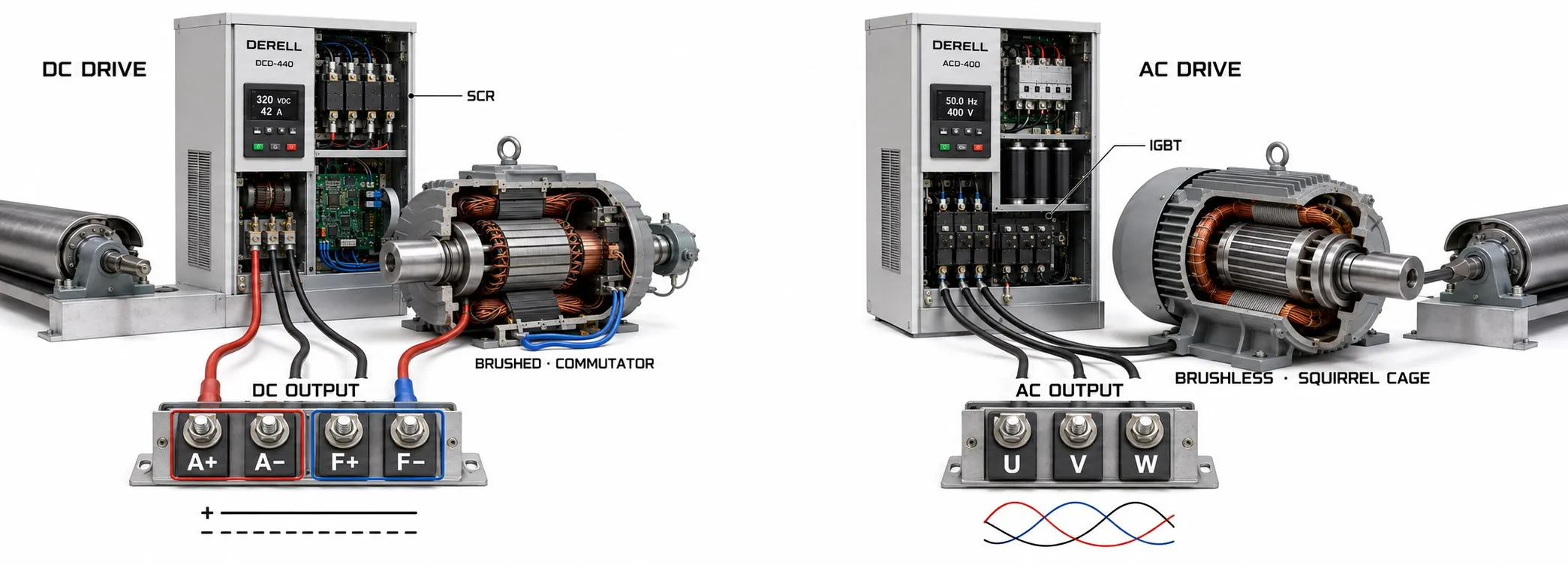
DC Drives vs AC Drives: What Actually Changes?
The practical difference between a DC drive and an AC drive starts with the motor each one is designed to control. A conventional DC drive regulates the armature supply of a brushed DC motor and, where required, its field supply. An AC variable frequency drive, or VFD, produces a controlled, variable-frequency output for a compatible AC motor. Neither description, by itself, tells you which system will deliver better accuracy or lower operating costs.
This guide compares industrial brushed DC drive systems with AC motor and VFD systems. Brushless DC controllers and servo systems need a little more explanation because their names do not map neatly onto that distinction.
1. “DC Drive” Does Not Necessarily Mean a DC Power Supply
Many industrial DC drives run from the AC mains. A controlled rectifier converts that incoming supply into an adjustable DC output for the DC motor. Separately excited motors also need a suitable field supply. Battery-powered DC controllers use a different power arrangement, so they should not be treated as interchangeable with a mains-fed industrial drive.
A typical VFD also contains DC internally. Its rectifier feeds a DC link, and an inverter stage switches that energy into the output needed by the AC motor. With pulse width modulation, the voltage at the motor terminals consists of switching pulses rather than a pure sine wave.
Check the supported motor technology before choosing a drive. A VFD designed for induction motors does not automatically support every permanent-magnet or synchronous motor. Likewise, a conventional brushed DC drive cannot directly replace the electronic commutation controller required by a BLDC motor.
2. Control Performance Depends on More Than AC or DC
For a DC motor operating at approximately constant magnetic flux, torque is approximately proportional to armature current. That relationship makes DC speed and torque control relatively straightforward. It does not establish a universal performance advantage over an AC drive.
On the AC side, basic volts-per-hertz control and vector control offer different capabilities. A properly selected and commissioned AC system can provide precise speed regulation and strong torque performance. The relevant comparison is between complete control systems operating under the same load conditions.
For demanding low-speed operation, consider whether encoder feedback is required, how the motor will be cooled, and how much continuous current the system can sustain. Acceleration and load recovery also depend on mechanical inertia, shaft compliance and tuning. These factors shape the system’s dynamic response, regardless of its AC or DC label.
3. Brushes Belong to the Motor, Not the Drive
Brush replacement is a brushed DC motor maintenance task. It is not maintenance of the electronic drive itself. Brush wear, commutator condition and carbon dust are part of DC motor maintenance. A squirrel-cage induction motor eliminates that brush-and-commutator assembly, but still needs appropriate bearing, insulation and cooling checks.
Both AC and DC drives have their own service requirements. Cooling fans, electrical connections and components that age with temperature or operating hours may need attention. The appropriate drive maintenance schedule depends on the hardware and its environment. Switching to AC can reduce motor maintenance without making the entire installation maintenance-free.
4. Braking Energy Needs Somewhere to Go
During deceleration or when an overhauling load drives the shaft, a motor can generate electrical energy. What happens next depends on the power circuit. There are regenerative and non-regenerative DC drive configurations; regeneration is not an automatic feature of every DC drive.
A conventional VFD with a diode input rectifier cannot return DC-link energy to the mains through that rectifier. A compatible brake chopper and braking resistor can dissipate the energy as heat. Returning it to the supply requires a regenerative front end or a suitable regeneration unit. Some AC drives include that capability within the drive package.
Resistor braking and energy recovery are different functions. Frequent deceleration, unwinding duty and descending loads can make the energy path a major selection factor. Electrical braking also does not automatically replace a mechanical holding brake where the machine requires one.
5. Efficiency and Cost Require a System-Level Comparison
There is no reliable rule that says every AC system is more efficient, or every DC system is cheaper. Assess drive-system efficiency across the actual duty cycle: motor losses, converter losses, cooling demand, operating hours and braking energy all matter. Part-load efficiency should come from the specific equipment data, rather than assumptions based on motor type.
Cabinet size is equally application-dependent. Input reactors, filters, braking equipment, ventilation clearances and other drive-system components can change the installation footprint substantially. Compare the complete assembly and include downtime, maintenance and spare parts when estimating ownership cost.
6. Where Do Servo Drives Fit?
A servo system is defined by its controlled motion and feedback architecture, rather than simply by the letters AC or DC. Many industrial servo motors use permanent-magnet synchronous construction, while other servo systems use DC motors.
The servo drive and motor combination must support the required feedback, electrical characteristics and motion functions. Fast indexing, coordinated axes and repeatable positioning are reasons to assess a servo solution. Some advanced VFDs also offer positioning functions, but adding an encoder to a general-purpose VFD does not automatically give it the capabilities of a dedicated motion system.
7. Match the Architecture to the Job
| Machine requirement | Option to evaluate | Main decision factors |
|---|---|---|
| Existing production line with a serviceable DC motor | Replace or upgrade the DC drive | Motor condition, shutdown window and maintenance costs |
| Variable-flow pumping or ventilation | Compatible AC motor and VFD | Process demand, load curve and operating speed range |
| Winding, unwinding or web tension control | Suitable DC, vector AC or servo system | Torque accuracy, changing roll diameter and braking duty |
| Fast, repeatable positioning | Servo or another suitable motion control system | Cycle time, load inertia and positioning tolerance |
In established DC drive applications such as rolling mills, extruders and paper machinery, retaining a healthy motor may be a sensible retrofit strategy. For winding and unwinding, the method of measuring and regulating tension can matter as much as the choice of motor technology.
8. Can a VFD Replace a DC Drive?
A standard AC VFD cannot directly operate a conventional brushed DC motor. Converting a DC installation to AC usually involves replacing the motor as well as the drive. Shaft dimensions, mounting arrangements, gearing, base speed, cooling, feedback and brake connections all need review. Matching the old motor’s kilowatt rating alone does not guarantee the required torque across the operating speed range.
Before selecting a replacement drive, establish the motor data, continuous and peak current requirements, minimum and maximum speed, and braking duty. If the machine also needs position control, include the relevant servo motor selection criteria. A useful comparison starts with a defined machine duty and checks which complete system can meet it reliably at an acceptable lifetime cost.