
What are the typical applications for DC drives?
Where are DC drives used? Applications and control requirements
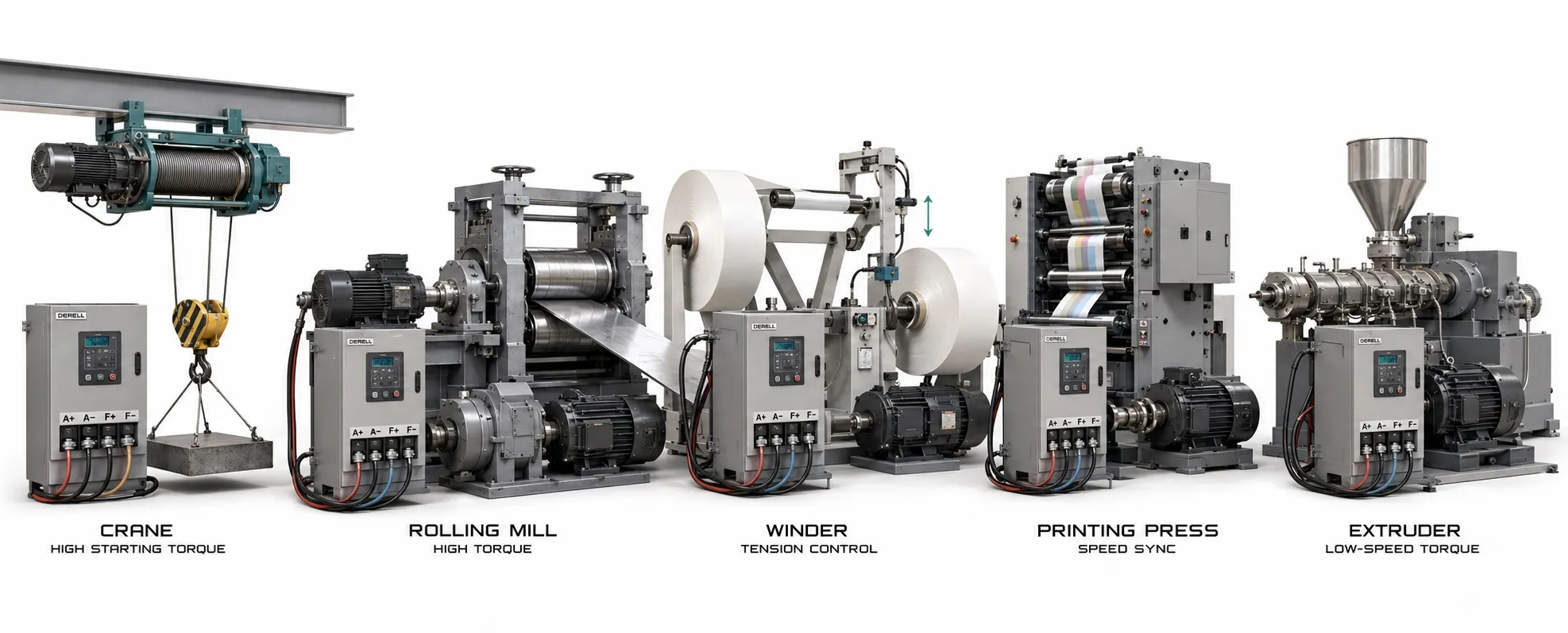
DC drives are used on conveyors, winders, extruders, rolling mills, paper and printing machinery, mixers and suitable DC-motor lifting systems. What connects these applications is the need to manage speed, torque and, in some cases, braking energy. The machine's operating cycle determines which capabilities are required.
The term DC drive covers different equipment. A line-fed industrial thyristor converter and a battery-powered motor controller are not interchangeable products. Start with the actual motor technology and supply arrangement. A DC battery does not, by itself, identify the type of motor connected to it.
Conveyors: maintaining throughput as the load changes
A conveyor drive must do more than turn a belt. It may need to hold speed as products arrive, accelerate without disturbing the load and follow the production rate of another machine. In a DC-motor installation, the selected control arrangement regulates armature voltage and current to meet that duty.
If a belt slows when material is added, the required load torque has increased. Suitable speed feedback allows the controller to respond, provided the motor and converter have enough capacity. Higher control gain cannot compensate for a jammed mechanism or an undersized drive.
Winding and unwinding: coordinating speed, diameter and tension
Film, paper, foil, wire and textile winding processes present a changing load geometry. As a winding roll grows, its rotational speed must decrease to maintain the same material speed. At the same time, maintaining a given web tension requires more roll torque.
A roll example: Ignoring losses and acceleration, T = F × r. A 100 N web force requires 10 N·m at a roll radius of 0.10 m and 20 N·m at 0.20 m. At unchanged line speed, doubling the radius halves the roll rpm. These are roll-shaft values; motor calculations must also account for gearing and efficiency.
This is why constant torque does not mean constant tension on a changing-diameter roll. The torque demand may be adjusted using a diameter estimate or a tension loop with appropriate process feedback, such as a load cell or dancer mechanism. The design must also address the sudden loss of load if the material breaks.
Extruders and mixers: handling variable process resistance
On a DC-driven extruder, screw speed influences throughput and processing conditions. Changes in material temperature, viscosity or feed can change the required shaft torque. The drive regulates speed within its current and voltage limits, but stable screw speed alone cannot guarantee product quality. Barrel temperatures, pressure and material preparation remain part of the process.
Mixers and kneaders can have different torque requirements at startup and during later stages of a batch. Check continuous loading, short-term overload and cooling at low speed. A nominal kilowatt rating does not describe the complete duty cycle. Current limiting should not automatically be treated as a substitute for any independent mechanical protection the machine requires.
Rolling mills and metal processing: responding to abrupt load changes
Where DC motors are installed, DC converters can serve rolling stands, strip-processing equipment and coiler or uncoiler sections. Material entering the rolls can create a rapid load change. Some processes also demand frequent reversals and controlled electrical braking.
High starting torque is a rated capability, not permission to apply unlimited current. Converter overload limits, motor commutation and the mechanical transmission must all be respected. The required dynamic performance depends on the complete motor-drive-load combination and its commissioning.
Paper, printing and textiles: controlling a connected line
Draw rolls, printing cylinders and winding sections often need coordinated motion. Equal motor rpm is not necessarily the objective: surface speed and material tension are what the process experiences. Two rolls with different diameters have different surface speeds at the same rpm.
A PLC interface can coordinate line references, speed ratios and operating sequences. Accurate print registration may additionally require position feedback and suitable motion-control functions. When another section is added, review multidrive coordination and the stopping behaviour of the whole line.
Cranes and hoists: managing an overhauling load
Some crane and hoist installations use DC motors and compatible DC drives. Raising a load requires motoring torque. During some lowering conditions, the load can drive the motor and return electrical energy to the converter. Selecting the system therefore involves torque direction and energy flow as well as speed.
Four-quadrant capability enables motoring and braking in both directions; it does not replace the mechanical holding brake. Brake sequencing, limits, overspeed response and fault handling must suit the application. Crane safety concerns the complete machine. A general-purpose drive is not suitable for lifting simply because its power rating is sufficient.
Test stands: driving a specimen or applying a controlled load
A suitable DC motor-drive system can rotate equipment at a commanded speed or apply opposing torque to load it. The test requirements determine the necessary speed-torque envelope and whether the system must support both motoring and generating operation. Any returned energy needs a defined destination.
A drive's calculated torque value is not automatically equivalent to an independent, calibrated torque measurement. Where measurement accuracy matters, specify the complete measurement chain. In regenerative arrangements, evaluate energy performance using the actual test cycle rather than assuming that all braking energy will be recovered.
Treadmills and battery-powered equipment: a different class of controller
Some treadmills, small transport vehicles, mobility equipment and golf vehicles use brushed DC motors with electronic speed controllers. A PWM power stage can regulate motor current and average voltage. A treadmill's DC motor may be supplied through a mains-powered converter rather than a battery.
Battery applications require attention to the operating voltage range, starting current, braking behaviour and the battery system's ability to accept returned energy. Battery-powered does not mean brushed-DC-driven. An electric vehicle may use an inverter-fed AC motor or a brushless motor, requiring a different controller from a conventional brushed DC design.
Pumps, fans and legacy transport systems
A pump or fan with an existing DC motor can use a compatible DC drive for speed regulation. The application name alone does not establish that DC is the best choice. Compare the installed motor, process requirements, maintenance needs and complete system cost.
DC motor technologies also appear in some older lift and railway traction systems. These require specialised control, braking and safety arrangements. A standard industrial converter should not be assumed suitable merely because its voltage and current ratings appear to match.
Choose for the duty, not just the industry
Define whether the machine needs regulated speed, controlled torque, material tension, accurate position or repeated braking. Where positioning matters, evaluate the required servo functions explicitly. Good speed regulation does not, on its own, establish positioning accuracy.
A practical DC drive selection considers armature voltage and current, field excitation where applicable, overload duty, minimum speed, feedback and braking. After confirming motor compatibility, size the cooling and other supporting equipment for the actual installation.