
Faq For Blockchain
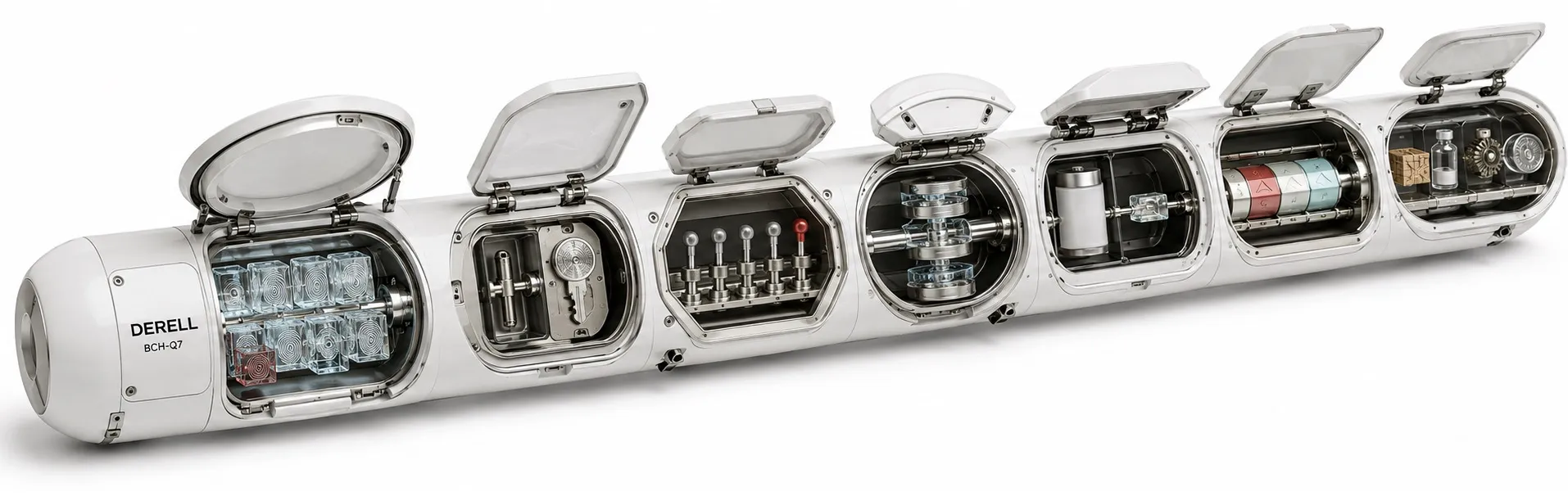
The image above treats blockchain as a chain of independent but connected technical stations. That is a useful way to look at the technology: individual systems generate events, while the network keeps a verifiable history of how those events were recorded and linked. The interesting part is not cryptocurrency itself, but what happens when several parties need to trust the same history without handing complete control to one database owner.
Blockchain FAQ: From the Basic Idea to Industrial Use
Blockchain is a distributed record-keeping approach in which transactions or events are grouped, verified according to predefined rules and linked using cryptographic methods. It is often introduced through Bitcoin, but cryptocurrency is only one application of the underlying idea.
For industrial users, the more useful question is not “What coin does it use?” but rather: Can several machines, companies or systems share a record whose history is difficult to alter without leaving evidence?
That question becomes relevant in Industry 4.0, Industrial IoT, distributed manufacturing, machine-service records, supply chains and multi-company data exchange.
Blockchain should not be confused with a PLC, SCADA system, historian or fieldbus. Those systems still perform the actual control, acquisition and communication work. Blockchain, where it makes sense, sits further up the architecture as a record, verification and trust layer.
1. What Is Blockchain Technology?
A blockchain is a shared digital ledger in which records are organised into blocks and linked to earlier records using cryptographic information. Copies of that ledger may exist on several network nodes rather than inside one central database.
The word immutable is often used here, but it can be misleading if taken literally. A better practical description is that a properly designed blockchain makes historical manipulation difficult to hide and increasingly costly to perform.
2. How Does Blockchain Work?
A transaction, measurement reference or event is submitted to the network. Depending on the blockchain architecture, selected nodes check whether the record satisfies the required rules. Valid records are then grouped and linked to the existing history.
The important industrial limitation is easy to miss: blockchain can protect the history of a record, but it cannot guarantee that the original measurement was correct. If a faulty pressure sensor reports the wrong value, blockchain may preserve that wrong value perfectly.
For that reason, sensor quality, calibration, acquisition hardware and data logging remain just as important as the ledger that stores the event history.
3. What Makes a Blockchain Different?
Distributed records: More than one node can maintain or verify the ledger.
Cryptographic linking: Records are mathematically linked to previous records.
Validation rules: New data is accepted according to the rules of the network.
Traceable history: The order of recorded events can be followed.
Tamper evidence: Silent historical modification becomes harder.
Controlled participation: Permissioned networks can restrict who may read, write or validate data.
None of these features means a blockchain is automatically “unhackable.” Compromised credentials, stolen cryptographic keys, weak software, poorly secured gateways or manipulated field devices can still undermine the overall system. Blockchain therefore belongs inside a wider industrial cybersecurity strategy, not outside it.
4. Are All Blockchains Public?
No. Public cryptocurrencies have made open networks familiar, but industrial blockchain projects are often designed very differently.
Public blockchain: Participation is broadly open and the network is not operated by a single organisation.
Private or permissioned blockchain: Participation is restricted to approved users or systems.
Consortium blockchain: Several organisations jointly govern the network.
Hybrid architecture: Public and private mechanisms may be combined depending on what must remain confidential and what must remain independently verifiable.
A factory normally has very different requirements from a cryptocurrency network. Machine identities, supplier access, maintenance records and production information usually demand controlled permissions, which is why permissioned architectures are often more relevant to industrial projects.
5. What Is a Smart Contract?
A smart contract is program logic stored or executed within a blockchain environment. When predefined conditions are satisfied, the program can trigger another operation automatically.
The name can be confusing. A smart contract is not automatically a legal contract. In industrial systems it may simply represent logic such as: inspection approved → shipment status released, or service record confirmed → maintenance stage completed.
6. Is Blockchain the Same as Cryptocurrency?
No. Cryptocurrency is one application built with blockchain technology. Bitcoin uses its own blockchain and digital currency. Ethereum is a blockchain platform whose native digital asset is Ether (ETH). Other blockchain systems may have no cryptocurrency function at all.
In an industrial plant, blockchain may be used to document the history of a component, verify a maintenance event or coordinate records between independent organisations without any cryptocurrency being involved.
7. Where Can Blockchain Be Useful?
Possible applications include finance, logistics, product provenance, document verification, digital identity and multi-party supply chains. Industrial environments add several more practical examples:
Machine service history: Recording maintenance and component changes across several service organisations.
Production traceability: Linking batches, inspections and process events.
Calibration records: Keeping a verifiable history of calibration and verification events.
Supply-chain records: Sharing product history between manufacturer, logistics company, distributor and customer.
IIoT event verification: Preserving selected machine or gateway events across organisational boundaries.
Energy records: Sharing verified production or consumption data where several parties are involved.
These applications can overlap with digital twin, big data and analytics and IIoT systems, but the technologies solve different problems.
8. What Are the Main Limitations?
Throughput: A distributed validation process may process data more slowly than a conventional database.
Latency: Some architectures are unsuitable for time-critical control loops.
Data volume: Writing every sensor sample directly to a blockchain is rarely sensible.
Integration: Existing PLC, SCADA, MES, ERP and database systems still need interfaces.
Privacy: Shared verification must be balanced against confidential production information.
Key management: Lost or compromised cryptographic credentials can become a serious operational problem.
Complexity: A blockchain can be an expensive answer to a problem that a conventional database already solves perfectly well.
That last point matters. The fact that blockchain can be used does not mean it should be used.
9. Can Blockchain Control Machines in Real Time?
Normally, no. A PLC scan, servo position loop or deterministic field network has requirements that are completely different from those of a distributed ledger.
Real-time machine control remains the job of PLCs, motion controllers, drives and appropriate industrial communication systems. Blockchain may record selected events above that layer: who approved a batch, when a service operation took place or whether a shared record was altered.
Where large amounts of IIoT data are involved, edge computing can first filter, aggregate or analyse the raw data. Only the event, hash or summary that actually needs independent verification may then be passed to the blockchain layer.
10. Does Blockchain Have a Future in Industrial Automation?
Probably not as a universal replacement for existing industrial databases—and that is not what it needs to be.
Its strongest use case appears when several independent parties need to rely on the same history but none of them should quietly control or rewrite that history alone. A single machine inside one factory usually does not need that level of distributed trust. A product moving between manufacturer, subcontractor, maintenance provider, logistics company and end customer may.
Energy use must also be judged by the actual blockchain architecture. Different consensus mechanisms have very different energy requirements, so environmental impact should not be generalised from one network to every blockchain system. Related issues can also be considered within the wider subject of carbon footprint.
The practical test is simple: if one trusted organisation already owns the system, controls the database and all participants are comfortable with that arrangement, blockchain may add little value. If several independent parties need a common history without giving one of them complete authority over it, then the technology becomes much more interesting.
Blockchain Basics and FAQ
Use the topics below to move from basic concepts to security, scalability and practical use.
+ What does blockchain do in everyday life?
- What is blockchain technology?
- How does blockchain work?
- What is the difference between Bitcoin and blockchain?
- What are the advantages of blockchain?
- Is blockchain secure?
- How is blockchain used?
- In which sectors is blockchain used?
- How does blockchain protect data?
- Are there any disadvantages to blockchain?
- What impact could blockchain have in the future?
- Can blockchain transactions be reversed?
- Who participates in a blockchain network?
- What are the environmental impacts of blockchain?
- How can blockchain technology be scaled?
- What are the most common misconceptions about blockchain?
Blockchain in Industrial Automation
In automation, the useful questions are less about cryptocurrency and more about data integrity, device identity, traceability, cybersecurity, shared records and cooperation between independent organisations.
- How can blockchain enhance the security of industrial automation systems?
- How can blockchain be used for data exchange between Industrial IoT devices?
- How can blockchain improve industrial supply-chain management?
- What are the advantages of blockchain-based smart contracts in industrial automation?
- How can blockchain be used to protect industrial data integrity?
- How can blockchain support cybersecurity in industrial automation systems?
- How can blockchain be integrated with real-time industrial monitoring and analysis?
- How does blockchain affect industrial automation performance?
- Is blockchain cost-effective in industrial automation?
- How does blockchain affect scalability and flexibility?
- What technical challenges arise when blockchain is introduced into industrial automation?
- How can blockchain be used while protecting industrial data privacy?
- How can blockchain protocols be standardised in industrial automation projects?
- How can blockchain support industrial data sharing and collaboration?
- What could the future of blockchain integration in industrial automation look like?
Related Automation Topics
Industry 4.0 | Industrial IoT | Internet of Things | Industrial Communication
Data Logger | Big Data and Analytics | Edge Computing | Cloud Computing
Industrial Cybersecurity | Digital Twin | Industrial Standards | Carbon Footprint
→ Back to the What Is Automation? Knowledge Hub
This section focuses on the practical engineering side of blockchain. Whether the technology is appropriate for a real project depends on latency, data volume, trust boundaries, cybersecurity, privacy, integration cost and the number of independent parties that must share the same record.
Refine Search
- Application of blockchain solutions in the field of automation
- Are there any disadvantages of blockchain?
- Blockchain technology and scalability of Automation systems
- Can blockchain transactions be reversed?
- Cybersecurity in Blockchain and Automation systems?
- How can blockchain be used for data exchange between Industrial IoT (IIoT) devices?
- How can blockchain be used for data tracking in automation systems?
- How can blockchain be used to ensure industrial data integrity?
- How can blockchain be used to protect data privacy in Automation systems?
- How can blockchain improve industrial supply chain management?
- How can blockchain technology be scaled?
- How can blockchain technology enhance the security of industrial automation systems?
- How can standardization of blockchain-based protocols in Automation projects be achieved?
- How does blockchain protect data?
- How does blockchain technology facilitate data sharing in Automation systems?
- How does blockchain work?
- How is blockchain used?
- In which sectors is blockchain used?
- Is blockchain secure?
- What are the advantages of blockchain-based smart contracts in industrial automation systems?
- What are the advantages of blockchain?
- What are the environmental impacts of blockchain?
- What are the most common misconceptions about blockchain?
- What does Blockchain do in our daily life?
- What does the future of blockchain integration in industrial automation systems look like?
- What impact will blockchain have in the future?
- What is blockchain technology?
- What is the cost of using blockchain in industrial automation systems?
- What is the difference between Bitcoin and blockchain?
- What is the impact of blockchain technology on the performance of Automation systems?
- Who is in the blockchain network?