
Digital Twin
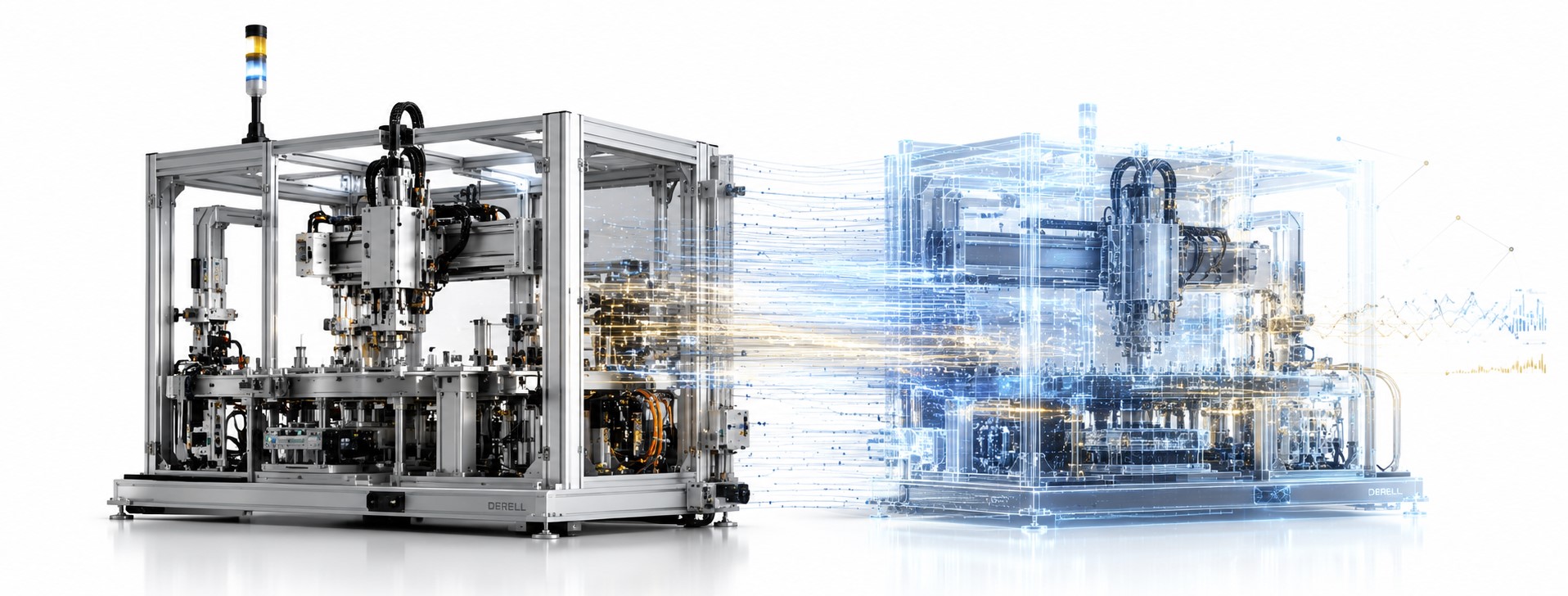
Understand the physical system through a connected model
A digital twin is a digital representation of a particular physical asset or process, kept up to date using data associated with that asset. It can cover a motor, pump set, production cell or complete line. Its purpose is to understand current conditions, evaluate different operating scenarios and support decisions with measurable evidence. The update frequency and level of detail should suit the problem; millisecond updates are not necessary for every application.
How does it differ from simulation and SCADA?
A simulation calculates how a system would behave under specified assumptions. It can operate without a current data connection to physical equipment. An operational digital twin links the model to the identity, condition and history of particular equipment. Prototype models can also support design before connection to a real machine; their validation and synchronization status should be stated clearly.
SCADA can provide monitoring, alarm management, data logging and supervisory functions. This infrastructure can feed a digital twin or integrate with model-based applications. Displaying a motor image beside a current reading does not, by itself, demonstrate that a predictive model of that motor exists. Visualization, data acquisition and modelling are distinct functions; project scope should explain which are provided.
How does information reach the model?
Sensors, drives and measuring instruments report physical conditions. A PLC or data acquisition system transfers the readings with their time information. Alongside industrial communication, a structure is needed to identify the equipment and explain what its data means. An OPC UA information model is one way to support these relationships. For a pressure reading, for example, the unit, measurement location and validity status should be known.
The Internet of Things can support connectivity, while the model can run on an industrial computer, a local server or in the cloud. Data latency, connection interruptions and maintenance requirements influence this choice. Automatically sending commands back to physical equipment is not a requirement for every application; a system can provide decision support without automatic intervention.
Is artificial intelligence required?
Artificial intelligence and machine learning can support anomaly detection or behaviour prediction. Models can also use physical equations, manufacturer performance curves, statistics or combinations of these approaches. A hybrid model combines physical knowledge with relationships learned from data. The choice depends on data quality, the need for explainable results and acceptable computation time.
A practical example: a pump set
A pump digital twin can collect frequency, speed and operating information from a variable frequency drive, together with relevant temperature and load data from the electric motor. Pressure sensors describe inlet and outlet conditions, while flow measurement indicates the amount of fluid being moved. The model evaluates these readings together with the pump curve, system characteristics and operating point.
An increase in current alone cannot reliably distinguish a blocked filter from a changed valve position or mechanical friction. Different causes can produce similar symptoms. A deviation between the expected pressure–flow–power relationship and measured behaviour can identify a condition worth investigating. Changes to the operating point must also be assessed for their effect on PID control and the process. A model result requires field validation before it is accepted as a definite diagnosis or a suitable setting.
Which benefits can be demonstrated through measurement?
Design and virtual commissioning: Models can be used to test motion sequences, capacity changes and selected fault scenarios. This can reveal design problems before physical trials. Confidence in the result depends on model scope; virtual testing does not fully replace commissioning and safety validation on the actual machine.
Condition monitoring and maintenance: Departures from expected behaviour can help initiate maintenance investigations earlier. Remaining useful life estimation requires appropriate degradation data and a validated method. A digital twin does not automatically provide a reliable prediction of the exact time of failure.
Energy and capacity: If measurements confirm that average real electrical power falls from 12 kW to 10 kW under the same production conditions, the difference over 6,000 operating hours is (12 − 10) × 6,000 = 12,000 kWh/year. This illustrates a calculation method and is not a savings guarantee. Production quantity, product quality and operating conditions must also remain comparable.
How can the model be validated?
Data quality begins with sensor accuracy, calibration, time alignment, missing records and unit conversions. Combining pressure and flow readings from different times as if they represented the same operating point can produce misleading results. Big data and data analytics are useful when data context is preserved; a large volume of records cannot compensate for incorrect measurements.
Test the model against measurements separate from those used to develop it, within a defined operating range. Report acceptable error, uncertainty and data freshness. Recheck the relationship after a pump replacement, mechanical modification or software update. Track the model version alongside the physical equipment's current configuration.
Why do data access and standards matter?
For industrial cybersecurity, separate read and write permissions, restrict access and log actions. Where an application sends machine commands, define its response to communication loss or incorrect model outputs in advance. The IEC 62443 family is a relevant framework addressing the security of industrial automation and control systems.
ISO/IEC 30173 addresses digital twin concepts and terminology; the ISO 23247 series addresses a digital twin framework for manufacturing. The Asset Administration Shell (AAS) provides a standardized approach to the structure, interfaces and semantics of asset information. Having AAS data or a communication connection does not establish that all analytical and predictive functions have been implemented.
Editor's note: Assess a digital twin project by the decision it improves, the measurements it uses and the error limits against which it has been validated. Visual detail can easily increase the budget. A simple model is valuable when it solves a defined problem using sound data; an elaborate three-dimensional presentation cannot make unvalidated predictions reliable.
Related topics
Cybernetics and system control
Industry 4.0 and manufacturing digitalization
Differences between Industry 4.0 and IoT
OPC UA Companion Specifications
Encoders and motion feedback
Industrial sensors
Functions of SCADA systems
PLCs and machine control