
Industrial standards
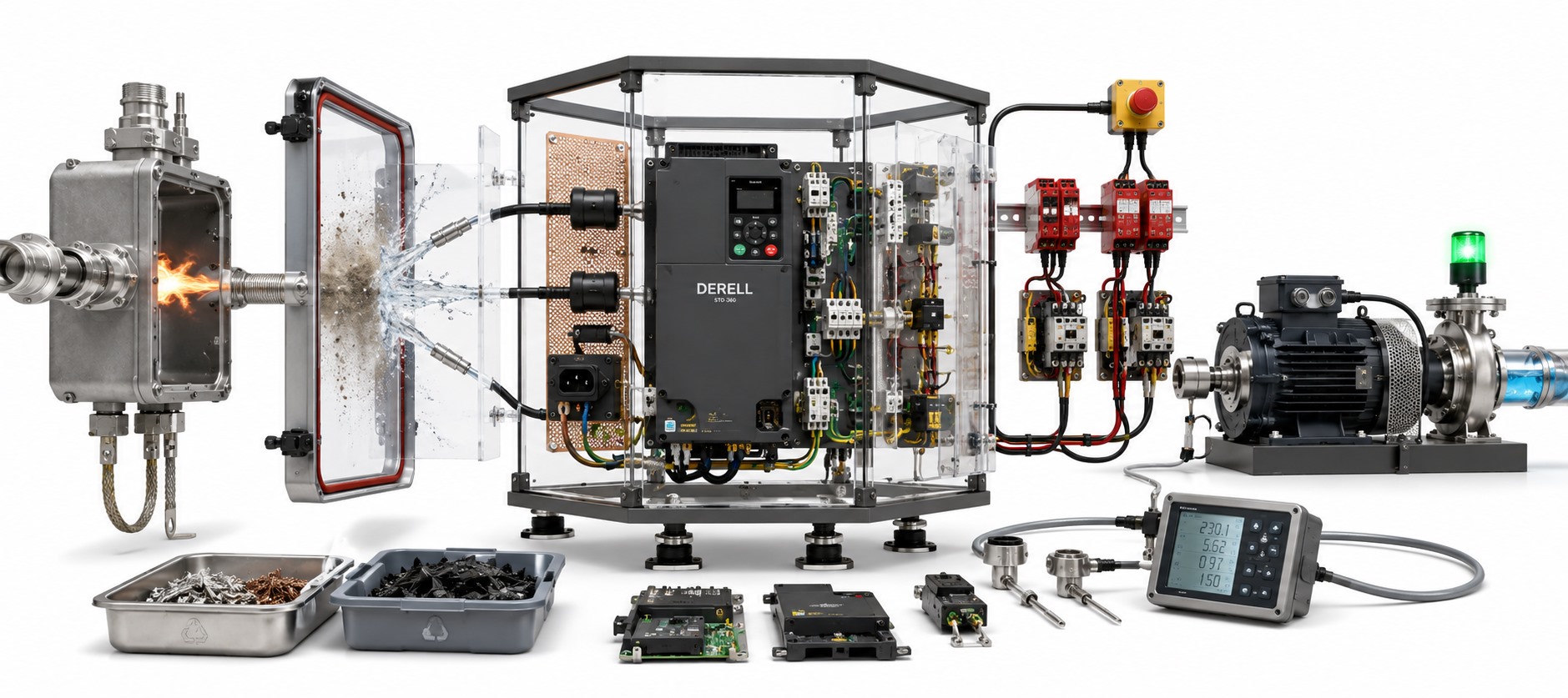
Industrial standards provide a common technical framework for the design, manufacture, testing, installation and use of industrial equipment and systems. In automation, they can address subjects such as electrical safety, electromagnetic compatibility (EMC), machinery safety, environmental testing, enclosure protection, functional safety, cybersecurity and control equipment.
A PLC, variable frequency drive, sensor, motor, industrial control panel or safety device is not normally governed by one single standard. The applicable requirements depend on the type of equipment, its function within the machine, the installation environment and the country or market in which the equipment will be placed on the market or used.
For this reason, standards, legislation, conformity assessment, certification and conformity marks should not be treated as the same thing. A technical standard describes agreed requirements, methods or specifications. Legislation establishes legal obligations, while a conformity mark may indicate compliance with the rules applicable in a particular market.
For electrical, electronic and automation technologies, the IEC standards are among the most important international references. The IEC publishes standards covering subjects ranging from rotating electrical machines and low-voltage switchgear to PLCs, adjustable-speed drives, industrial cybersecurity and machinery-related electrical equipment.
ISO standards cover a broader range of technologies, management systems and industrial subjects. In machinery and automation, ISO standards are particularly important in areas such as risk reduction, safety-related control systems and machine guarding. More information can be found in our ISO standards guide.
European Standards (EN) are standards adopted within the European standardization system. Some European Standards are based on international IEC or ISO publications, while others are developed specifically within the European framework. An EN standard should not automatically be described as legislation. In the European Union, harmonised standards can provide a recognised technical route for demonstrating conformity with applicable legal requirements, although other technical solutions may also be possible. See our EN standards section for related guides.
Electrical and machinery safety: Industrial machines contain many different sources of risk. Electrical equipment, emergency stop functions, guards, interlocks, safety sensors and safety-related control systems therefore need to be considered as parts of the complete machine rather than as isolated components. Standards such as IEC 60204-1, ISO 12100, ISO 13849 and IEC 62061 may become relevant depending on the machine and safety function. These subjects are organised in our machinery safety standards section.
Ingress protection: IEC 60529 defines the IP Code used to classify the protection provided by an enclosure against access to hazardous parts, solid foreign objects and water. Ratings such as IP20, IP54, IP65 and IP67 represent different protection conditions and should not be interpreted as general environmental durability ratings. Our IP protection guide explains the code structure and commonly used IP ratings.
Variable frequency drives and power drive systems: The IEC 61800 series covers several technical aspects of adjustable-speed electrical power drive systems. Individual parts of the series address different subjects and should not be treated as interchangeable.
For example, IEC 61800-3 deals with electromagnetic compatibility requirements and specific EMC test methods for power drive systems, while IEC 61800-5-1 addresses electrical, thermal and energy-related safety requirements. Functional safety functions associated with power drive systems are addressed separately within the IEC 61800 family.
EMC requirements: Variable frequency drives, switching power electronics, contactors and other industrial equipment can generate electromagnetic disturbances or be affected by disturbances generated elsewhere in the installation. Proper EMC performance therefore depends not only on the device itself but also on installation practices such as cable routing, shielding, grounding, filtering and control-panel layout.
A manufacturer's declaration that a drive complies with an EMC product standard does not mean that every machine containing that drive will automatically comply. Product compliance and compliance of the completed machine or installation are related, but they are not identical.
CE marking: CE marking should not be described as a general quality certificate or as an approval issued by the European Union. For products within the scope of EU legislation requiring CE marking, the manufacturer is responsible for identifying the applicable legislation, carrying out the required conformity assessment, preparing the technical documentation and issuing the appropriate EU Declaration of Conformity before affixing the CE mark.
Depending on the product, several pieces of EU legislation may apply at the same time. For an industrial electrical device, requirements concerning electrical safety, EMC, machinery integration or other product-specific matters may need to be evaluated separately.
Functional safety: Safety functions used to reduce machine or process risk require a different approach from ordinary machine control. Terms such as SIL, SILCL and Performance Level describe safety-related concepts and should not be confused with general product quality or reliability ratings. The principles and terminology are explained in our SIL and functional safety guide.
North American requirements: Equipment intended for the United States or Canada may need to be evaluated using a different combination of product, installation and control-panel requirements. UL, CSA, ANSI, NFPA and NEMA publications are frequently encountered in North American industrial projects. For industrial control panels, subjects such as UL 508A, NFPA 70, NFPA 79 and SCCR can be particularly important. See our North American industrial control panel standards guide.
NEMA enclosure types are also widely encountered in North American equipment specifications. They should not be treated as direct one-to-one replacements for IEC IP ratings because the two classification systems use different test requirements and address different environmental conditions. Related information is available in our NEMA standards section.
Global conformity systems: Equipment exported outside Europe may encounter national or regional conformity systems, approval schemes and regulatory marks. Requirements differ considerably between markets. A mark required in one country may have no regulatory meaning in another. Country-specific subjects and conformity systems are organised in our global standards and conformity marks section.
Older industrial equipment also needs to be interpreted in its historical context. For example, documentation for legacy drives may refer to standards or conformity marks that have since been revised, replaced or withdrawn. The former C-Tick mark found on older Australian and New Zealand equipment is one example. The presence of an older marking should therefore be evaluated according to the rules that applied when the equipment was manufactured or supplied.
Which standard applies to an industrial device? Start by identifying the product and its function. Then consider its supply voltage, electrical hazards, EMC environment, enclosure requirements, operating conditions, safety functions, installation method and target market. A standard applicable to a PLC, drive or sensor may be different from the standard applicable to the complete machine or control panel in which that device is installed.
For equipment-oriented guidance, see our device standards section. It provides a practical route from the type of industrial equipment to the standard families that may need to be investigated.
Important: Standards are periodically revised, amended, replaced or withdrawn. A standard number and publication year shown in an old user manual should not automatically be assumed to represent the current requirements for a new machine or product. For design, conformity assessment and certification work, always verify the current edition of the applicable standard, the legislation in the target market and the manufacturer's technical documentation.