
Archimedes and "Eureka!"
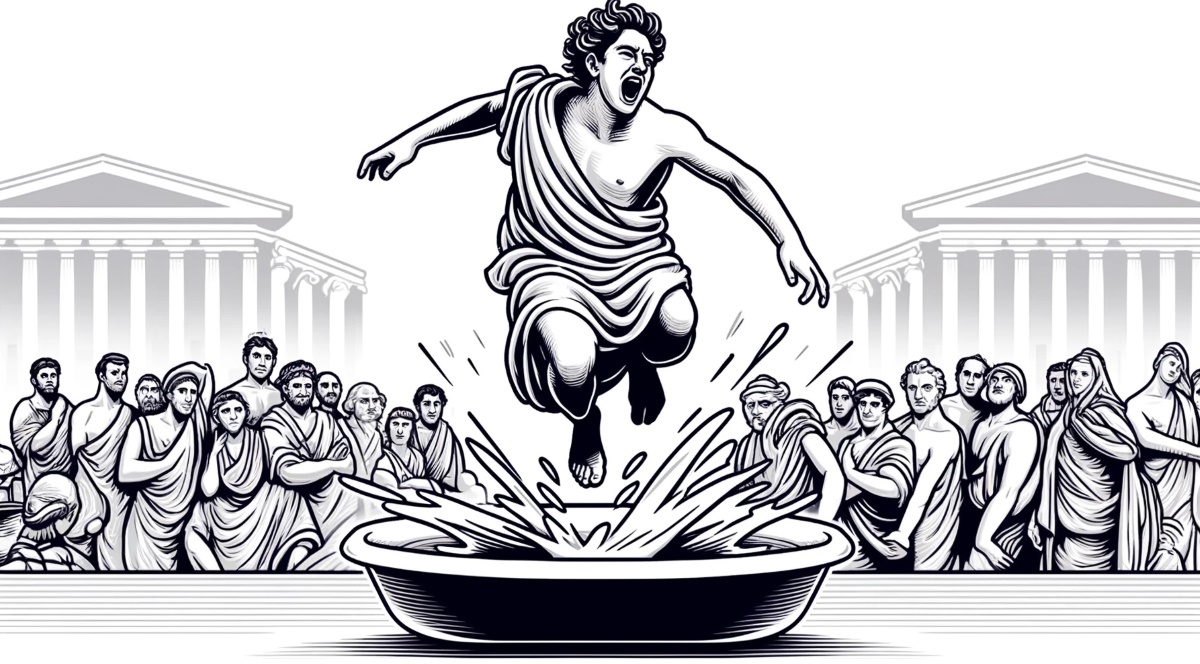
Hi everyone,
The story of Archimedes shouting "Eureka!" (meaning "I have found it!" in Greek) is one of the most famous anecdotes in the history of science. This exclamation is said to have occurred during a moment of scientific discovery that not only had implications for the understanding of physics but also had practical applications.
Background
Archimedes of Syracuse (c. 287–212 BC) was a Greek mathematician, physicist, engineer, inventor, and astronomer. Although he is known primarily for his mathematical writings, Archimedes also made significant contributions to the field of physics, particularly in understanding fluid mechanics and buoyancy.
The Eureka Moment
The most famous tale about Archimedes is the "Eureka!" story, associated with his discovery of the principle of buoyancy. Here's a detailed breakdown:
The Problem
King Hiero II of Syracuse had provided a quantity of gold to a goldsmith to craft a new crown. Suspicious that the goldsmith might have stolen some of the gold, replacing it with the same weight in silver, Hiero asked Archimedes to determine whether the crown was made entirely of gold, without damaging it.
The Insight
While taking a bath, Archimedes noticed that the amount of water that overflowed the tub was proportional to the part of his body he submerged. This observation led to a sudden understanding of how he could measure the crown’s volume by the water displacement without harming it. Realizing the significance, he reportedly leapt out of the bath and ran home naked, shouting "Eureka!"
The Experiment
Archimedes then conducted a controlled experiment:
Control Setup: He submerged a quantity of pure gold equal in weight to the crown in water and measured the water displacement.
Test Setup: He then submerged the crown under the same conditions and measured its displacement.
The difference in the water displacement between the crown and the pure gold would indicate whether the crown was composed entirely of gold or mixed with a less dense metal like silver.
The Principle of Buoyancy
This experiment led Archimedes to formulate what is now known as the Archimedes' Principle, which states that any object, wholly or partially immersed in a fluid, is buoyed up by a force equal to the weight of the fluid displaced by the object. This principle not only solved the problem of the crown but also laid the foundational concept for the science of hydrostatics.
Broader Implications and Legacy
Archimedes’ discovery was monumental for several reasons:
Scientific Method: Archimedes’ approach to solving the problem with the crown showcases an early use of the scientific method involving observation, hypothesis, experimentation, and conclusion.
Practical Applications: Beyond goldsmithing fraud, the principle of buoyancy has broad applications in designing ships and submarines, among other things.
Cultural Impact: The story of Archimedes and his "Eureka!" moment has become a symbol of human discovery and ingenuity.
In summary, Archimedes' exclamation of "Eureka!" marks a seminal moment in ancient science, illustrating a profound understanding of the natural world and the potential for simple observations to lead to significant scientific advancements.
Based on the questions you have asked us, we have attempted to discuss the topic of weight measurement and scales both socially and technically. Weight measurement has undoubtedly been one of the most important topics in known history. Throughout our lives, we are all involved in weight measurement in production, consumption, trade, art, sports, etc.
General Questions:
++ Weight standards
- What's the difference between mass and weight, and their measurement methods?
- How does gravity's acceleration affect an object's weight on different planets?
- What are the uses and accuracy factors of precision scales and balances in weight measurement?
- How does weight measurement help determine an object's density?
- How is an object's apparent weight underwater calculated and related to its actual weight?
Industrial Automation and Production:
- How is weight measurement and control integrated into industrial production, and its impact on efficiency?
- What role do automatic weight control systems play in quality control, and how do they improve product quality?
- How are weight sensors selected and configured in industrial automation, and their accuracy evaluated?
- What are the latest developments in weight measurement technologies for industrial automation?
- What software and tools are used for weight data analysis in industrial automation, and their impact on workflow?
For the General Public:
- How can I test the accuracy of home kitchen scales?
- Which bathroom scale is best for tracking body weight, and what are the differences between models?
- How can I accurately measure luggage weight for travel and comply with airline limits?
- What type of kitchen scale should I use for measuring food portion sizes for healthy eating?
- How can I determine if my children are at a healthy weight, and what methods should I use?
Historical
- Archimedes and "Eureka!
- What instruments were used for weight measurement in ancient times?
- What were the units of weight in ancient civilizations?
- How important was weight measurement in trade in ancient societies?
- How did the first scales for measuring weight work in ancient times?
- How were standards for weight measurement established in ancient times?
- What were some significant discoveries related to weight measurement in ancient history?
- What methods were used to prevent fraud in weight measurement in ancient times?
- What events can be considered turning points in the history of weight measurement?
- How were weight measurement units compared between different cultures in ancient times?
- What are some written sources about weight measurement in ancient history?
++ Weight measuring devices homepage
"These
questions often include those that may come to mind for many people
regarding 'Weight measurement.' Each user or student will
have their own specific questions depending on a particular situation or
application. The answers are not binding or entirely definitive. There is no objection to sharing our above article, citing it as a source. - Automation Mall Community, 02/2021"
 -
-
Your shopping cart is empty!