
CENELEC Standards for Fuses
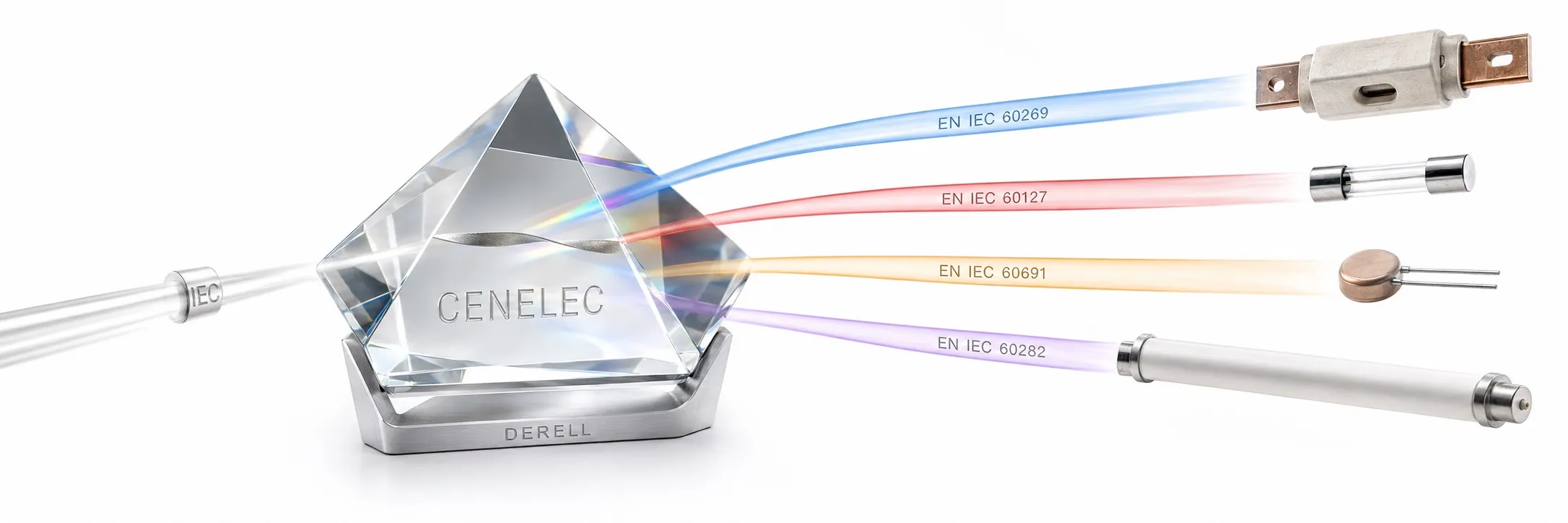
Match the protective device to the right standard family
CENELEC is the European Committee for Electrotechnical Standardization. It contributes to common technical requirements for electrical and electrotechnical applications. For fuses, these requirements address overcurrent interruption, dimensions, insulation, heating, markings and test methods. However, devices described casually as “fuses” do not necessarily belong to the same standard family.
Fuses, MCBs, RCCBs and RCBOs perform different functions. Start by identifying the fault condition a device detects and the protection it actually provides. Placement in the same catalogue section does not make one standard applicable to every device.
Editor's note: On an RCCB marked 40 A / 30 mA, 40 A is the rated current and 30 mA is the rated residual operating current. The 40 A marking does not establish 40 A overload protection. Coordinate the RCCB with a suitable fuse or circuit breaker for overcurrent protection.
What do EN, IEC and HD designations mean?
IEC identifies an international standard, while EN identifies a European Standard. An IEC text may be adopted as a European Standard, but its part, edition and any European modifications still need to be read separately. National adoptions may carry prefixes such as TS EN, BS EN or DIN EN. An identical number alone does not establish that every detail of two differently dated documents is identical.
An HD, or Harmonization Document, is a separate CENELEC normative deliverable. Identical national implementation of an EN differs from implementation of an HD through national announcement and technical equivalence. Furthermore, the abbreviation HD does not automatically establish harmonised-standard status under EU legislation.
For example, at the 15 October 2026 catalogue check, BSI lists general fuse requirements as BS EN IEC 60269-1:2025, while the international foundation is IEC 60269-1:2024. Procurement specifications should identify the complete standard number, part and edition rather than simply requesting “CENELEC compliance”.
The principal low-voltage fuse family: 60269
The EN 60269 family addresses low-voltage fuse characteristics. Within the corresponding IEC 60269 series, general requirements are supplemented by parts covering industrial, household and similar, semiconductor, photovoltaic and battery applications. An operated fuse-link is replaced; it is not reset like a circuit breaker.
gG identifies full-range general-purpose protection, while aM identifies partial-range short-circuit protection for motor circuits. aR is a partial-range semiconductor category, and gR is a full-range category. Different categories with the same current rating are therefore not directly interchangeable. Overload protection requires separate consideration, particularly for aM and aR applications.
MCB: overload and short-circuit protection
EN 60898 addresses overcurrent circuit breakers for household and similar installations. An appropriately selected MCB operates under overload and short-circuit conditions. IEC 60898-1 defines the AC operating scope. This product family should not be presented as a dimensional or construction standard for fuse-links.
The difference between a fuse and a circuit breaker extends beyond replacing one and resetting the other. Their time-current and current-limiting characteristics can also differ. An MCB's B, C or D curve describes its overcurrent tripping characteristic, not residual-current sensitivity.
RCCB: no integral overcurrent protection
The EN 61008 family addresses RCCBs without integral overcurrent protection for household and similar uses. The corresponding IEC 61008 family makes the same fundamental distinction. The device responds to residual current by evaluating the imbalance between currents in the active conductors passing through it.
An RCCB alone is not a cable overload or short-circuit protective device. Check its rated current, short-circuit withstand and manufacturer-specified upstream protection combination together. The presence of just any upstream fuse does not establish adequate coordination for every RCCB.
RCBO: combined residual-current and overcurrent protection
EN 61009 addresses RCBOs with integral overcurrent protection. Combining residual-current and overcurrent protection in one device is also the defining function within the IEC 61009 family. Selecting between an MCB, RCCB and RCBO requires more than comparing module width or ampere markings.
Rated current, short-circuit capacity, residual operating current and detectable current waveforms are separate RCBO characteristics. Assess RCD Types AC, A, F and B separately as well. For example, a B-curve RCBO does not necessarily have Type B residual-current detection.
60674 does not specify fuse dimensions
The EN 60674 and corresponding IEC 60674 series address plastic films for electrical purposes. Applications include capacitor dielectrics and other electrical insulation uses. For example, 60674-3-2 concerns particular PET films for electrical insulation. Consequently, 60674 should not be identified as a principal standard for the dimensions and protective characteristics of household fuse cartridges.
Product compliance must be followed by correct circuit selection
Rated current relates to load and conductor protection; rated voltage and AC/DC suitability relate to the supply; and breaking capacity relates to prospective short-circuit current at the installation point. For example, 32 A and 120 kA markings describe different quantities. The 120 kA figure is not permissible continuous load current.
During protective device selection, examine time-current characteristics, peak let-through current and, where relevant, total clearing I²t. Two equally sized and equally rated products may serve different duties if one is gG and the other aR. A fuse-holder's dimensions, contacts, voltage rating and acceptable power dissipation must also suit the installed fuse-link.
Selectivity aims to operate only the protective device serving the faulty outgoing circuit. If upstream protection operates before the outgoing device, assess curves and manufacturer coordination tables. A higher upstream current rating alone does not guarantee selectivity at every fault level.
Distinguish harmonised standards from CE marking
Standards are generally voluntary; compliance with applicable legal requirements is mandatory. Assess legislative references and contractual requirements separately. For EU presumption of conformity, check the correct edition's reference under the relevant legislation in the Official Journal of the European Union, including any limitations. An EN designation does not automatically establish presumption of conformity with every legal requirement.
CE marking is not a product test certificate issued by CENELEC. The manufacturer identifies applicable legislation, assesses conformity and prepares technical documentation and the required EU Declaration of Conformity. Independent product certificates or laboratory reports may provide supporting evidence, but a general “certified” statement is insufficient without checking the product code, scope and edition used.
Combine document review with installation and maintenance checks
During procurement, record the product code, standard and edition, utilization category, electrical ratings and installation instructions together. Verify whether a product-family test report covers the specific variant being purchased. A product standard alone does not establish conformity of the completed panel, wiring or installation as a whole.
A continuity measurement can identify an open fuse element but does not verify breaking capacity. An RCD test button does not replace all installation measurements either. Perform fuse replacement and connection work with appropriate isolation and verification of absence of voltage. Inspection and test intervals depend on product instructions, installation conditions and applicable rules; one interval should not be assigned to every device.
Related guides and products
Fuse types and basic concepts
Fuse standards
IEC fuse standards
Fuse products
Sources
CEN-CENELEC: EN, HD and other deliverable types
CEN-CENELEC: standards, legislation and voluntary use
European Commission: harmonised standards and Official Journal references
European Union: CE marking and manufacturer responsibilities
BSI: BS EN IEC 60269-1:2025, low-voltage fuses
BEAMA: fuse categories, holders and protective coordination
IEC: 60898-1, overcurrent protection in AC circuits
IEC: 61008-1:2024, RCCBs without integral overcurrent protection
IEC: 61009-1:2024, RCBOs with integral overcurrent protection
BSI: EN IEC 60674-3-2, plastic films for electrical insulation