
EN 60674
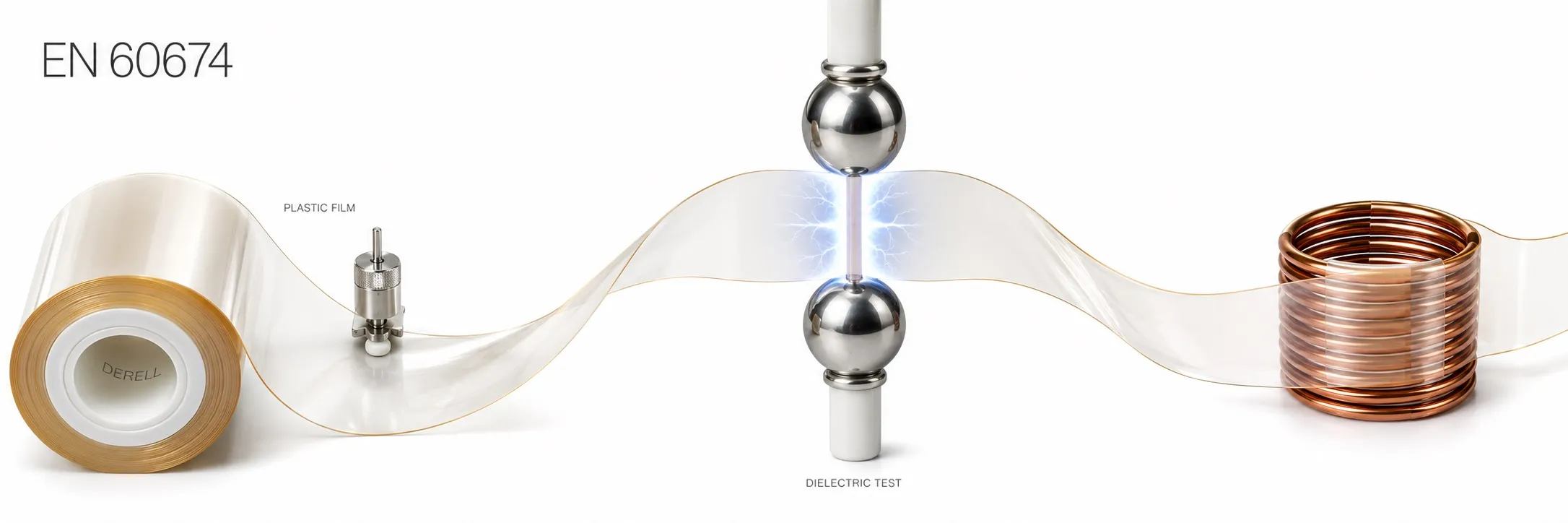
Assess insulating film against its operating conditions
The EN 60674 series addresses plastic films for electrical purposes. Capacitor dielectrics are an important application, but the series is not limited to capacitors. In a capacitor, the film provides insulation between electrodes and supports the electric field. Film quality matters, while the performance of the finished component also depends on its electrodes, connections, winding and enclosure.
Editor's note: EN 60674 is not a fuse or circuit-breaker standard. Compliance of the film material does not establish that every capacitor made from it is suitable for every circuit. Read the material test report separately from the finished product's operating ratings.
Read general requirements, test methods and material sheets together
Within the corresponding IEC 60674 series, Part 1 addresses definitions, general quality, rolls, joins, cores, dimensions, packaging and labelling. Part 2 provides test methods. Part 3 contains separate sheets for individual materials. Knowing a test method alone does not identify the acceptance limit applicable to a particular material class.
60674-3-1 covers biaxially oriented polypropylene (PP) films for capacitors. 60674-3-2 addresses balanced biaxially oriented polyethylene terephthalate (PET) films for electrical insulation. PET is a polyester; it should not be confused with polyethylene. Procurement documents should specify the complete part number, material classification and edition rather than simply requesting “60674 compliance”.
PP and PET behave differently in service
Film, ceramic and electrolytic capacitors have different characteristics, and material selection also matters within the film family. PP's low dielectric losses make it useful in suitable designs for pulse, high-frequency and power electronics applications. PET's higher relative permittivity helps achieve compact capacitance and is widely used for coupling and general-purpose circuits. These tendencies do not replace a specific product's datasheet limits.
Changes in operating frequency, temperature and applied waveform can change losses and heating. PP and PET components with identical capacitance and voltage markings are not automatically interchangeable in a high-frequency circuit. The material identifies an initial candidate; product data establishes application suitability.
Thickness, electric strength and losses describe different properties
Film thickness and its uniformity affect electric field stress and manufacturing consistency. In a simplified parallel-plate model, capacitance increases with electrode area and permittivity and decreases with thickness. Reducing thickness from 10 µm to 5 µm doubles the theoretical capacitance if material and area remain unchanged. At the same applied voltage, E = V/d shows that the electric field also doubles. This illustration explains why thinner film is not inherently safer; it is not a product design rating.
Electric strength describes resistance to breakdown under specified test conditions. Insulation resistance relates to leakage current under an applied DC voltage. The dissipation factor, tan δ, is used to assess energy losses under AC conditions. High insulation resistance is not the same property as high breakdown strength or low AC loss. Read results together with specimen thickness, temperature, humidity, electrode arrangement and voltage application conditions.
The consolidated 2016+A1:2019 publication of 60674-2 includes determination of DC electric strength according to IEC 60243-2. BSI's description of the PET sheet identifies wound-capacitor, 6 mm electrode and aluminium-foil sandwich methods. Results obtained using different arrangements therefore require examination of the test conditions before direct comparison.
What self-healing means in metallized film
A film/foil construction uses separate metal foils as electrodes. Metallized film carries a very thin metal electrode layer on the film. In a suitable metallized design, a local breakdown can cause metal around the fault to evaporate, electrically isolating the affected area. This is called self-healing; the polymer does not return to its original condition.
Repeated clearing events can reduce effective electrode area and eventually capacitance. The mechanism is not present in every plastic film and does not provide unlimited overvoltage endurance. When interpreting capacitance, voltage and polarity information, also consider electrode construction, pulse capability and the manufacturer's operating limits.
Select the finished capacitor for its circuit function
Voltage, current and power are different quantities. A DC voltage rating does not establish suitability for the same numerical AC voltage or a particular ripple current. Capacitors at the input and output of buck and boost converters can experience different current waveforms. Check permissible AC voltage, ripple current, temperature and dV/dt, including frequency-dependent derating curves where applicable.
For capacitors suppressing electromagnetic interference in mains-connected EMI filters, assess the appropriate X or Y safety class for the connection. IEC 60384-14 addresses requirements for this product group. A general-purpose film capacitor is not established as suitable for mains connection merely because its film material meets 60674.
Motor-start capacitors provide another application example: starting duty and continuous running duty are not interchangeable. An identical µF value does not establish equivalence in duty cycle, AC voltage, connections or product classification.
What to record during procurement and inspection
For film supplies, record the polymer type, applicable sheet and edition, nominal thickness and tolerance, width, roll details and batch traceability. A useful test report identifies the method, conditioning, measurement conditions, results and acceptance criteria instead of simply stating “passed”. Obtain storage and handling conditions from the manufacturer; one temperature or humidity limit cannot be assigned to every film.
Measuring capacitance with a multimeter provides limited information about the finished capacitor; it does not verify the film's standard tests or behaviour at operating voltage. When investigating a faulty capacitor, assess losses, leakage and physical condition as well as capacitance, using methods suitable for the application. Before measurement, disconnect power and verify that stored energy has been safely discharged.
Specify both the part number and the edition
At the 15 October 2026 catalogue check, IEC lists the third edition of the PP film sheet as IEC 60674-3-1:2026, published on 1 October 2026. This edition expands the film thickness ranges. BSI's PET record is titled BS EN IEC 60674-3-2:2019. A new IEC publication does not automatically establish EN adoption with the same year designation; verify the document and edition required by the specification.
Related guides
Basic electronic components and circuit-board repair
How electromagnetic filters work
Sources
IEC: 60674-1, definitions and general requirements
IEC: 60674-2:2016+A1:2019, methods of test
IEC: 60674-3-1:2026, PP films for capacitors
BSI: BS EN IEC 60674-3-2:2019, PET films for electrical insulation
Vishay: film constructions, dielectric materials and applications
TDK: electrical characteristics and operating limits of film capacitors
WIMA: metallized film and the self-healing mechanism
IEC: 60384-14:2023+A1:2025, interference suppression capacitors connected to the mains