
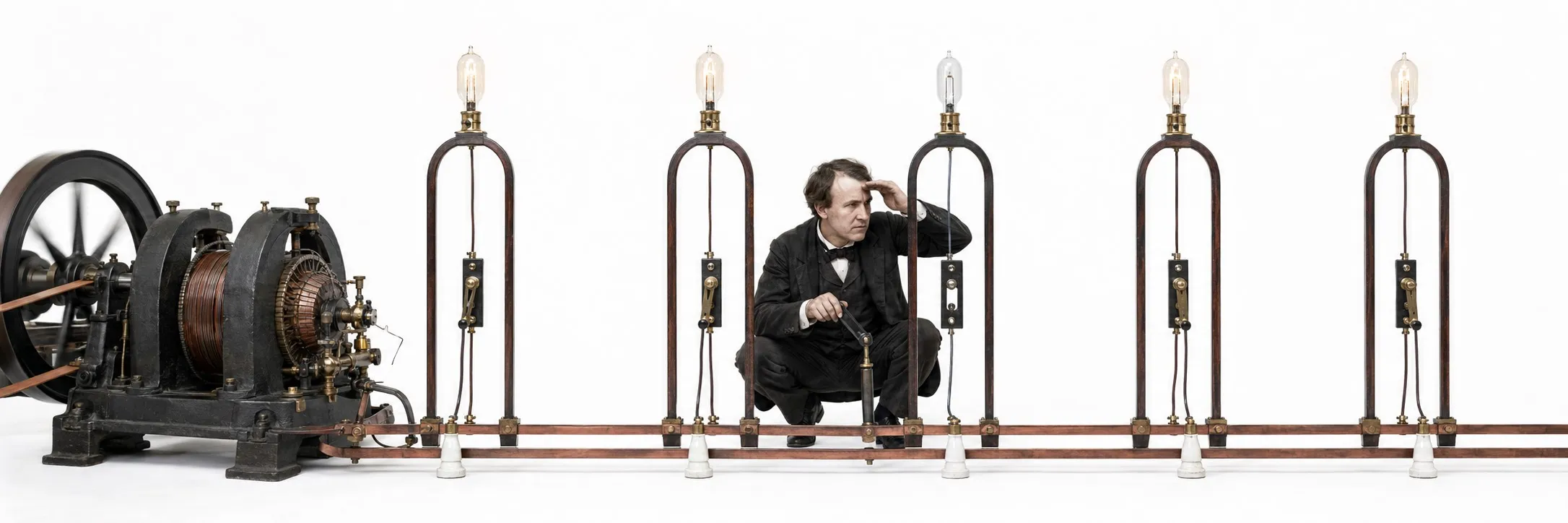
Thomas Edison: Making Electrical Inventions Work as Systems
A working lamp is a device. A street full of working lamps requires a power station, distribution cables, connections, measurement and people who can maintain the equipment. Thomas Alva Edison (1847–1931) built his career around that larger engineering challenge: turning an experimental result into something people could use and businesses could supply.
His name is associated with incandescent lighting, the phonograph and early motion pictures. His influence also came from organizing research teams and connecting their work to manufacturing. Understanding Edison means looking beyond the familiar picture of a lone inventor beside a glowing bulb.
The light bulb was part of a much bigger project
Edison did not originate the idea of incandescent lighting. Earlier experimenters, including Joseph Swan, contributed to its development. In 1879, Edison’s team achieved successful results with a carbon filament inside an evacuated glass bulb. The task involved lamp life, manufacturing and compatibility with an electrical supply network.
Electrical resistance mattered to the design. A relatively high-resistance filament limited current at the chosen supply voltage. Parallel connections allowed individual lamps to be switched independently.
For a simple DC load, the relationship is P = V × I. Here, voltage describes the potential difference across the load, while current describes the rate of charge flow. The distinction between volts, amperes and watts is essential when comparing electrical equipment. A higher resistance alone does not tell you that a lamp converts electricity into light more efficiently.
Pearl Street and the business of supplying electricity
Edison’s Pearl Street generating station began operating in New York on September 4, 1882. It brought generation, DC distribution and customer lighting together in an operating service. The engineering problem extended from the generators all the way to the buildings they supplied.
Electrical generation itself rested on earlier scientific discoveries, particularly the electromagnetic induction work associated with Michael Faraday. Edison’s contribution belonged to the development and deployment of practical equipment and networks, rather than the discovery of that underlying principle.
What the War of the Currents was really about
The late nineteenth-century rivalry between competing electricity suppliers involved investment, patents, equipment and public confidence. At its technical core was the question of how to distribute power economically. Understanding alternating current and direct current helps explain why the competing networks developed differently.
Edison’s early low-voltage DC system faced practical limits as distribution distances increased. AC offered a useful advantage with the equipment available at the time: transformers could raise the voltage for transmission and lower it near the customer.
George Westinghouse helped turn AC distribution into a commercial competitor. Nikola Tesla contributed important polyphase motor and system developments. The outcome involved many engineers and organizations, with different contributions to generation, transmission and utilization.
Our War of the Currents and The Prestige article explores the rivalry in more detail and separates the history of electrical engineering from fictional treatments of invention.
Before electric lighting: Telegraphy and an unsuccessful first patent
Born in Milan, Ohio, on February 11, 1847, Edison had little formal schooling and continued learning through reading and practical work. His early employment as a telegraph operator exposed him to a fast-growing communications industry. The systems associated with Samuel Morse provided a setting in which reliability and operating speed had direct commercial value.
Edison’s first U.S. patent, issued on June 1, 1869, covered an electrical vote recorder. It was intended to accelerate legislative voting, but it did not become a commercial success. Improved stock-ticker equipment came later and helped finance his developing business. The first patent and the first profitable product were different milestones.
Telegraph equipment also illustrates the relationship between an electrical signal and a mechanical action. A modern electromagnetic relay makes that relationship easy to see: energizing a coil changes the position of a mechanism and its contacts.
Menlo Park made organized experimentation part of the story
Edison established his Menlo Park laboratory in 1876 and opened a larger research complex at West Orange in 1887. These facilities brought experimentation, machine work and product development into a shared working environment.
The important feature was the ability to move repeatedly between a proposal, a prototype and a measured result. Researchers, machinists and other specialists contributed to that process. The laboratory’s output depended on a team, even when Edison’s name became the public identity of the resulting technology.
Recorded sound and moving pictures: Three devices worth distinguishing
The phonograph, developed in 1877, could record sound and reproduce it. In early versions, a diaphragm and stylus transferred sound vibrations into a physical recording surface. Playback converted those recorded variations back into audible vibration. Earlier sound-recording experiments existed, but recording and machine playback were central to Edison’s achievement.
The motion-picture terminology is equally important. The Kinetograph was a camera; the Kinetoscope was a viewing device through which a person watched moving images. They were different parts of a recording-and-viewing system.
William Kennedy Laurie Dickson carried out much of the technical development in Edison’s laboratory. Recognizing his role gives a more accurate account of how the equipment emerged and why early cinema cannot be credited to one inventor.
Why an automation engineer still encounters both AC and DC
Open the electrical design of a modern machine and the historical rivalry becomes less useful as a division between technologies. A common variable frequency drive rectifies its AC supply into a DC link, then switches that DC to produce a controlled motor output. Both forms of electricity have a role within one device.
A PLC control system may use 24 V DC field devices alongside AC-powered equipment. Matching the voltage is only the beginning of making those components work together. NPN and PNP sensor outputs require compatible input arrangements, while analog and digital inputs represent information in different ways.
A servo motor similarly belongs to a system that includes its drive and feedback arrangement. Selecting a capable motor does not, by itself, guarantee a capable machine. Electrical compatibility, control behavior and operating conditions must agree.
That is a useful connection to Edison’s work: the performance of the complete installation matters as much as the performance of its individual components.
What does the figure of 1,093 patents actually mean?
Edison held 1,093 U.S. patents. The number covers inventions and improvements across several fields; it should not be read as a count of separate finished products designed without assistance. Patent records document particular technical claims, while the development of a commercial product may involve many people and successive changes.
Edison died on October 18, 1931. His lasting importance lies in the combination of invention, organized research, manufacturing and deployment. Giving those achievements their proper weight also means recognizing the earlier discoveries, colleagues and competing inventors that helped shape the same technologies.
Sources and historical references: National Park Service — Edison biography · Rutgers — The vote recorder · Rutgers — Electric lamp development · Rutgers — Lighting development and Pearl Street · National Park Service — Origins of the phonograph · Library of Congress — Edison motion-picture history · U.S. Department of Energy — The War of the Currents · Rutgers — Edison’s patents.