
what is frequence invertors
What is a Frequency Inverter?
A frequency inverter is a power-electronics device that controls the speed and torque behaviour of an AC motor by producing an output with adjustable frequency and voltage. In industrial automation, the terms VFD, variable frequency drive, AC drive, inverter and variable speed drive are often used for the same general family of equipment.
An induction motor connected directly to the mains is largely tied to the supply frequency and its pole count. A VFD breaks that limitation. Instead of being restricted to a fixed 50 or 60 Hz supply, the motor can be operated at 20 Hz, 35 Hz, 50 Hz or another frequency that suits the process.
For the wider subject, the main OtomasyonAVM VFD technical guide contains the individual functions in much more detail, while What is an AC Drive? explains the basic drive architecture.
What happens inside a VFD?
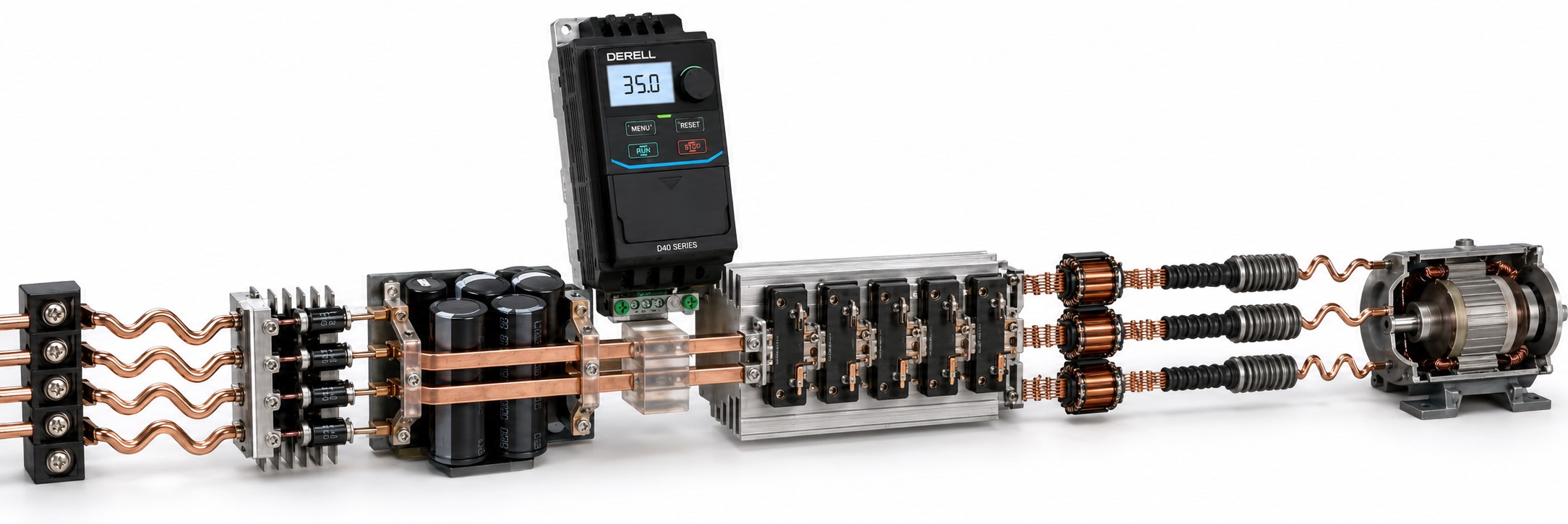
It helps to think of a conventional drive as three power stages. The incoming AC supply first passes through a rectifier and is converted into DC. That energy is held and smoothed in the DC bus. Finally, the inverter power stage switches the DC link to create a controlled three-phase output for the motor.
PWM – Pulse Width Modulation is one of the main techniques used to generate that output. IGBTs or similar power semiconductors switch the DC bus rapidly so that the motor receives the required fundamental voltage and frequency.
The motor's fundamental output frequency should not be confused with the drive's carrier or switching frequency. A motor may be operating at 30 Hz while the inverter semiconductors switch at several kilohertz.
How does a VFD control motor speed?
The synchronous speed of an induction motor rises with electrical frequency and falls when frequency is reduced. For a four-pole motor, for example, the synchronous speed is 1500 rpm at 50 Hz and approximately 750 rpm at 25 Hz.
The actual rotor runs slightly below synchronous speed because of slip, and that difference changes with motor load. So output frequency and actual shaft rpm are related, but they are not the same physical quantity.
The requested operating frequency comes from the drive's frequency reference. That reference can come from the keypad, a potentiometer, a 0–10 V or 4–20 mA signal, preset speeds, a PLC, PID control or an industrial communications network.
Frequency changes the basic motor speed. Voltage is adjusted with frequency below base speed. Motor current is not simply proportional to frequency; it depends strongly on magnetising current and the torque demanded by the load.
Educational example: 400 V / 50 Hz, four-pole induction motor. Actual speed and current depend on the motor, load and selected control method.
Why does voltage change with frequency?
With basic V/F control, reducing frequency while leaving motor voltage unchanged would not maintain the intended magnetic-flux operating point. The drive therefore adjusts voltage with frequency through the normal operating region.
Real drives may also apply low-frequency compensation such as torque boost, so the actual voltage/frequency characteristic does not always have to be one perfectly straight line.
The relationship can also be customised through the drive's V/F curve.
What happens above base frequency?
Below the motor's base frequency, the drive can normally raise voltage as frequency rises. Once the available output voltage reaches its limit, frequency can continue to increase but voltage cannot continue increasing in the same ratio.
This is the field-weakening region. Motor speed may continue to rise, but the available continuous torque behaviour is no longer the same as it was below base speed. Running a motor at twice the frequency does not mean that it suddenly produces twice the power or torque.
Does motor current automatically rise with frequency?
No. Motor current depends strongly on the magnetic requirements of the motor and the torque demanded by the mechanical load. A motor running almost unloaded at 40 Hz does not draw the same current as the same motor driving a heavily loaded conveyor at 40 Hz.
This is why a modern drive continuously monitors output current rather than assuming current from frequency alone. Current and torque limits protect the motor and semiconductor power stage when the mechanical load suddenly becomes excessive.
A useful rule of thought is: frequency is closely related to speed command; current is closely related to torque demand.
Does a VFD automatically speed up when load increases?
Not by itself. If the active frequency reference is 35 Hz, the drive does not normally decide to jump to 50 Hz simply because the machine becomes more heavily loaded.
Automatic speed changes require a control system to alter the reference. For example, the built-in PID controller can increase pump speed when a pressure sensor reports falling pressure. A PLC can do the same thing according to flow, pressure, temperature or another process measurement.
In other words, the motor does not speed up simply because the load increased; the control system changed the frequency reference.
How does a VFD save energy?
A VFD does not create an automatic energy saving just because it is installed. The saving comes when the process can genuinely operate at a lower speed instead of continuously running the motor at full speed.
This is particularly important with centrifugal fans and pumps, where reducing speed can be much more efficient than running at full speed and throttling the process mechanically.
On a constant-torque conveyor that needs to perform the same mechanical work, simply adding a VFD does not guarantee a large reduction in energy use. The benefit depends on the real process and duty cycle.
V/F, Vector Control and FOC
Not every frequency inverter controls the motor in the same way. V/F control is simple and robust, making it useful for many general fan, pump and machine applications.
Where stronger low-speed torque and better load response are required, vector control uses a motor model to manage the motor more closely.
FOC – Field-Oriented Control goes further by controlling flux-producing and torque-producing current components in a rotating reference frame. Correct motor data and Auto-Tuning become increasingly important as the control method becomes more advanced.
How does a VFD provide a smooth start?
A direct-on-line motor attempts to accelerate very quickly. A VFD can instead build output frequency and voltage gradually over a defined acceleration time, reducing sudden mechanical shock in belts, couplings, gearboxes and conveyors.
Where even smoother motion is required, an S-curve acceleration profile can soften the beginning and end of the acceleration or deceleration transition.
A VFD should not be confused with a soft starter. A soft starter primarily manages the starting voltage and torque, while a VFD continues controlling motor frequency throughout normal operation.
How does a VFD stop a motor?
For a normal load, the drive can reduce frequency through a controlled deceleration ramp. With a high-inertia machine, however, rapid deceleration can turn the motor into a generator and push energy back into the DC bus.
Where that energy needs to be removed quickly, the system may use a braking resistor and, where required, a DBU braking unit.
The resistor must be selected from the drive's permitted resistance range together with braking energy, braking time and duty cycle; motor kW alone is not enough.
Where does the speed command come from?
On a simple machine, an operator may turn a potentiometer. Another installation may use a 0–10 V or 4–20 mA signal. In a modern machine, the frequency reference can come directly from a PLC or industrial network.
This allows much more than RUN and STOP commands. Depending on the drive, a PLC or HMI may also monitor output current, active frequency, DC-bus voltage, operating state and fault information.
For multi-device systems, this naturally connects the VFD to the wider OtomasyonAVM Industrial Communication section.
Can a three-phase motor run from a single-phase supply?
With the correct drive, yes. A single-phase-input VFD can rectify a 220–230 V single-phase supply and synthesize a controlled three-phase output suitable for the corresponding motor voltage class.
That does not mean any 400 V three-phase motor can automatically be run at full performance from every 230 V single-phase drive. Motor winding connection, motor nameplate voltage and drive output class must all match.
Is motor kW enough to choose a VFD?
No. The selection should also consider motor rated current, supply voltage, motor type, overload requirement, load characteristic, braking requirement, ambient temperature and enclosure conditions.
A 7.5 kW fan and a 7.5 kW crane motor do not necessarily demand the same overload capability from a drive. Applications requiring strong starting torque, frequent braking or very low-speed operation may need a different drive class even when motor kW is identical.
The control requirement matters too. Basic V/F may be enough for one machine, while another may require vector control, encoder feedback or even a completely different servo system.
Editor's note: Thinking of a frequency inverter only as “a box that changes 50 Hz into 30 Hz” misses most of what a modern drive can do. The same device may also handle ramps, PID, current limiting, communications, motor protection and braking. But a clever drive cannot magically repair poor wiring, the wrong motor or a badly designed mechanical system.
Why do filters, motor cable and EMC matter?
VFD output is created by high-speed semiconductor switching rather than being a simple utility sine wave. Motor-cable routing, shielding, grounding and EMC practice therefore become especially important as motor-cable length increases.
The OtomasyonAVM VFD input-filter section covers components used around the drive. Remember that an EMC/RFI filter, line reactor and surge-protection device perform different jobs and should not be treated as interchangeable components.
Is a frequency inverter the same as a servo drive?
No. A high-performance vector VFD can provide excellent speed and torque regulation, but a servo motor and servo drive are designed around high-bandwidth motion control, high-resolution feedback and often precise position control.
The core job of a general-purpose frequency inverter is still to control the speed and torque behaviour of an industrial AC motor in a way that suits the machine or process.
In short: a frequency inverter converts fixed incoming AC into DC and then reconstructs it as AC with controlled frequency and voltage. This lets motor speed follow the actual needs of the process. Continue through the OtomasyonAVM knowledge base with Frequency Reference, V/F Control, Vector Control, FOC, PWM, DC Bus, PID with a VFD and Braking Resistors.